Sets — Chapter Summary
ICSE · Class 6 · Mathematics
Summary of Sets for ICSE Class 6 Mathematics. Key concepts: A set is a collection, The items in a set and There are three main ways.
Interactive on Super Tutor
Studying Sets? Get the full interactive chapter.
Quizzes, flashcards, AI doubt-solver and a step-by-step study plan — built for chapter summary and more.
Free trial, no card needed.
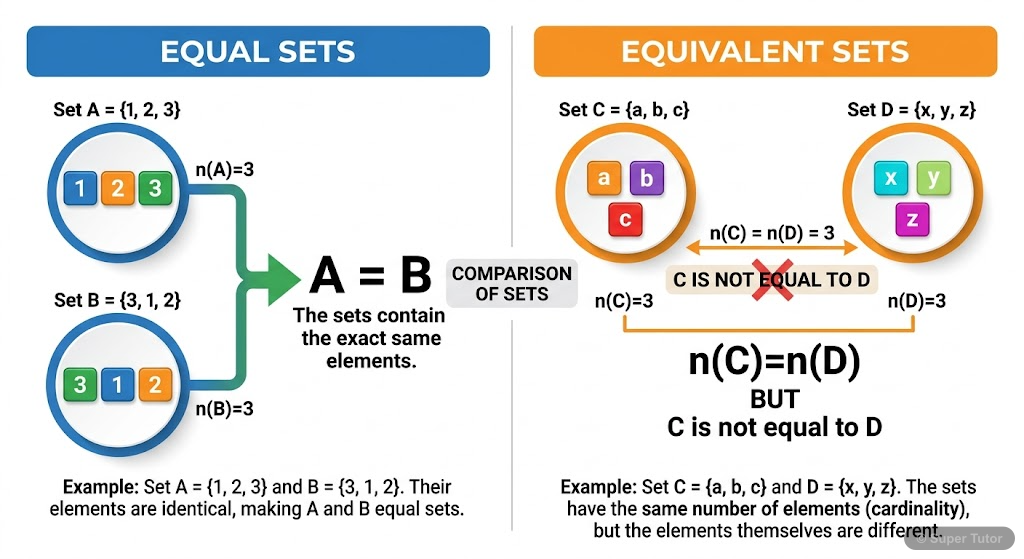
Learn better with visuals Super Tutor pairs illustrations like this with notes and quizzes for Sets.
Overview
In mathematics, a set is a well-defined collection of different objects or elements grouped together based on a common property. The concept of sets helps us organize and classify things in a systematic way. For example, a set can be a group of numbers, letters, shapes, or even students in a class.
Key Concepts
A set is a collection
A set is a collection of well-defined objects. For example, the set of vowels in English is {a, e, i, o, u}. But a collection like 'beautiful flowers'
The items in a set
The items in a set are called elements or members. They are written inside curly brackets { } and separated by commas. We use the symbol ∈ to mean 'be
There are three main ways
There are three main ways: (1) Description method: describe the set in words, like 'set of even numbers less than 10'. (2) Roster method: list all ele
Finite Set
Finite Set: has a fixed number of elements, like days of a week. Infinite Set: has unlimited elements, like counting numbers. Empty Set: has no elemen
The number of distinct elements
The number of distinct elements in a set is called its cardinal number. It is written as n(A). For example, if A = {1, 2, 3}, then n(A) = 3. For an em
Learning Objectives
- Understand the meaning of a set and what it means to be 'well-defined'.
- Identify elements of a set and use the symbols ∈ and ∉ correctly.
- Represent sets using description, roster, and set-builder methods.
- Differentiate between finite and infinite sets.
- Recognize empty, equal, equivalent, disjoint, and overlapping sets.
Frequently Asked Questions
What are the important topics in Sets for ICSE Class 6 Mathematics?
How should I revise Sets for Class 6 exams?
Sources & Official References
Content is aligned to the official syllabus. Refer to the board website for the latest curriculum.
More resources for Sets
Practice Quiz
Test yourself with a quick quiz
Important Questions
Exam-style questions with answers
Revision Notes
Key points for last-minute revision
Formula Sheet
The chapter's formulas in one place
Concept Maps
See how topics connect
Study Plan
Step-by-step plan for this chapter
Flashcards
Quick-fire cards for active recall
Syllabus
What topics to cover
For serious students
Get the full Sets chapter — start free.
Quizzes, flashcards, an AI doubt solver and a study plan for ICSE Class 6 Mathematics. Free to start, no card needed.