Negative Numbers and Integers — Important Questions
ICSE · Class 6 · Mathematics
92 important questions from Negative Numbers and Integers for ICSE Class 6 Mathematics, with answers. Part of the ICSE Class 6 Mathematics syllabus.
Interactive on Super Tutor
Studying Negative Numbers and Integers? Get the full interactive chapter.
Quizzes, flashcards, AI doubt-solver and a step-by-step study plan — built for important questions and more.
Free trial, no card needed.
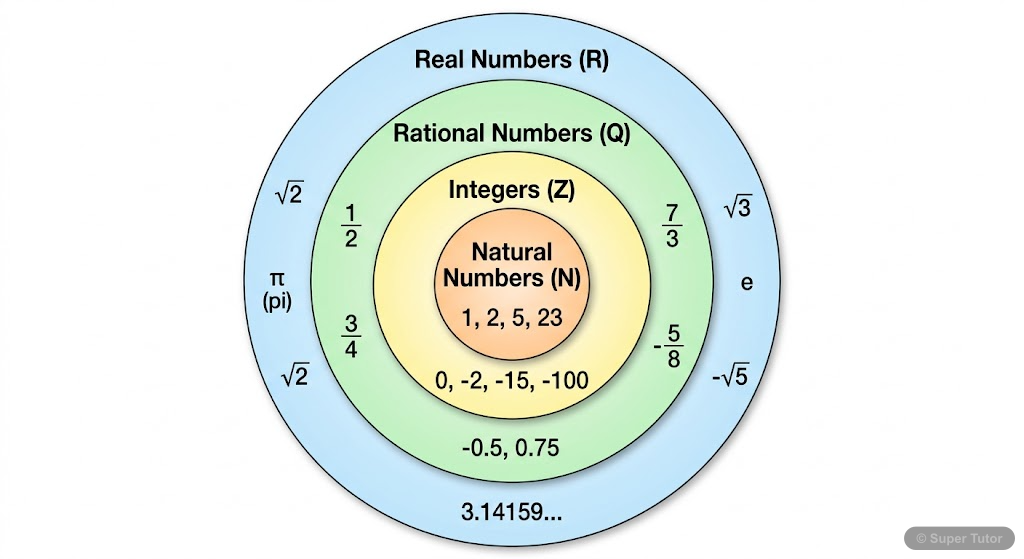
Learn better with visuals Super Tutor pairs illustrations like this with notes and quizzes for Negative Numbers and Integers.
Important Questions from Negative Numbers and Integers
The temperature in Shimla on Monday was –3°C. By Tuesday it fell by 5°C, and by Wednesday it rose by 8°C. What was the temperature on Wednesday?
Show answer
0°C
Step 1: Monday's temperature = –3°C. Step 2: 'Fell by 5°C' means subtract 5: –3 – 5 = –8°C. This is Tuesday's temperature. Step 3: 'Rose by 8°C' means add 8: –8 + 8 = 0°C. This is Wednesday's temperature. Step 4: Verify: –3 – 5 + 8 = –8 + 8 = 0. ✓ Final Answer: 0°C. Common mistake: Students may add 5 when temperature 'falls', but falling means it gets colder, so we subtract.
If a > b, which of the following is always TRUE about their negatives?
Show answer
–a < –b
Step 1: We are given that a > b. This is the key rule about negatives of integers. Step 2: Example to verify — let a = 9, b = 7. So 9 > 7. Their negatives: –9 and –7. Step 3: On a number line, –9 is further LEFT than –7. So –9 < –7, which means –a < –b. ✓ Step 4: The general rule is: if a > b, then –a < –b. The greater an integer, the smaller its negative (opposite). Final Answer: –a < –b. Common mistake: Students assume the inequality direction stays the same when negating both sides. It always REVERSES.
What integer must be added to (–27) to get a result of +13?
Show answer
+40
Step 1: Let the unknown integer be x. We need: (–27) + x = +13. Step 2: To find x, rearrange: x = 13 – (–27). Step 3: Subtracting a negative is the same as adding its positive: x = 13 + 27. Step 4: Calculate: x = 40. So the integer is +40. Step 5: Verify: (–27) + (+40) = 40 – 27 = +13 ✓ Final Answer: +40. Common mistake: Students compute 13 – 27 = –14, forgetting to change the sign when subtracting a negative.
On a number line, point P is at –6 and point Q is at +9. What is the distance between P and Q, and what integer represents the midpoint of PQ?
Show answer
Distance = 15, and midpoint is not an integer
Step 1: Distance between P (–6) and Q (+9) on a number line = |9 – (–6)| = |9 + 6| = |15| = 15 units. Step 2: The midpoint formula = (P + Q) ÷ 2 = (–6 + 9) ÷ 2 = 3 ÷ 2 = 1.5. Step 3: 1.5 is NOT an integer — it lies between integers 1 and 2 on the number line. Step 4: So the distance is 15 but the midpoint is 1.5, which is not an integer. Final Answer: Distance = 15, midpoint is not an integer. Common mistake: Students may compute distance as 9 – 6 = 3, ignoring the negative sign of P.
+88 more questions on Negative Numbers and Integers (ICSE Class 6 Mathematics)
Practise AllFrequently Asked Questions
What are the important topics in Negative Numbers and Integers for ICSE Class 6 Mathematics?
How many important questions are there in Negative Numbers and Integers?
Sources & Official References
Content is aligned to the official syllabus. Refer to the board website for the latest curriculum.
More resources for Negative Numbers and Integers
Practice Quiz
Test yourself with a quick quiz
Revision Notes
Key points for last-minute revision
Formula Sheet
The chapter's formulas in one place
Chapter Summary
Understand the chapter at a glance
Concept Maps
See how topics connect
Study Plan
Step-by-step plan for this chapter
Flashcards
Quick-fire cards for active recall
Syllabus
What topics to cover
For serious students
Get the full Negative Numbers and Integers chapter — start free.
Quizzes, flashcards, an AI doubt solver and a study plan for ICSE Class 6 Mathematics. Free to start, no card needed.