Physical and Chemical Changes — Concept Maps
ICSE · Class 7 · Chemistry
4 concept maps of Physical and Chemical Changes for ICSE Class 7 Chemistry, each also written out as a text outline.
Interactive on Super Tutor
Studying Physical and Chemical Changes? Get the full interactive chapter.
Quizzes, flashcards, AI doubt-solver and a step-by-step study plan — built for concept maps and more.
Free trial, no card needed.
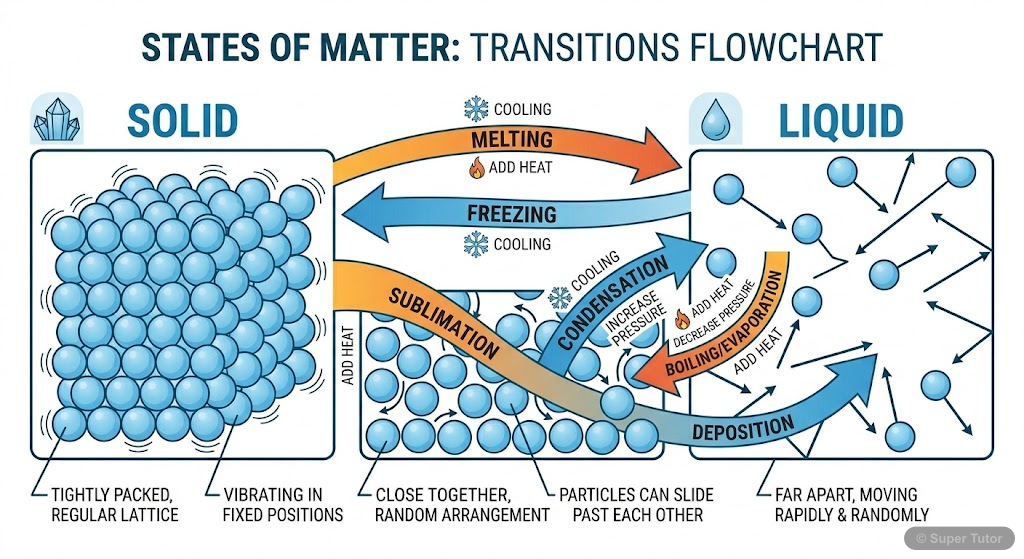
Learn better with visuals Super Tutor pairs illustrations like this with notes and quizzes for Physical and Chemical Changes.
Chapter Overview – Physical and Chemical Changes
The map in words
- Changes in Matter
- Types of Changes
- Slow vs Fast
- Slow: Rusting, Growth
- Fast: Burning, Explosion
- Natural vs Man-made
- Natural: Seasons, Earthquake
- Man-made: Cooking, Steel
- Periodic vs Non-periodic
- Periodic: Day-Night, Tides
- Non-periodic: Floods, Illness
- Desirable vs Undesirable
- Desirable: Ripening, Cooking
- Undesirable: Rusting, Rotting
- Reversible vs Irreversible
- Reversible: Melting Ice, Dissolving
- Irreversible: Burning, Cooking
- Slow vs Fast
- Physical Change
- No new substance
- Temporary change
- Usually reversible
- Examples
- Melting of ice
- Dissolving salt
- Sublimation
- Cutting paper
- Key Terms
- Melting and Freezing
- Boiling and Condensation
- Evaporation
- Sublimation
- Chemical Change
- New substance formed
- Permanent change
- Energy always exchanged
- Examples
- Rusting of iron
- Burning of paper
- Respiration
- Curd from milk
- Indicators
- Colour change
- Gas evolved
- Energy change
- New substance
- Types of Changes
Mind map showing the classification of changes based on three criteria: time duration, origin, and frequency of occurrence.
The map in words
- Types of Changes
- Based on Time
- Fast Changes
- Burning of paper
- Explosion
- Slow Changes
- Rusting
- Growth
- Fast Changes
- Based on Origin
- Natural
- Day-night
- Seasons
- Man-made
- Cooking
- Construction
- Natural
- Based on Frequency
- Periodic
- Moon cycles
- Tides
- Non-periodic
- Earthquakes
- Accidents
- Periodic
- Based on Time
Flowchart distinguishing between reversible and irreversible changes with examples.
The map in words
- Change Occurs
- Can Original Substance Be Recovered?
- Yes: Reversible Change
- Water to Ice
- Stretching Band
- No: Irreversible Change
- Burning Paper
- Cooking Food
- Yes: Reversible Change
- Can Original Substance Be Recovered?
Changes in matter can be classified as physical changes and chemical changes based on whether a new substance is formed, whether the change is temporary or permanent, and whether it can be reversed easily.
The map in words
- Changes in matter can be classified as physical changes and chemical changes based on whether a new substance is formed, whether the change is temporary or permanent, and whether it can be reversed easily.
- Change in matter
- Types of changes
- Physical change
- Chemical change
- Reversible change
- Irreversible change
- Evaporation and boiling
- Melting and freezing
Explore these maps interactively
Explore DiagramsFrequently Asked Questions
What are the important topics in Physical and Chemical Changes for ICSE Class 7 Chemistry?
What do the concept maps for Physical and Chemical Changes show?
How should I revise Physical and Chemical Changes for Class 7 exams?
Sources & Official References
Content is aligned to the official syllabus. Refer to the board website for the latest curriculum.
More resources for Physical and Chemical Changes
Practice Quiz
Test yourself with a quick quiz
Important Questions
Exam-style questions with answers
Revision Notes
Key points for last-minute revision
Formula Sheet
The chapter's formulas in one place
Chapter Summary
Understand the chapter at a glance
Study Plan
Step-by-step plan for this chapter
Flashcards
Quick-fire cards for active recall
Syllabus
What topics to cover
For serious students
Get the full Physical and Chemical Changes chapter — start free.
Quizzes, flashcards, an AI doubt solver and a study plan for ICSE Class 7 Chemistry. Free to start, no card needed.