Physical and Chemical Changes — Chapter Summary
ICSE · Class 7 · Chemistry
Summary of Physical and Chemical Changes for ICSE Class 7 Chemistry. Part of the ICSE Class 7 Chemistry syllabus.
Interactive on Super Tutor
Studying Physical and Chemical Changes? Get the full interactive chapter.
Quizzes, flashcards, AI doubt-solver and a step-by-step study plan — built for chapter summary and more.
Free trial, no card needed.
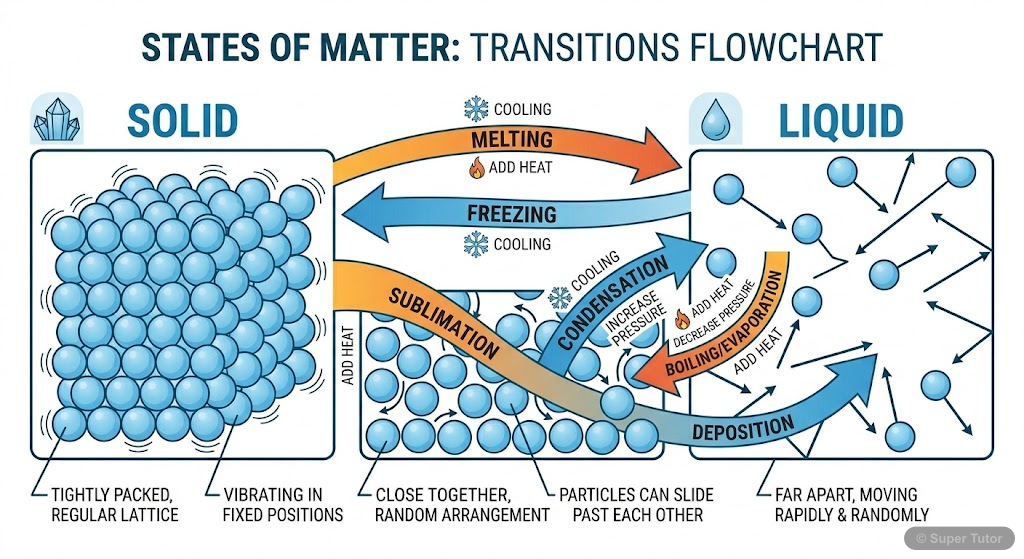
Learn better with visuals Super Tutor pairs illustrations like this with notes and quizzes for Physical and Chemical Changes.
Overview
Matter changes all around us in different ways. Some changes are temporary and affect only the form, while others are permanent and form new substances with different properties. Changes may happen slowly or quickly, naturally or because of human activity, and they may be desirable or undesirable. T
Key Concepts
A physical change is a temporary
A physical change is a temporary change in which no new substance is formed and the chemical composition remains the same. Only physical properties su
A chemical change is a permanent
A chemical change is a permanent change in which new substance(s) are formed. The new substance has properties that are completely different from the
A reversible change can be changed
A reversible change can be changed back by changing conditions, often by simple methods. An irreversible change cannot be brought back to the original
Evaporation is the slow change
Evaporation is the slow change of a liquid into vapour at any temperature below its boiling point, and it happens only from the surface. Boiling is a
Melting point is the temperature at
Melting point is the temperature at which a solid changes into a liquid. Freezing point is the temperature at which a liquid changes into a solid. For
Learning Objectives
- Differentiate between physical and chemical changes
- Recognise reversible and irreversible changes
- Identify signs of a chemical change such as colour change, gas formation, and energy change
- Understand evaporation, boiling, melting, freezing, condensation, and sublimation
- Classify everyday examples like rusting, burning, dissolving, and curd formation
Frequently Asked Questions
What are the important topics in Physical and Chemical Changes for ICSE Class 7 Chemistry?
How should I revise Physical and Chemical Changes for Class 7 exams?
Sources & Official References
Content is aligned to the official syllabus. Refer to the board website for the latest curriculum.
More resources for Physical and Chemical Changes
Practice Quiz
Test yourself with a quick quiz
Important Questions
Exam-style questions with answers
Revision Notes
Key points for last-minute revision
Formula Sheet
The chapter's formulas in one place
Concept Maps
See how topics connect
Study Plan
Step-by-step plan for this chapter
Flashcards
Quick-fire cards for active recall
Syllabus
What topics to cover
For serious students
Get the full Physical and Chemical Changes chapter — start free.
Quizzes, flashcards, an AI doubt solver and a study plan for ICSE Class 7 Chemistry. Free to start, no card needed.