Physical and Chemical Changes — Revision Notes
ICSE · Class 7 · Chemistry
Physical and Chemical Changes revision notes for ICSE Class 7 Chemistry: 4 topics in quick points. Part of the ICSE Class 7 Chemistry syllabus.
Interactive on Super Tutor
Studying Physical and Chemical Changes? Get the full interactive chapter.
Quizzes, flashcards, AI doubt-solver and a step-by-step study plan — built for revision notes and more.
Free trial, no card needed.
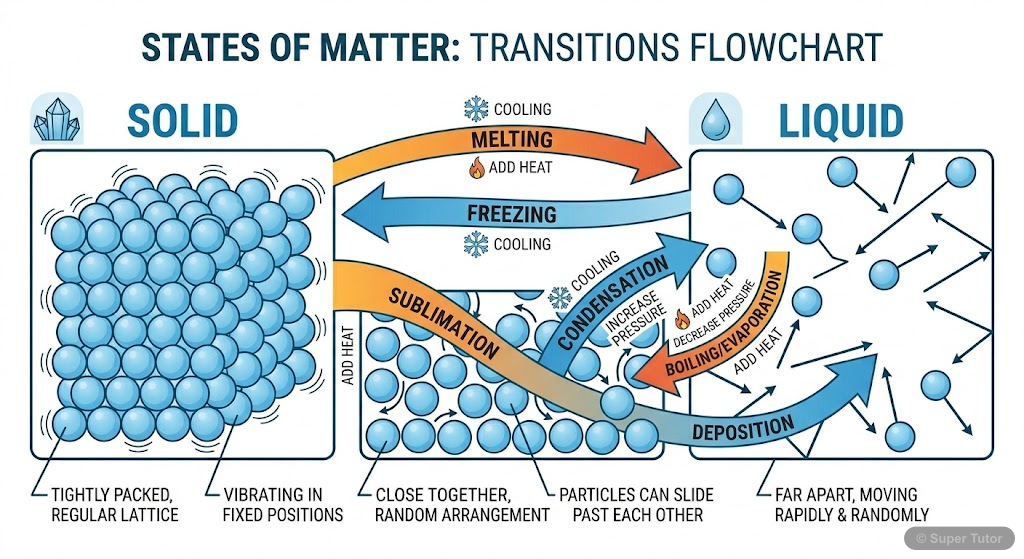
Learn better with visuals Super Tutor pairs illustrations like this with notes and quizzes for Physical and Chemical Changes.
Key Topics to Revise
Types of Changes
- Changes can be classified as slow or fast, natural or man-made, periodic or non-periodic, desirable or undesirable, reversible or irreversible, and physical or chemical.
- Slow changes take a long time to complete, such as rusting of iron, growth of a plant, or evaporation of water from a lake.
- Fast changes happen in a short time, such as burning of paper, bursting of a cracker, or lighting of an electric bulb.
Physical Changes
- A physical change is temporary.
- No new substance is formed in a physical change.
- Only physical properties like colour, state, shape, size, hardness, or smell may change.
Chemical Changes
- A chemical change is permanent.
- One or more new substances are formed in a chemical change.
- The properties of the new substance are different from those of the original substance.
Important Reactions and Examples
- Burning of paper gives ash and smoke; it is a chemical change.
- Burning of sugar first melts the sugar, then turns it brown and finally black; the black residue is charcoal.
- Charcoal is a form of carbon, an element.
Get complete notes with diagrams and examples
Full NotesKey Concepts
Frequently Asked Questions
What are the important topics in Physical and Chemical Changes for ICSE Class 7 Chemistry?
How should I revise Physical and Chemical Changes for Class 7 exams?
Sources & Official References
Content is aligned to the official syllabus. Refer to the board website for the latest curriculum.
More resources for Physical and Chemical Changes
Practice Quiz
Test yourself with a quick quiz
Important Questions
Exam-style questions with answers
Formula Sheet
The chapter's formulas in one place
Chapter Summary
Understand the chapter at a glance
Concept Maps
See how topics connect
Study Plan
Step-by-step plan for this chapter
Flashcards
Quick-fire cards for active recall
Syllabus
What topics to cover
For serious students
Get the full Physical and Chemical Changes chapter — start free.
Quizzes, flashcards, an AI doubt solver and a study plan for ICSE Class 7 Chemistry. Free to start, no card needed.