Matter — Important Questions
ICSE · Class 8 · Chemistry
43 important questions from Matter for ICSE Class 8 Chemistry, with answers. Includes multiple correct and multiple choice questions.
Interactive on Super Tutor
Studying Matter? Get the full interactive chapter.
Quizzes, flashcards, AI doubt-solver and a step-by-step study plan — built for important questions and more.
Free trial, no card needed.
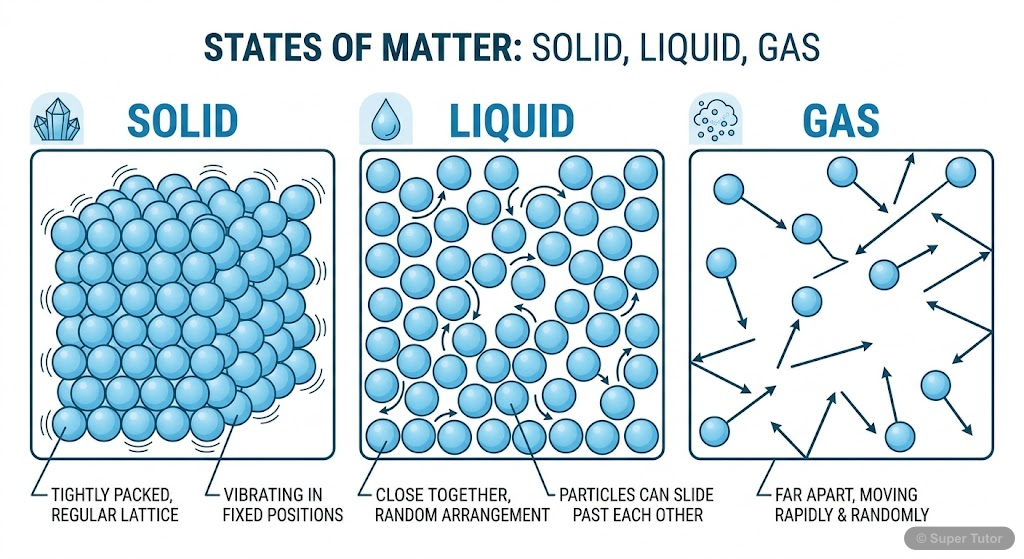
One of 3 illustrations for Matter in Super Tutor — alongside flashcards, concept maps and practice questions.
Important Questions from Matter
According to the kinetic theory of matter, what happens to the intermolecular force of attraction and the kinetic energy of particles when a solid is gradually heated until it becomes a gas?
Show answer
Intermolecular force of attraction decreases; kinetic energy increases, Intermolecular force of attraction remains the same; kinetic energy increases
Step 1: When a solid is heated, energy is supplied to its particles. Step 2: This supplied energy converts into kinetic energy of the particles, making them vibrate faster and then move more freely. Step 3: As kinetic energy increases, the particles can overcome the intermolecular forces of attraction holding them together. Step 4: As a result, intermolecular forces DECREASE while kinetic energy INCREASES. Step 5: Option A is wrong because forces do not increase on heating. Option C is wrong because kinetic energy never decreases on heating. Option D is wrong because forces do change — they de
Robert Brown observed pollen grains moving in a zig-zag pattern in water. Which of the following CORRECTLY explains why the pollen grains move in an irregular (zig-zag) pattern and NOT in a straight line?
Show answer
Water molecules collide with pollen grains from all directions with unequal forces at any given moment
Step 1: Brownian motion is the random, zig-zag movement of suspended particles caused by the collision of moving liquid (or gas) molecules with those particles. Step 2: Water molecules are in constant random motion and collide with pollen grains continuously. Step 3: At any instant, collisions happen from all sides, but the number and force of collisions from different directions are NOT equal. Step 4: This unequal bombardment pushes the pollen grain in one direction, then another, creating the zig-zag path. Step 5: Option A is wrong — pollen grains used in Robert Brown's experiment were dead.
LPG (Liquefied Petroleum Gas) is stored in cylinders in liquid state under normal conditions it is a gas. Which combination of conditions is used to keep it in liquid state inside the cylinder?
Show answer
High pressure and low temperature
Step 1: To convert a gas into a liquid, we need to bring its particles closer together. Step 2: Increasing pressure forces gas molecules closer to each other, reducing intermolecular space and increasing intermolecular forces of attraction. Step 3: Decreasing temperature reduces the kinetic energy of gas molecules, making it easier for intermolecular forces to hold them together in liquid form. Step 4: Both conditions together — HIGH pressure and LOW temperature — are used to liquefy gases like LPG, oxygen, and hydrogen. Step 5: High temperature (Option A and D) increases kinetic energy, which
In the experiment with baking soda and vinegar in a zip-lock bag, why is it ESSENTIAL to seal the bag immediately after adding the baking soda?
Show answer
To prevent carbon dioxide gas (a product) from escaping, which would make the measured mass of products less than reactants
Step 1: The reaction is: NaHCO₃ + CH₃COOH → CO₂ + CH₃COONa + H₂O. Step 2: CO₂ is a gas and a product of this reaction. Step 3: If the bag is not sealed, CO₂ gas escapes into the atmosphere. Step 4: When we weigh after the reaction, the mass of escaped CO₂ will not be counted, making it appear that mass was lost — falsely suggesting the law of conservation of mass is violated. Step 5: To correctly verify the law, ALL products must remain within the closed system. Option A is incorrect — vinegar evaporation is negligible and not the main concern. Option C is wrong — pressure plays no role here.
+39 more questions on Matter (ICSE Class 8 Chemistry)
Practise AllFrequently Asked Questions
What are the important topics in Matter for ICSE Class 8 Chemistry?
How many important questions are there in Matter?
Sources & Official References
Content is aligned to the official syllabus. Refer to the board website for the latest curriculum.
More resources for Matter
Practice Quiz
Test yourself with a quick quiz
Revision Notes
Key points for last-minute revision
Formula Sheet
The chapter's formulas in one place
Chapter Summary
Understand the chapter at a glance
Concept Maps
See how topics connect
Study Plan
Step-by-step plan for this chapter
Flashcards
Quick-fire cards for active recall
Syllabus
What topics to cover
For serious students
Get the full Matter chapter — start free.
Quizzes, flashcards, an AI doubt solver and a study plan for ICSE Class 8 Chemistry. Free to start, no card needed.