Matter — Chapter Summary
ICSE · Class 8 · Chemistry
Summary of Matter for ICSE Class 8 Chemistry. Key concepts: Matter is anything which has, Matter is made of very tiny and Greek philosophers believed.
Interactive on Super Tutor
Studying Matter? Get the full interactive chapter.
Quizzes, flashcards, AI doubt-solver and a step-by-step study plan — built for chapter summary and more.
Free trial, no card needed.
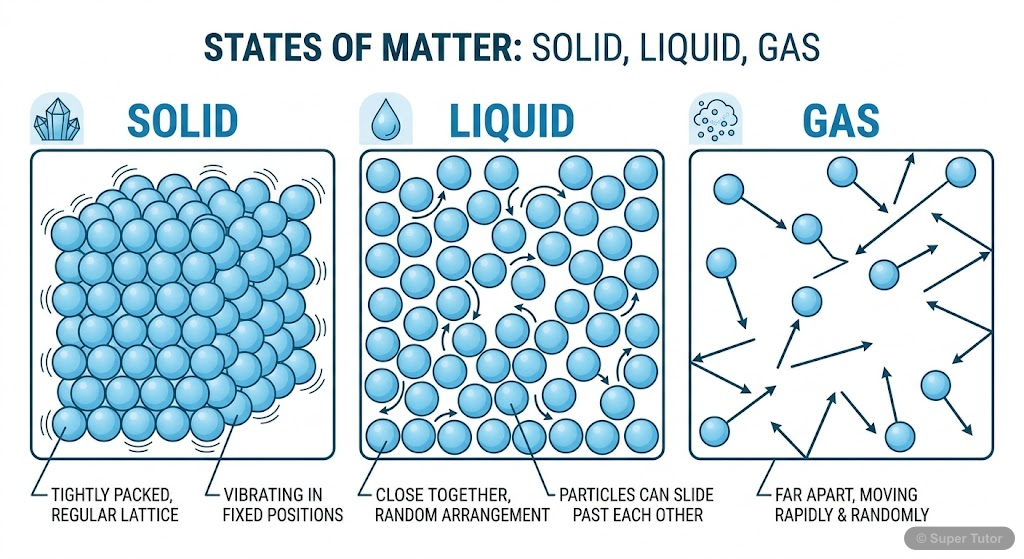
One of 3 illustrations for Matter in Super Tutor — alongside flashcards, concept maps and practice questions.
Overview
Matter is anything which has mass, occupies space and can be perceived by our senses. Chemistry studies matter in terms of its structure, composition, and physical and chemical properties. Matter is made of tiny particles called atoms and molecules, and it exists mainly as solids, liquids, and gases
Key Concepts
Matter is anything which has mass
Matter is anything which has mass, occupies space and can be perceived by our senses. Air is also matter because it occupies space and can be felt whe
Matter is made of very tiny
Matter is made of very tiny particles called atoms and molecules. Atoms usually do not have independent existence and combine to form molecules, which
Greek philosophers believed matter was made
Greek philosophers believed matter was made of fire, water, air, and earth. Indian philosophers believed in five elements. Maharshi Kannada suggested
Particles of matter are always
Particles of matter are always in random motion. Their kinetic energy increases with increase in temperature and decreases on cooling. Robert Brown sh
Diffusion is the intermixing of two
Diffusion is the intermixing of two or more substances due to the motion of their particles to form a uniform mixture. It is fastest in gases, slower
Learning Objectives
- Describe matter and identify examples of matter in daily life.
- Explain the idea that matter is made of tiny particles.
- Compare solids, liquids, and gases using shape, volume, packing, attraction, and diffusion.
- Explain Brownian motion and diffusion as evidence of particle motion.
- Describe change of state by heating, cooling, and pressure.
Frequently Asked Questions
What are the important topics in Matter for ICSE Class 8 Chemistry?
How should I revise Matter for Class 8 exams?
Sources & Official References
Content is aligned to the official syllabus. Refer to the board website for the latest curriculum.
More resources for Matter
Practice Quiz
Test yourself with a quick quiz
Important Questions
Exam-style questions with answers
Revision Notes
Key points for last-minute revision
Formula Sheet
The chapter's formulas in one place
Concept Maps
See how topics connect
Study Plan
Step-by-step plan for this chapter
Flashcards
Quick-fire cards for active recall
Syllabus
What topics to cover
For serious students
Get the full Matter chapter — start free.
Quizzes, flashcards, an AI doubt solver and a study plan for ICSE Class 8 Chemistry. Free to start, no card needed.