Light Energy — Practice Quiz
ICSE · Class 8 · Physics
Try a 4-question quiz on Light Energy for ICSE Class 8 Physics: tap an answer to check it and see why. 44 questions in the full chapter test.
Interactive on Super Tutor
Studying Light Energy? Get the full interactive chapter.
Quizzes, flashcards, AI doubt-solver and a step-by-step study plan — built for practice quiz and more.
Free trial, no card needed.
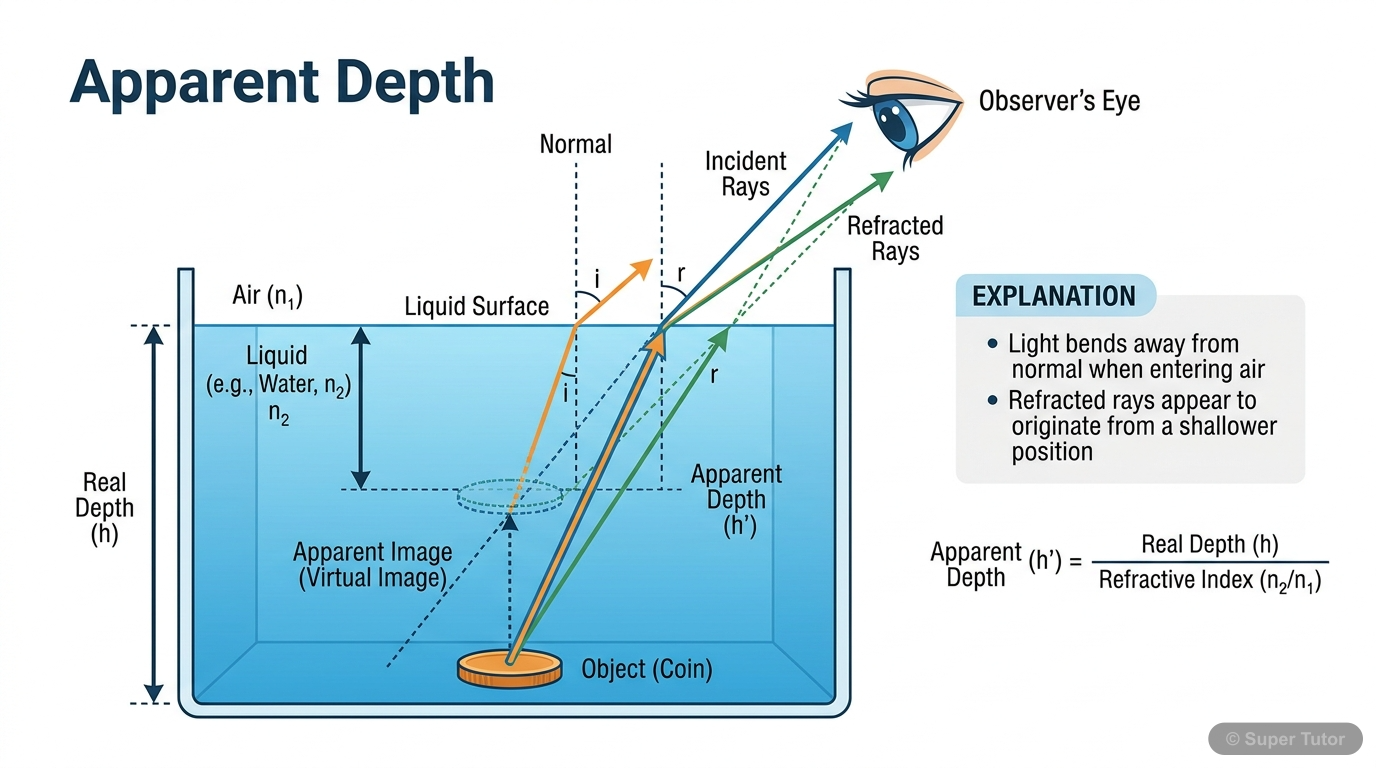
One of 5 illustrations for Light Energy in Super Tutor — alongside flashcards, concept maps and practice questions.
Quick Quiz: Light Energy
0/4Tap an answer to check it instantly. No sign-up needed for these 4.
What is the speed of light in air?
When a ray of light travels from air (rarer medium) into glass (denser medium), which direction does it bend?
What is the phenomenon called when white light splits into seven colours on passing through a prism?
What is the correct order of colours in the spectrum of white light from the base of the prism upwards?
Sample Questions
The focal length of a concave mirror is 10 cm. What is its radius of curvature?
Show answer
20 cm
The relationship between focal length (f) and radius of curvature (R) is: R = 2 × f. Step 1: Write the formula — R = 2 × f. Step 2: Substitute the value — R = 2 × 10 cm. Step 3: Calculate — R = 20 cm. The radius of curvature is always TWICE the focal length. A common error is to halve the focal length instead of doubling it.
What type of image is ALWAYS formed by a convex mirror, regardless of the position of the object?
Show answer
Virtual, erect and diminished
A convex mirror ALWAYS forms a virtual, erect (upright) and diminished (smaller) image, no matter where the object is placed. This is because a convex mirror is a diverging mirror — it spreads reflected rays apart. The image is always formed between the pole and focus, behind the mirror. This property makes it useful as a rear-view mirror in vehicles.
A concave mirror has a radius of curvature of 30 cm. What is its focal length?
Show answer
15 cm
The formula connecting focal length and radius of curvature is: f = R/2. Step 1: Write the formula — f = R ÷ 2. Step 2: Substitute — f = 30 cm ÷ 2. Step 3: Calculate — f = 15 cm. The focal length is HALF the radius of curvature. A common mistake is to multiply R by 2 instead of dividing.
Which of the following is the MAIN use of a concave mirror as a shaving mirror?
Show answer
It forms an erect and magnified image when the object is close to it
A concave mirror is used as a shaving mirror because when the face (object) is placed between the pole and focus of the mirror, it forms a VIRTUAL, ERECT and MAGNIFIED image. This enlarged image helps in seeing facial features clearly for shaving. If the face were placed beyond the focus, the image would be real and inverted — not useful for shaving!
+40 more questions on Light Energy (ICSE Class 8 Physics)
Practise AllFrequently Asked Questions
What are the important topics in Light Energy for ICSE Class 8 Physics?
How many practice questions are there for Light Energy?
Sources & Official References
Content is aligned to the official syllabus. Refer to the board website for the latest curriculum.
More resources for Light Energy
Important Questions
Exam-style questions with answers
Revision Notes
Key points for last-minute revision
Formula Sheet
The chapter's formulas in one place
Chapter Summary
Understand the chapter at a glance
Concept Maps
See how topics connect
Study Plan
Step-by-step plan for this chapter
Flashcards
Quick-fire cards for active recall
Syllabus
What topics to cover
For serious students
Get the full Light Energy chapter — start free.
Quizzes, flashcards, an AI doubt solver and a study plan for ICSE Class 8 Physics. Free to start, no card needed.