Globalisation — Flashcards
ICSE · Class 9 · Economic Applications
35 flashcards for Globalisation (ICSE Class 9 Economic Applications) to test yourself on key terms and facts. Sample: "What is globalisation?"
Interactive on Super Tutor
Studying Globalisation? Get the full interactive chapter.
Quizzes, flashcards, AI doubt-solver and a step-by-step study plan — built for flashcards and more.
Free trial, no card needed.
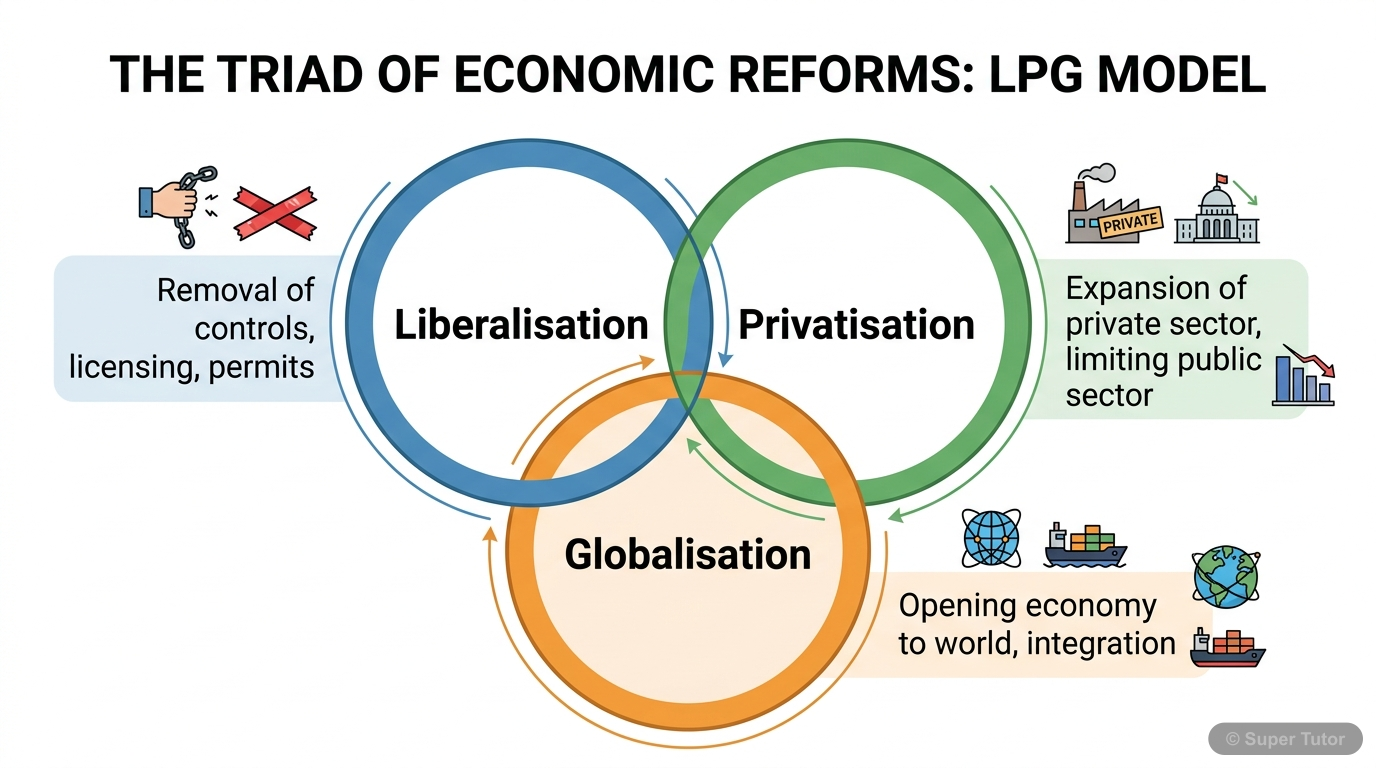
One of 6 illustrations for Globalisation in Super Tutor — alongside flashcards, concept maps and practice questions.
What is globalisation?
Answer
Globalisation is the policy and process of opening up the Indian economy to other economies of the world through trade, capital flows, and technology. It helps countries connect more closely in econom…
What are the three main channels through which globalisation takes place?
Answer
Globalisation mainly takes place through three channels: opening up world trade, removing barriers to international investment, and free flow of technology between countries.
What does Liberalisation mean in the New Economic Policy?
Answer
Liberalisation means reducing various controls, licensing rules, and permits that regulated the non-agricultural sector before 1991. It makes the economy freer from unnecessary restrictions.
What does Privatisation mean?
Answer
Privatisation means expanding the role of the private sector and limiting the role of the public sector. It also includes transfer of ownership of public sector enterprises to the private sector.
What does Globalisation mean in the LPG policy?
Answer
Globalisation in the LPG policy means opening up the Indian economy to other economies of the world. It connects India with world trade, foreign investment, and technology.
Why is the year 1991 important for the Indian economy?
Answer
The year 1991 is important because it marks a watershed in the growth of the Indian economy. The new economic policy began then, and globalisation started in full earnest in July 1991.
What were the seeds of globalisation in India?
Answer
The seeds of globalisation were sown in the early 1980s through liberalisation of imports, some concessions to foreign capital, and allowing multinational companies to enter some areas of the economy.
Why did India need globalisation in 1991?
Answer
India needed globalisation because of weak pre-1991 policies, a serious foreign exchange crisis, conditionalities imposed by IMF and World Bank, and the fall of the USSR, which affected Indian trade.
+27 more flashcards
Practise AllFrequently Asked Questions
What are the important topics in Globalisation for ICSE Class 9 Economic Applications?
How many flashcards are available for Globalisation?
How should I revise Globalisation for Class 9 exams?
Sources & Official References
Content is aligned to the official syllabus. Refer to the board website for the latest curriculum.
More resources for Globalisation
Practice Quiz
Test yourself with a quick quiz
Important Questions
Exam-style questions with answers
Revision Notes
Key points for last-minute revision
Chapter Summary
Understand the chapter at a glance
Concept Maps
See how topics connect
Study Plan
Step-by-step plan for this chapter
Syllabus
What topics to cover
For serious students
Get the full Globalisation chapter — start free.
Quizzes, flashcards, an AI doubt solver and a study plan for ICSE Class 9 Economic Applications. Free to start, no card needed.