Globalisation — Revision Notes
ICSE · Class 9 · Economic Applications
Globalisation revision notes for ICSE Class 9 Economic Applications: 4 topics in quick points. Part of the ICSE Class 9 Economic Applications syllabus.
Interactive on Super Tutor
Studying Globalisation? Get the full interactive chapter.
Quizzes, flashcards, AI doubt-solver and a step-by-step study plan — built for revision notes and more.
Free trial, no card needed.
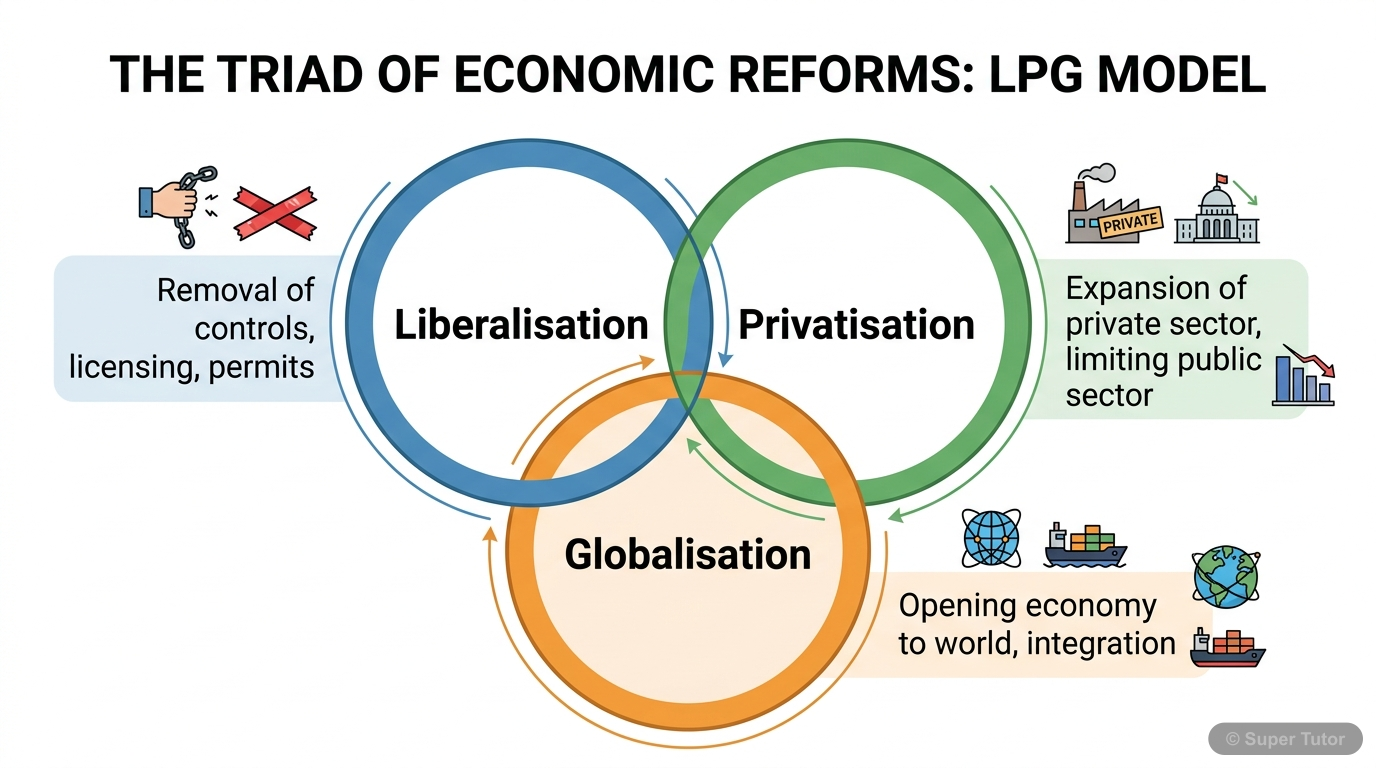
One of 6 illustrations for Globalisation in Super Tutor — alongside flashcards, concept maps and practice questions.
Key Topics to Revise
1. Meaning and Main Ideas
- Globalisation means integrating one country’s economy with the economies of other countries.
- It happens mainly through three channels: opening up world trade, removing barriers to international investment, and free flow of technology.
- It is one of the three broad components of the new economic policy, along with liberalisation and privatisation.
2. Why Globalisation Became Necessary in India
- Weaknesses of pre-1991 policies led to low economic growth, rising unemployment, stagnation in domestic saving and investment, poor performance of public sector enterprises, inadequate infrastructure,
- A major foreign exchange crisis occurred in 1991.
- The Gulf war between Iraq and Kuwait in 1990-91 was the first and immediate cause of the foreign exchange crisis.
3. Policy Measures Used to Promote Globalisation
- Exchange rate reforms changed the system from fixed exchange rates to market-determined flexible exchange rates.
- Convertibility of the Indian rupee on trade account was achieved in August 1994.
- This convertibility was partial convertibility because it covered current account transactions only and not capital account transactions.
4. Effects of Globalisation on the Indian Economy
- Globalisation helped raise the growth rate of the Indian economy.
- GDP growth rate picked up from 5 per cent in 1990-91 to 9 per cent in 2021-22.
- India experienced GDP growth of around 7 per cent between 2003-04 and 2021-22.
Get complete notes with diagrams and examples
Full NotesKey Concepts
Frequently Asked Questions
What are the important topics in Globalisation for ICSE Class 9 Economic Applications?
How should I revise Globalisation for Class 9 exams?
Sources & Official References
Content is aligned to the official syllabus. Refer to the board website for the latest curriculum.
More resources for Globalisation
For serious students
Get the full Globalisation chapter — start free.
Quizzes, flashcards, an AI doubt solver and a study plan for ICSE Class 9 Economic Applications. Free to start, no card needed.