Conditionals — Chapter Summary
ICSE · Class 9 · English Language - Archer
Summary of Conditionals for ICSE Class 9 English Language - Archer. Part of the ICSE Class 9 English Language - Archer syllabus.
Interactive on Super Tutor
Studying Conditionals? Get the full interactive chapter.
Quizzes, flashcards, AI doubt-solver and a step-by-step study plan — built for chapter summary and more.
Free trial, no card needed.
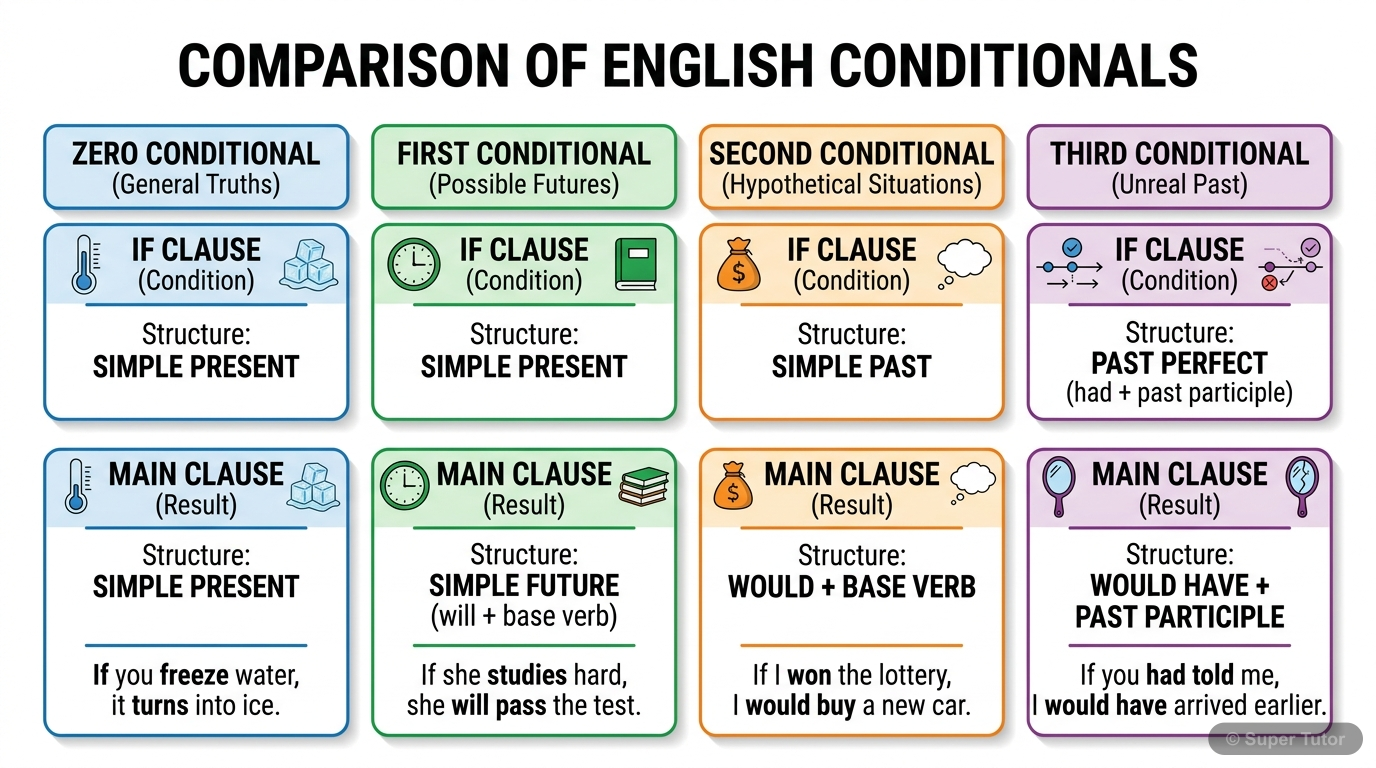
One of 2 illustrations for Conditionals in Super Tutor — alongside flashcards, concept maps and practice questions.
Overview
Conditionals are sentences with two parts: the if clause and the main clause. The if clause gives the condition, and the main clause gives the result. There are four types of conditionals: zero, first, second, and third. Conditionals also include special forms called inverted conditionals, where if
Key Concepts
A conditional sentence has two elements
A conditional sentence has two elements: the if clause and the main clause. The if clause gives the condition, and the main clause gives the result.
The zero conditional is used
The zero conditional is used for real or factual situations, or when one thing automatically follows another. Its structure is if clause in simple pre
The first conditional is used
The first conditional is used to express possible future situations. Its structure is if clause in simple present plus main clause in simple future.
The second conditional is used
The second conditional is used to imagine present or future situations that are impossible or unlikely to be true in reality. Its structure is if clau
The third conditional is used
The third conditional is used to talk about hypothetical past situations. The condition was not fulfilled in the past, so the result did not happen an
Learning Objectives
- Identify the if clause and the main clause in conditional sentences.
- Differentiate between the four types of conditionals.
- Use the correct tense pattern for each type of conditional.
- Recognize when zero and first conditionals allow different present tense forms in the if clause.
- Use were instead of was in purely imaginary second conditional statements.
Frequently Asked Questions
What are the important topics in Conditionals for ICSE Class 9 English Language - Archer?
How should I revise Conditionals for Class 9 exams?
Sources & Official References
Content is aligned to the official syllabus. Refer to the board website for the latest curriculum.
More resources for Conditionals
Practice Quiz
Test yourself with a quick quiz
Important Questions
Exam-style questions with answers
Revision Notes
Key points for last-minute revision
Formula Sheet
The chapter's formulas in one place
Concept Maps
See how topics connect
Study Plan
Step-by-step plan for this chapter
Flashcards
Quick-fire cards for active recall
Syllabus
What topics to cover
For serious students
Get the full Conditionals chapter — start free.
Quizzes, flashcards, an AI doubt solver and a study plan for ICSE Class 9 English Language - Archer. Free to start, no card needed.