Chapter 1 of 13
NCERT Solutions

Chemical Reaction and Equations

Jharkhand Board · Class 10 · Science

NCERT Solutions for Chemical Reaction and Equations — Jharkhand Board Class 10 Science.

62 questions20 flashcards5 concepts

Interactive on Super Tutor

Studying Chemical Reaction and Equations? Get the full interactive chapter.

Quizzes, flashcards, AI doubt-solver and a step-by-step study plan — built for ncert solutions and more.

1,000+ Class 10 students started this chapter today

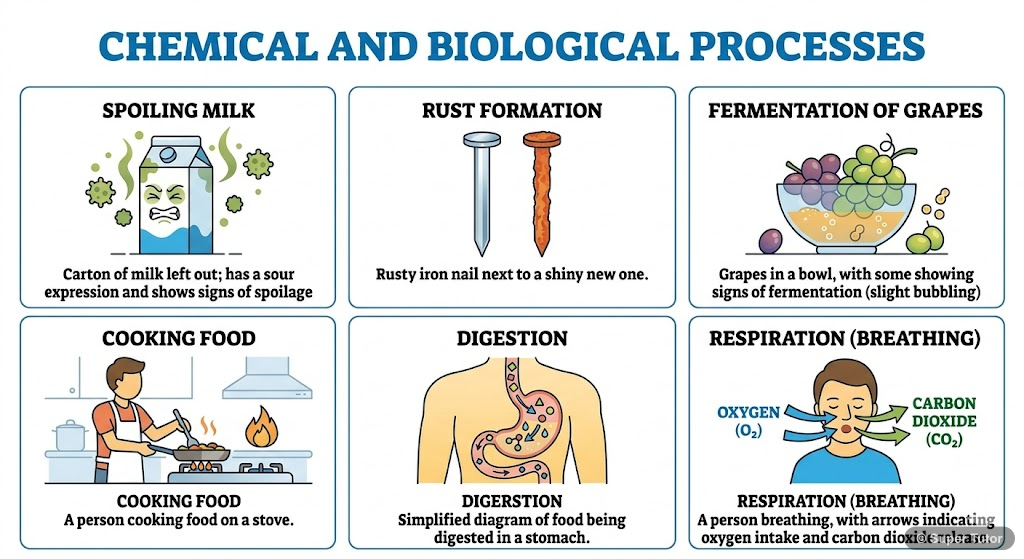
An illustration showing common daily life situations where chemical reactions occur, such as milk turning sour, iron rusting, grapes fermenting, food cooking, food digestion, and respiration.
Super Tutor

Super Tutor has 23+ illustrations like this for Chemical Reaction and Equations alone — flashcards, concept maps, and step-by-step visuals.

See them all
24 Questions Solved · 2 Sections

Intext Questions (Page – Oxidation/Reduction Section)

Recall Activity 1.1Recall Activity 1.1 where a magnesium ribbon burns with a dazzling flame in air (oxygen) and changes into a white substance, magnesium oxide. Is magnesium being oxidised or reduced in this reaction?Show solution
Given: Magnesium ribbon burns in air (oxygen) to form magnesium oxide.

Reaction:
2Mg(s)+O2(g)2MgO(s)2\mathrm{Mg}(\mathrm{s}) + \mathrm{O}_2(\mathrm{g}) \rightarrow 2\mathrm{MgO}(\mathrm{s})

Concept: A substance is said to be oxidised if it gains oxygen during a reaction.

Conclusion: Magnesium gains oxygen to form magnesium oxide. Therefore, magnesium is being oxidised in this reaction.
1Why does the colour of copper sulphate solution change when an iron nail is dipped in it?Show solution
Given: An iron nail is dipped in copper sulphate (CuSO₄) solution.

Concept: This is a displacement reaction. A more reactive metal displaces a less reactive metal from its salt solution. Iron is more reactive than copper.

Reaction:
Fe(s)+CuSO4(aq)FeSO4(aq)+Cu(s)\mathrm{Fe}(\mathrm{s}) + \mathrm{CuSO}_4(\mathrm{aq}) \rightarrow \mathrm{FeSO}_4(\mathrm{aq}) + \mathrm{Cu}(\mathrm{s})

Explanation: Iron displaces copper from copper sulphate solution. The blue colour of copper sulphate solution fades (or turns light green) because blue CuSO₄ is consumed and green FeSO₄ is formed. A reddish-brown deposit of copper metal appears on the iron nail.

Answer: The colour of copper sulphate solution changes because iron displaces copper from the solution, forming iron sulphate (FeSO₄) which is light green, and copper metal is deposited on the nail.
2Give an example of a double displacement reaction other than the one given in Activity 1.10.Show solution
Concept: In a double displacement reaction, two compounds react by exchanging their ions (or groups of atoms) to form two new compounds.

Example: Reaction between sodium sulphate and barium chloride:
Na2SO4(aq)+BaCl2(aq)BaSO4(s)+2NaCl(aq)\mathrm{Na}_2\mathrm{SO}_4(\mathrm{aq}) + \mathrm{BaCl}_2(\mathrm{aq}) \rightarrow \mathrm{BaSO}_4(\mathrm{s})\downarrow + 2\mathrm{NaCl}(\mathrm{aq})

Explanation: Here, Na+\mathrm{Na}^+ and Ba2+\mathrm{Ba}^{2+} ions exchange their respective anions. Barium sulphate (BaSO4\mathrm{BaSO}_4) is formed as a white insoluble precipitate. This is also a precipitation reaction.
3Identify the substances that are oxidised and the substances that are reduced in the following reactions.
(i) 4Na(s)+O2(g)2Na2O(s)4\mathrm{Na}(\mathrm{s}) + \mathrm{O}_2(\mathrm{g}) \rightarrow 2\mathrm{Na}_2\mathrm{O}(\mathrm{s})
(ii) CuO(s)+H2(g)Cu(s)+H2O(l)\mathrm{CuO(s)} + \mathrm{H}_2(\mathrm{g}) \rightarrow \mathrm{Cu(s)} + \mathrm{H}_2\mathrm{O(l)}
Show solution
Concept:
- Oxidation = gain of oxygen OR loss of hydrogen.
- Reduction = loss of oxygen OR gain of hydrogen.

(i) 4Na(s)+O2(g)2Na2O(s)4\mathrm{Na}(\mathrm{s}) + \mathrm{O}_2(\mathrm{g}) \rightarrow 2\mathrm{Na}_2\mathrm{O}(\mathrm{s})

- Sodium (Na) gains oxygen to form sodium oxide (Na₂O). Therefore, sodium (Na) is oxidised.
- Oxygen (O2\mathrm{O}_2) itself is the oxidising agent; it is being used up to oxidise Na. (In this reaction, only oxidation occurs — there is no separate substance being reduced in the classical sense, but O2\mathrm{O}_2 acts as the oxidising agent.)

Answer: Sodium (Na) is oxidised (gains oxygen).

(ii) CuO(s)+H2(g)Cu(s)+H2O(l)\mathrm{CuO(s)} + \mathrm{H}_2(\mathrm{g}) \rightarrow \mathrm{Cu(s)} + \mathrm{H}_2\mathrm{O(l)}

- CuO loses oxygen to form Cu. Therefore, CuO (copper oxide) is reduced.
- H₂ gains oxygen to form H₂O. Therefore, hydrogen (H₂) is oxidised.

Answer:
- Substance oxidisedH2\mathrm{H}_2 (hydrogen gas gains oxygen).
- Substance reducedCuO\mathrm{CuO} (copper oxide loses oxygen).

EXERCISES

1Which of the statements about the reaction below are incorrect?
2PbO(s)+C(s)2Pb(s)+CO2(g)2\mathrm{PbO}(\mathrm{s}) + \mathrm{C}(\mathrm{s}) \rightarrow 2\mathrm{Pb}(\mathrm{s}) + \mathrm{CO}_2(\mathrm{g})
(a) Lead is getting reduced.
(b) Carbon dioxide is getting oxidised.
(c) Carbon is getting oxidised.
(d) Lead oxide is getting reduced.
(i) (a) and (b) (ii) (a) and (c) (iii) (a), (b) and (c) (iv) all
Show solution
Correct Option: (i) (a) and (b)

Analysis of the reaction:
2PbO(s)+C(s)2Pb(s)+CO2(g)2\mathrm{PbO}(\mathrm{s}) + \mathrm{C}(\mathrm{s}) \rightarrow 2\mathrm{Pb}(\mathrm{s}) + \mathrm{CO}_2(\mathrm{g})

- PbO loses oxygen → PbO is reduced (statement (d) is correct).
- Pb is the product of reduction of PbO, so lead itself is not getting reduced — statement (a) is incorrect.
- Carbon (C) gains oxygen to form CO₂ → Carbon is oxidised (statement (c) is correct).
- CO₂ is the product of oxidation; it is not getting oxidised further — statement (b) is incorrect.

Incorrect statements: (a) and (b) → Option (i)
2Fe2O3+2AlAl2O3+2Fe\mathrm{Fe}_2\mathrm{O}_3 + 2\mathrm{Al} \rightarrow \mathrm{Al}_2\mathrm{O}_3 + 2\mathrm{Fe}
The above reaction is an example of a
(a) combination reaction.
(b) double displacement reaction.
(c) decomposition reaction.
(d) displacement reaction.
Show solution
Correct Option: (d) displacement reaction.

Justification: Aluminium (Al) is more reactive than iron (Fe). It displaces iron from iron(III) oxide (Fe₂O₃), taking its place. A single more reactive element displaces a less reactive element from its compound — this is the definition of a displacement reaction. This reaction is also known as the thermite reaction.
3What happens when dilute hydrochloric acid is added to iron fillings? Tick the correct answer.
(a) Hydrogen gas and iron chloride are produced.
(b) Chlorine gas and iron hydroxide are produced.
(c) No reaction takes place.
(d) Iron salt and water are produced.
Show solution
Correct Answer: (a) Hydrogen gas and iron chloride are produced.

Reaction:
Fe(s)+2HCl(aq)FeCl2(aq)+H2(g)\mathrm{Fe}(\mathrm{s}) + 2\mathrm{HCl}(\mathrm{aq}) \rightarrow \mathrm{FeCl}_2(\mathrm{aq}) + \mathrm{H}_2(\mathrm{g})\uparrow

Justification: Iron is more reactive than hydrogen. It displaces hydrogen from dilute hydrochloric acid, forming iron(II) chloride (FeCl₂) and hydrogen gas. This is a displacement reaction.
4What is a balanced chemical equation? Why should chemical equations be balanced?Show solution
Balanced Chemical Equation:

A balanced chemical equation is one in which the number of atoms of each element is equal on both the reactant side and the product side of the equation.

Example:
2H2+O22H2O2\mathrm{H}_2 + \mathrm{O}_2 \rightarrow 2\mathrm{H}_2\mathrm{O}
Here, H: 4 on each side; O: 2 on each side — the equation is balanced.

Why should chemical equations be balanced?

Chemical equations must be balanced to satisfy the Law of Conservation of Mass, which states that matter can neither be created nor destroyed in a chemical reaction. This means the total mass of reactants must equal the total mass of products. Since atoms are neither created nor destroyed during a reaction, the number of atoms of each element must be the same on both sides of the equation. An unbalanced equation violates this fundamental law.
5Translate the following statements into chemical equations and then balance them.
(a) Hydrogen gas combines with nitrogen to form ammonia.
(b) Hydrogen sulphide gas burns in air to give water and sulphur dioxide.
(c) Barium chloride reacts with aluminium sulphate to give aluminium chloride and a precipitate of barium sulphate.
(d) Potassium metal reacts with water to give potassium hydroxide and hydrogen gas.
Show solution
(a) Hydrogen gas combines with nitrogen to form ammonia.

Unbalanced: H2+N2NH3\mathrm{H}_2 + \mathrm{N}_2 \rightarrow \mathrm{NH}_3

Balancing:
- N: 2 on left, 1 on right → put 2 before NH₃: H2+N22NH3\mathrm{H}_2 + \mathrm{N}_2 \rightarrow 2\mathrm{NH}_3
- H: 2 on left, 6 on right → put 3 before H₂: 3H2+N22NH33\mathrm{H}_2 + \mathrm{N}_2 \rightarrow 2\mathrm{NH}_3

Balanced equation:
3H2(g)+N2(g)2NH3(g)3\mathrm{H}_2(\mathrm{g}) + \mathrm{N}_2(\mathrm{g}) \rightarrow 2\mathrm{NH}_3(\mathrm{g})

---

(b) Hydrogen sulphide gas burns in air to give water and sulphur dioxide.

Unbalanced: H2S+O2H2O+SO2\mathrm{H}_2\mathrm{S} + \mathrm{O}_2 \rightarrow \mathrm{H}_2\mathrm{O} + \mathrm{SO}_2

Balancing:
- S: 1 on each side ✓
- H: 2 on each side ✓
- O: 2 on left, 3 on right → Balance O by adjusting coefficients.
- Try: 2H2S+3O22H2O+2SO22\mathrm{H}_2\mathrm{S} + 3\mathrm{O}_2 \rightarrow 2\mathrm{H}_2\mathrm{O} + 2\mathrm{SO}_2
- S: 2 = 2 ✓; H: 4 = 4 ✓; O: 6 = 6 ✓

Balanced equation:
2H2S(g)+3O2(g)2H2O(l)+2SO2(g)2\mathrm{H}_2\mathrm{S}(\mathrm{g}) + 3\mathrm{O}_2(\mathrm{g}) \rightarrow 2\mathrm{H}_2\mathrm{O}(\mathrm{l}) + 2\mathrm{SO}_2(\mathrm{g})

---

(c) Barium chloride reacts with aluminium sulphate to give aluminium chloride and a precipitate of barium sulphate.

Unbalanced: BaCl2+Al2(SO4)3AlCl3+BaSO4\mathrm{BaCl}_2 + \mathrm{Al}_2(\mathrm{SO}_4)_3 \rightarrow \mathrm{AlCl}_3 + \mathrm{BaSO}_4

Balancing:
- Al: 2 on left → put 2 before AlCl₃
- SO₄: 3 on left → put 3 before BaSO₄
- Ba: 3 on right → put 3 before BaCl₂
- Cl: 6 on left (3×2) → 6 on right (2×3) ✓

Balanced equation:
3BaCl2(aq)+Al2(SO4)3(aq)2AlCl3(aq)+3BaSO4(s)3\mathrm{BaCl}_2(\mathrm{aq}) + \mathrm{Al}_2(\mathrm{SO}_4)_3(\mathrm{aq}) \rightarrow 2\mathrm{AlCl}_3(\mathrm{aq}) + 3\mathrm{BaSO}_4(\mathrm{s})\downarrow

Check: Ba=3, Cl=6, Al=2, S=3, O=12 — equal on both sides ✓

---

(d) Potassium metal reacts with water to give potassium hydroxide and hydrogen gas.

Unbalanced: K+H2OKOH+H2\mathrm{K} + \mathrm{H}_2\mathrm{O} \rightarrow \mathrm{KOH} + \mathrm{H}_2

Balancing:
- K: 1 on each side ✓
- O: 1 on each side ✓
- H: 2 on left, 3 on right → multiply through:
- 2K+2H2O2KOH+H22\mathrm{K} + 2\mathrm{H}_2\mathrm{O} \rightarrow 2\mathrm{KOH} + \mathrm{H}_2
- K: 2=2 ✓; O: 2=2 ✓; H: 4 left = 2+2=4 right ✓

Balanced equation:
2K(s)+2H2O(l)2KOH(aq)+H2(g)2\mathrm{K}(\mathrm{s}) + 2\mathrm{H}_2\mathrm{O}(\mathrm{l}) \rightarrow 2\mathrm{KOH}(\mathrm{aq}) + \mathrm{H}_2(\mathrm{g})\uparrow
6Balance the following chemical equations.
(a) HNO3+Ca(OH)2Ca(NO3)2+H2O\mathrm{HNO}_3 + \mathrm{Ca(OH)}_2 \rightarrow \mathrm{Ca(NO}_3)_2 + \mathrm{H}_2\mathrm{O}
(b) NaOH+H2SO4Na2SO4+H2O\mathrm{NaOH} + \mathrm{H}_2\mathrm{SO}_4 \rightarrow \mathrm{Na}_2\mathrm{SO}_4 + \mathrm{H}_2\mathrm{O}
(c) NaCl+AgNO3AgCl+NaNO3\mathrm{NaCl} + \mathrm{AgNO}_3 \rightarrow \mathrm{AgCl} + \mathrm{NaNO}_3
(d) BaCl2+H2SO4BaSO4+HCl\mathrm{BaCl}_2 + \mathrm{H}_2\mathrm{SO}_4 \rightarrow \mathrm{BaSO}_4 + \mathrm{HCl}
Show solution
(a) HNO3+Ca(OH)2Ca(NO3)2+H2O\mathrm{HNO}_3 + \mathrm{Ca(OH)}_2 \rightarrow \mathrm{Ca(NO}_3)_2 + \mathrm{H}_2\mathrm{O}

- Ca(NO3)2\mathrm{Ca(NO}_3)_2 has 2 NO₃ groups → need 2 HNO₃ on left.
- H on left: 2(from HNO₃) + 2(from Ca(OH)₂) = 4 → need 2 H₂O on right.

Balanced:
2HNO3(aq)+Ca(OH)2(aq)Ca(NO3)2(aq)+2H2O(l)2\mathrm{HNO}_3(\mathrm{aq}) + \mathrm{Ca(OH)}_2(\mathrm{aq}) \rightarrow \mathrm{Ca(NO}_3)_2(\mathrm{aq}) + 2\mathrm{H}_2\mathrm{O}(\mathrm{l})
Check: H=4, N=2, O=8, Ca=1 — equal on both sides ✓

---

(b) NaOH+H2SO4Na2SO4+H2O\mathrm{NaOH} + \mathrm{H}_2\mathrm{SO}_4 \rightarrow \mathrm{Na}_2\mathrm{SO}_4 + \mathrm{H}_2\mathrm{O}

- Na₂SO₄ needs 2 Na → 2 NaOH on left.
- H on left: 2(NaOH) + 2(H₂SO₄) = 4 → 2 H₂O on right.

Balanced:
2NaOH(aq)+H2SO4(aq)Na2SO4(aq)+2H2O(l)2\mathrm{NaOH}(\mathrm{aq}) + \mathrm{H}_2\mathrm{SO}_4(\mathrm{aq}) \rightarrow \mathrm{Na}_2\mathrm{SO}_4(\mathrm{aq}) + 2\mathrm{H}_2\mathrm{O}(\mathrm{l})
Check: Na=2, O=6, H=4, S=1 — equal on both sides ✓

---

(c) NaCl+AgNO3AgCl+NaNO3\mathrm{NaCl} + \mathrm{AgNO}_3 \rightarrow \mathrm{AgCl} + \mathrm{NaNO}_3

- All atoms are already balanced: Na=1, Cl=1, Ag=1, N=1, O=3 on each side.

Balanced:
NaCl(aq)+AgNO3(aq)AgCl(s)+NaNO3(aq)\mathrm{NaCl}(\mathrm{aq}) + \mathrm{AgNO}_3(\mathrm{aq}) \rightarrow \mathrm{AgCl}(\mathrm{s})\downarrow + \mathrm{NaNO}_3(\mathrm{aq})
(Already balanced as written.)

---

(d) BaCl2+H2SO4BaSO4+HCl\mathrm{BaCl}_2 + \mathrm{H}_2\mathrm{SO}_4 \rightarrow \mathrm{BaSO}_4 + \mathrm{HCl}

- Cl: 2 on left → 2 HCl on right.
- H: 2 on left (H₂SO₄) → 2 HCl on right ✓

Balanced:
BaCl2(aq)+H2SO4(aq)BaSO4(s)+2HCl(aq)\mathrm{BaCl}_2(\mathrm{aq}) + \mathrm{H}_2\mathrm{SO}_4(\mathrm{aq}) \rightarrow \mathrm{BaSO}_4(\mathrm{s})\downarrow + 2\mathrm{HCl}(\mathrm{aq})
Check: Ba=1, Cl=2, H=2, S=1, O=4 — equal on both sides ✓
7Write the balanced chemical equations for the following reactions.
(a) Calcium hydroxide + Carbon dioxide → Calcium carbonate + Water
(b) Zinc + Silver nitrate → Zinc nitrate + Silver
(c) Aluminium + Copper chloride → Aluminium chloride + Copper
(d) Barium chloride + Potassium sulphate → Barium sulphate + Potassium chloride
Show solution
(a) Calcium hydroxide + Carbon dioxide → Calcium carbonate + Water

Unbalanced: Ca(OH)2+CO2CaCO3+H2O\mathrm{Ca(OH)}_2 + \mathrm{CO}_2 \rightarrow \mathrm{CaCO}_3 + \mathrm{H}_2\mathrm{O}

Check: Ca=1, C=1, O=4 left (2+2), O=4 right (3+1), H=2 on each side ✓

Balanced:
Ca(OH)2(aq)+CO2(g)CaCO3(s)+H2O(l)\mathrm{Ca(OH)}_2(\mathrm{aq}) + \mathrm{CO}_2(\mathrm{g}) \rightarrow \mathrm{CaCO}_3(\mathrm{s})\downarrow + \mathrm{H}_2\mathrm{O}(\mathrm{l})

---

(b) Zinc + Silver nitrate → Zinc nitrate + Silver

Unbalanced: Zn+AgNO3Zn(NO3)2+Ag\mathrm{Zn} + \mathrm{AgNO}_3 \rightarrow \mathrm{Zn(NO}_3)_2 + \mathrm{Ag}

- Zn(NO₃)₂ needs 2 NO₃ → 2 AgNO₃ on left → 2 Ag on right.

Balanced:
Zn(s)+2AgNO3(aq)Zn(NO3)2(aq)+2Ag(s)\mathrm{Zn}(\mathrm{s}) + 2\mathrm{AgNO}_3(\mathrm{aq}) \rightarrow \mathrm{Zn(NO}_3)_2(\mathrm{aq}) + 2\mathrm{Ag}(\mathrm{s})
Check: Zn=1, Ag=2, N=2, O=6 — equal on both sides ✓

---

(c) Aluminium + Copper chloride → Aluminium chloride + Copper

Unbalanced: Al+CuCl2AlCl3+Cu\mathrm{Al} + \mathrm{CuCl}_2 \rightarrow \mathrm{AlCl}_3 + \mathrm{Cu}

- AlCl₃ needs 3 Cl; CuCl₂ provides 2 Cl each → LCM of 3 and 2 = 6
- 2 AlCl₃ needs 6 Cl → 3 CuCl₂ on left → 3 Cu on right → 2 Al on left.

Balanced:
2Al(s)+3CuCl2(aq)2AlCl3(aq)+3Cu(s)2\mathrm{Al}(\mathrm{s}) + 3\mathrm{CuCl}_2(\mathrm{aq}) \rightarrow 2\mathrm{AlCl}_3(\mathrm{aq}) + 3\mathrm{Cu}(\mathrm{s})
Check: Al=2, Cu=3, Cl=6 — equal on both sides ✓

---

(d) Barium chloride + Potassium sulphate → Barium sulphate + Potassium chloride

Unbalanced: BaCl2+K2SO4BaSO4+KCl\mathrm{BaCl}_2 + \mathrm{K}_2\mathrm{SO}_4 \rightarrow \mathrm{BaSO}_4 + \mathrm{KCl}

- K: 2 on left → 2 KCl on right → Cl: 2 on right, 2 on left ✓

Balanced:
BaCl2(aq)+K2SO4(aq)BaSO4(s)+2KCl(aq)\mathrm{BaCl}_2(\mathrm{aq}) + \mathrm{K}_2\mathrm{SO}_4(\mathrm{aq}) \rightarrow \mathrm{BaSO}_4(\mathrm{s})\downarrow + 2\mathrm{KCl}(\mathrm{aq})
Check: Ba=1, Cl=2, K=2, S=1, O=4 — equal on both sides ✓
8Write the balanced chemical equation for the following and identify the type of reaction in each case.
(a) Potassium bromide(aq) + Barium iodide(aq) → Potassium iodide(aq) + Barium bromide(s)
(b) Zinc carbonate(s) → Zinc oxide(s) + Carbon dioxide(g)
(c) Hydrogen(g) + Chlorine(g) → Hydrogen chloride(g)
(d) Magnesium(s) + Hydrochloric acid(aq) → Magnesium chloride(aq) + Hydrogen(g)
Show solution
(a) Potassium bromide + Barium iodide → Potassium iodide + Barium bromide

Unbalanced: KBr+BaI2KI+BaBr2\mathrm{KBr} + \mathrm{BaI}_2 \rightarrow \mathrm{KI} + \mathrm{BaBr}_2

- Ba: 1 on each side ✓; BaBr₂ needs 2 Br → 2 KBr on left; 2 KI on right.

Balanced:
2KBr(aq)+BaI2(aq)2KI(aq)+BaBr2(s)2\mathrm{KBr}(\mathrm{aq}) + \mathrm{BaI}_2(\mathrm{aq}) \rightarrow 2\mathrm{KI}(\mathrm{aq}) + \mathrm{BaBr}_2(\mathrm{s})
Check: K=2, Br=2, Ba=1, I=2 — equal on both sides ✓

Type of Reaction: Double Displacement Reaction (two compounds exchange their ions; BaBr₂ is precipitated).

---

(b) Zinc carbonate → Zinc oxide + Carbon dioxide

ZnCO3(s)ΔZnO(s)+CO2(g)\mathrm{ZnCO}_3(\mathrm{s}) \xrightarrow{\Delta} \mathrm{ZnO}(\mathrm{s}) + \mathrm{CO}_2(\mathrm{g})

Check: Zn=1, C=1, O=3 on each side ✓ (Already balanced)

Type of Reaction: Decomposition Reaction (a single compound breaks down into two simpler substances on heating).

---

(c) Hydrogen + Chlorine → Hydrogen chloride

H2(g)+Cl2(g)2HCl(g)\mathrm{H}_2(\mathrm{g}) + \mathrm{Cl}_2(\mathrm{g}) \rightarrow 2\mathrm{HCl}(\mathrm{g})

Check: H=2, Cl=2 on each side ✓

Type of Reaction: Combination Reaction (two elements combine to form a single product).

---

(d) Magnesium + Hydrochloric acid → Magnesium chloride + Hydrogen

Unbalanced: Mg+HClMgCl2+H2\mathrm{Mg} + \mathrm{HCl} \rightarrow \mathrm{MgCl}_2 + \mathrm{H}_2

- MgCl₂ needs 2 Cl → 2 HCl on left; H: 2 on left, 2 on right ✓

Balanced:
Mg(s)+2HCl(aq)MgCl2(aq)+H2(g)\mathrm{Mg}(\mathrm{s}) + 2\mathrm{HCl}(\mathrm{aq}) \rightarrow \mathrm{MgCl}_2(\mathrm{aq}) + \mathrm{H}_2(\mathrm{g})\uparrow
Check: Mg=1, H=2, Cl=2 — equal on both sides ✓

Type of Reaction: Displacement Reaction (magnesium, being more reactive, displaces hydrogen from hydrochloric acid).
9What does one mean by exothermic and endothermic reactions? Give examples.Show solution
Exothermic Reactions:

Reactions in which energy (heat) is released along with the formation of products are called exothermic reactions.

Example 1: Burning of natural gas (methane):
CH4(g)+2O2(g)CO2(g)+2H2O(g)+Heat\mathrm{CH}_4(\mathrm{g}) + 2\mathrm{O}_2(\mathrm{g}) \rightarrow \mathrm{CO}_2(\mathrm{g}) + 2\mathrm{H}_2\mathrm{O}(\mathrm{g}) + \text{Heat}

Example 2: Respiration:
C6H12O6(aq)+6O2(aq)6CO2(aq)+6H2O(l)+Energy\mathrm{C}_6\mathrm{H}_{12}\mathrm{O}_6(\mathrm{aq}) + 6\mathrm{O}_2(\mathrm{aq}) \rightarrow 6\mathrm{CO}_2(\mathrm{aq}) + 6\mathrm{H}_2\mathrm{O}(\mathrm{l}) + \text{Energy}

---

Endothermic Reactions:

Reactions in which energy (heat) is absorbed from the surroundings are called endothermic reactions.

Example 1: Decomposition of calcium carbonate (limestone):
CaCO3(s)HeatCaO(s)+CO2(g)\mathrm{CaCO}_3(\mathrm{s}) \xrightarrow{\text{Heat}} \mathrm{CaO}(\mathrm{s}) + \mathrm{CO}_2(\mathrm{g})

Example 2: Photosynthesis:
6CO2(g)+6H2O(l)SunlightC6H12O6(aq)+6O2(g)6\mathrm{CO}_2(\mathrm{g}) + 6\mathrm{H}_2\mathrm{O}(\mathrm{l}) \xrightarrow{\text{Sunlight}} \mathrm{C}_6\mathrm{H}_{12}\mathrm{O}_6(\mathrm{aq}) + 6\mathrm{O}_2(\mathrm{g})
10Why is respiration considered an exothermic reaction? Explain.Show solution
Given: The process of respiration in living organisms.

Explanation:

During respiration, glucose (food) that we eat is broken down in the presence of oxygen inside our body cells. This process releases energy in the form of heat, which is used by the body for various life processes.

Reaction:
C6H12O6(aq)+6O2(aq)6CO2(aq)+6H2O(l)+Energy\mathrm{C}_6\mathrm{H}_{12}\mathrm{O}_6(\mathrm{aq}) + 6\mathrm{O}_2(\mathrm{aq}) \rightarrow 6\mathrm{CO}_2(\mathrm{aq}) + 6\mathrm{H}_2\mathrm{O}(\mathrm{l}) + \text{Energy}

Since energy (heat) is released during this reaction, respiration is considered an exothermic reaction.

The energy released during respiration is used by our body to maintain body temperature and to carry out other activities.
11Why are decomposition reactions called the opposite of combination reactions? Write equations for these reactions.Show solution
Combination Reaction:

In a combination reaction, two or more substances combine to form a single new substance.

A+BAB\mathrm{A} + \mathrm{B} \rightarrow \mathrm{AB}

Example:
2Mg(s)+O2(g)2MgO(s)2\mathrm{Mg}(\mathrm{s}) + \mathrm{O}_2(\mathrm{g}) \rightarrow 2\mathrm{MgO}(\mathrm{s})

---

Decomposition Reaction:

In a decomposition reaction, a single substance breaks down into two or more simpler substances.

ABA+B\mathrm{AB} \rightarrow \mathrm{A} + \mathrm{B}

Example:
2MgO(s)Heat2Mg(s)+O2(g)2\mathrm{MgO}(\mathrm{s}) \xrightarrow{\text{Heat}} 2\mathrm{Mg}(\mathrm{s}) + \mathrm{O}_2(\mathrm{g})

---

Why are they called opposites?

In a combination reaction, reactants combine to give one product (many → one). In a decomposition reaction, one reactant breaks down to give many products (one → many). The direction of the process is exactly reversed. Hence, decomposition reactions are called the opposite of combination reactions.
12Write one equation each for decomposition reactions where energy is supplied in the form of heat, light or electricity.Show solution
(i) Decomposition by Heat (Thermolysis):

2Pb(NO3)2(s)Heat2PbO(s)+4NO2(g)+O2(g)2\mathrm{Pb(NO}_3)_2(\mathrm{s}) \xrightarrow{\text{Heat}} 2\mathrm{PbO}(\mathrm{s}) + 4\mathrm{NO}_2(\mathrm{g}) + \mathrm{O}_2(\mathrm{g})

Lead nitrate decomposes on heating to give lead oxide, nitrogen dioxide (brown fumes), and oxygen.

---

(ii) Decomposition by Light (Photolysis):

2AgCl(s)Sunlight2Ag(s)+Cl2(g)2\mathrm{AgCl}(\mathrm{s}) \xrightarrow{\text{Sunlight}} 2\mathrm{Ag}(\mathrm{s}) + \mathrm{Cl}_2(\mathrm{g})

Silver chloride decomposes in the presence of sunlight to give silver metal and chlorine gas. (This reaction is used in black-and-white photography.)

---

(iii) Decomposition by Electricity (Electrolysis):

2H2O(l)Electric current2H2(g)+O2(g)2\mathrm{H}_2\mathrm{O}(\mathrm{l}) \xrightarrow{\text{Electric current}} 2\mathrm{H}_2(\mathrm{g}) + \mathrm{O}_2(\mathrm{g})

Water decomposes into hydrogen and oxygen gases when electric current is passed through it.
13What is the difference between displacement and double displacement reactions? Write equations for these reactions.Show solution
Displacement Reaction:

A reaction in which a more reactive element displaces a less reactive element from its compound (salt solution, acid, etc.).

A+BCAC+B\mathrm{A} + \mathrm{BC} \rightarrow \mathrm{AC} + \mathrm{B}

Example:
Fe(s)+CuSO4(aq)FeSO4(aq)+Cu(s)\mathrm{Fe}(\mathrm{s}) + \mathrm{CuSO}_4(\mathrm{aq}) \rightarrow \mathrm{FeSO}_4(\mathrm{aq}) + \mathrm{Cu}(\mathrm{s})

Iron displaces copper from copper sulphate solution.

---

Double Displacement Reaction:

A reaction in which two compounds react by exchanging their ions (or groups of atoms) to form two new compounds. Usually one of the products is a precipitate, gas, or water.

AB+CDAD+CB\mathrm{AB} + \mathrm{CD} \rightarrow \mathrm{AD} + \mathrm{CB}

Example:
Na2SO4(aq)+BaCl2(aq)BaSO4(s)+2NaCl(aq)\mathrm{Na}_2\mathrm{SO}_4(\mathrm{aq}) + \mathrm{BaCl}_2(\mathrm{aq}) \rightarrow \mathrm{BaSO}_4(\mathrm{s})\downarrow + 2\mathrm{NaCl}(\mathrm{aq})

Both compounds exchange their ions; barium sulphate precipitates out.

---

Key Difference:

| Feature | Displacement | Double Displacement |
|---|---|---|
| Number of reactants | One element + one compound | Two compounds |
| Exchange | One element replaces another | Two groups of ions are exchanged |
| Example | Fe + CuSO₄ | Na₂SO₄ + BaCl₂ |
14In the refining of silver, the recovery of silver from silver nitrate solution involved displacement by copper metal. Write down the reaction involved.Show solution
Given: Copper metal displaces silver from silver nitrate solution.

Concept: Copper is more reactive than silver, so it displaces silver from silver nitrate solution. This is a displacement reaction.

Reaction:
Cu(s)+2AgNO3(aq)Cu(NO3)2(aq)+2Ag(s)\mathrm{Cu}(\mathrm{s}) + 2\mathrm{AgNO}_3(\mathrm{aq}) \rightarrow \mathrm{Cu(NO}_3)_2(\mathrm{aq}) + 2\mathrm{Ag}(\mathrm{s})

Explanation: Copper displaces silver from silver nitrate solution. Copper nitrate [Cu(NO3)2][\mathrm{Cu(NO}_3)_2] is formed in solution and silver metal is deposited.
15What do you mean by a precipitation reaction? Explain by giving examples.Show solution
Precipitation Reaction:

A reaction in which an insoluble solid (precipitate) is formed when two solutions are mixed is called a precipitation reaction. The insoluble product that settles down is called a precipitate.

Example 1:
Na2SO4(aq)+BaCl2(aq)BaSO4(s)+2NaCl(aq)\mathrm{Na}_2\mathrm{SO}_4(\mathrm{aq}) + \mathrm{BaCl}_2(\mathrm{aq}) \rightarrow \mathrm{BaSO}_4(\mathrm{s})\downarrow + 2\mathrm{NaCl}(\mathrm{aq})

When sodium sulphate solution is mixed with barium chloride solution, a white insoluble precipitate of barium sulphate (BaSO4\mathrm{BaSO}_4) is formed.

Example 2:
NaCl(aq)+AgNO3(aq)AgCl(s)+NaNO3(aq)\mathrm{NaCl}(\mathrm{aq}) + \mathrm{AgNO}_3(\mathrm{aq}) \rightarrow \mathrm{AgCl}(\mathrm{s})\downarrow + \mathrm{NaNO}_3(\mathrm{aq})

When sodium chloride solution is mixed with silver nitrate solution, a white insoluble precipitate of silver chloride (AgCl\mathrm{AgCl}) is formed.

Precipitation reactions are a type of double displacement reaction.
16Explain the following in terms of gain or loss of oxygen with two examples each.
(a) Oxidation
(b) Reduction
Show solution
(a) Oxidation:

Definition: Oxidation is the process in which a substance gains oxygen (or loses hydrogen).

Example 1: Burning of magnesium in oxygen:
2Mg(s)+O2(g)2MgO(s)2\mathrm{Mg}(\mathrm{s}) + \mathrm{O}_2(\mathrm{g}) \rightarrow 2\mathrm{MgO}(\mathrm{s})
Magnesium gains oxygen → Magnesium is oxidised.

Example 2: Oxidation of carbon:
2C(s)+O2(g)2CO(g)2\mathrm{C}(\mathrm{s}) + \mathrm{O}_2(\mathrm{g}) \rightarrow 2\mathrm{CO}(\mathrm{g})
Carbon gains oxygen → Carbon is oxidised.

---

(b) Reduction:

Definition: Reduction is the process in which a substance loses oxygen (or gains hydrogen).

Example 1: Reduction of copper oxide by hydrogen:
CuO(s)+H2(g)Cu(s)+H2O(l)\mathrm{CuO}(\mathrm{s}) + \mathrm{H}_2(\mathrm{g}) \rightarrow \mathrm{Cu}(\mathrm{s}) + \mathrm{H}_2\mathrm{O}(\mathrm{l})
CuO loses oxygen → CuO (copper oxide) is reduced to copper.

Example 2: Reduction of zinc oxide by carbon:
ZnO(s)+C(s)Zn(s)+CO(g)\mathrm{ZnO}(\mathrm{s}) + \mathrm{C}(\mathrm{s}) \rightarrow \mathrm{Zn}(\mathrm{s}) + \mathrm{CO}(\mathrm{g})
ZnO loses oxygen → ZnO is reduced to zinc.
17A shiny brown coloured element 'X' on heating in air becomes black in colour. Name the element 'X' and the black coloured compound formed.Show solution
Given: A shiny brown coloured element 'X' turns black on heating in air.

Identification: The shiny brown coloured element is Copper (Cu).

Reaction: When copper is heated in air (oxygen), it reacts with oxygen to form copper(II) oxide, which is black in colour.

2Cu(s)+O2(g)Heat2CuO(s)2\mathrm{Cu}(\mathrm{s}) + \mathrm{O}_2(\mathrm{g}) \xrightarrow{\text{Heat}} 2\mathrm{CuO}(\mathrm{s})

Answer:
- Element 'X' = Copper (Cu)
- Black coloured compound formed = Copper(II) oxide (CuO)

This is an oxidation reaction as copper gains oxygen.
18Why do we apply paint on iron articles?Show solution
Reason:

Iron articles are painted to prevent corrosion (rusting).

Explanation: When iron is exposed to moisture and oxygen in the air, it undergoes a chemical reaction to form hydrated iron(III) oxide, commonly known as rust (Fe2O3xH2O\mathrm{Fe}_2\mathrm{O}_3 \cdot x\mathrm{H}_2\mathrm{O}), which is reddish-brown in colour.

When paint is applied on iron articles, it forms a protective layer that prevents iron from coming in contact with moisture and oxygen. This stops the process of rusting/corrosion.

Thus, painting is a method of preventing corrosion and increasing the life of iron articles.
19Oil and fat containing food items are flushed with nitrogen. Why?Show solution
Reason:

Oil and fat containing food items are flushed with nitrogen gas to prevent oxidation (rancidity).

Explanation: When fats and oils in food are exposed to oxygen in the air, they get oxidised and become rancid — their smell and taste change, making the food unfit for consumption. This process is called rancidity.

Nitrogen is a chemically inert (unreactive) gas. When bags of chips or other fat-containing food items are flushed with nitrogen, the oxygen inside the packet is replaced by nitrogen. Since there is no oxygen, the fats and oils cannot get oxidised.

This helps in preserving the food for a longer time and prevents it from becoming rancid.
20Explain the following terms with one example each.
(a) Corrosion
(b) Rancidity
Show solution
(a) Corrosion:

Definition: The process by which metals are slowly eaten away (attacked) by substances such as moisture, acids, or other chemicals present in the environment is called corrosion.

Explanation: When a metal surface comes in contact with air, moisture, or chemicals, it undergoes oxidation and forms an undesirable compound on its surface.

Example: Rusting of iron — when iron is exposed to moist air, it reacts with oxygen and water to form a reddish-brown layer of hydrated iron(III) oxide (rust).
4Fe(s)+3O2(g)+xH2O(l)2Fe2O3xH2O(s)4\mathrm{Fe}(\mathrm{s}) + 3\mathrm{O}_2(\mathrm{g}) + x\mathrm{H}_2\mathrm{O}(\mathrm{l}) \rightarrow 2\mathrm{Fe}_2\mathrm{O}_3 \cdot x\mathrm{H}_2\mathrm{O}(\mathrm{s})

Other examples: green coating on copper, black coating on silver.

---

(b) Rancidity:

Definition: The process by which fats and oils in food are oxidised on exposure to air, resulting in a change in their smell and taste (making the food unfit for consumption), is called rancidity.

Explanation: When food items containing fats and oils are left open in air for a long time, the oxygen in air oxidises the fats and oils. This produces new compounds with an unpleasant smell and taste.

Example: Butter left open in air for a long time becomes rancid — it develops a bad smell and taste due to oxidation of the fats present in it.

Prevention: Rancidity can be prevented by:
- Adding antioxidants to food.
- Storing food in airtight containers.
- Flushing food packets with inert gases like nitrogen.

Stuck on a step?

Ask Super Tutor AI to explain any solution on this page in a simpler way — free, 24x7.

Ask a Doubt Free

Frequently Asked Questions

What are the important topics in Chemical Reaction and Equations for Jharkhand Board Class 10 Science?
Key topics in Chemical Reaction and Equations include Chemical Reactions and Equations - Complete Concept Map, Chemical Reactions and Equations - Complete Overview, Chemical Reactions and Equations Overview. These are the concepts Jharkhand Board Class 10 examiners draw on most — study them first, then practise related questions.
How to score full marks in Chemical Reaction and Equations — Jharkhand Board Class 10 Science?
Understand the core concepts first, then work through the 62 practice questions available for this chapter. Revise formulas and definitions regularly, and use flashcards for quick recall before the exam.
Where can I get free NCERT Solutions for Chemical Reaction and Equations Class 10 Science?
This page has free step-by-step NCERT Solutions for every exercise question in Chemical Reaction and Equations (Jharkhand Board Class 10 Science) — written the way examiners award marks: given, formula, working, answer.

Sources & Official References

Content is aligned to the official syllabus. Refer to the board website for the latest curriculum.

For serious students

Get the full Chemical Reaction and Equations chapter — for free.

Quizzes, flashcards, AI doubt-solver and a step-by-step study plan for Jharkhand Board Class 10 Science.