Chapter 8 of 13
NCERT Solutions

Heredity

Jharkhand Board · Class 10 · Science

NCERT Solutions for Heredity — Jharkhand Board Class 10 Science.

57 questions20 flashcards5 concepts

Interactive on Super Tutor

Studying Heredity? Get the full interactive chapter.

Quizzes, flashcards, AI doubt-solver and a step-by-step study plan — built for ncert solutions and more.

1,000+ Class 10 students started this chapter today

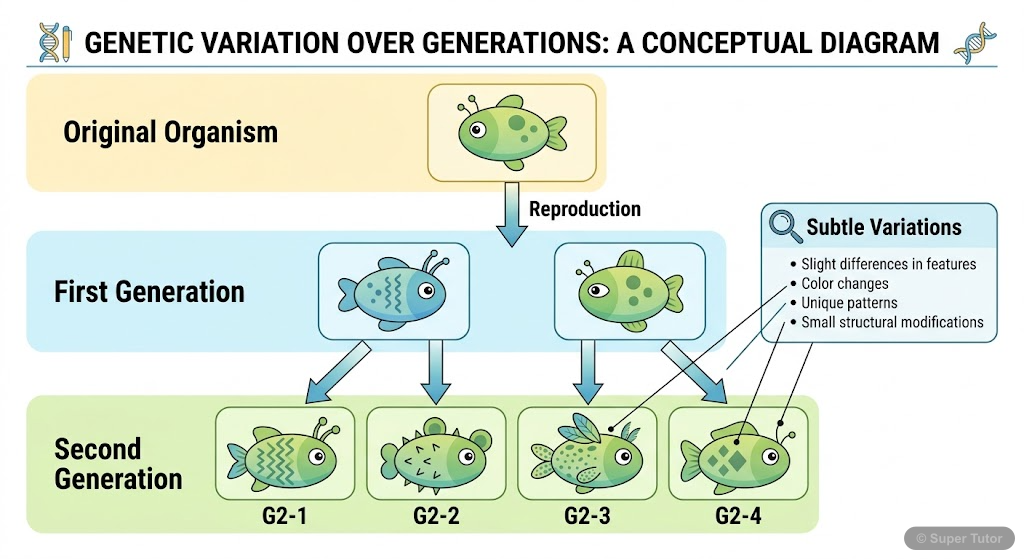
A flowchart illustrating how variations accumulate over successive generations, starting from an original organism and showing subtle differences in offspring through asexual reproduction, leading to
Super Tutor

Learn better with visuals Super Tutor has hundreds of illustrations like this across every chapter — all free to try.

Get started
8 Questions Solved · 2 Sections

QUESTIONS

1How do Mendel's experiments show that traits may be dominant or recessive?Show solution
Given/Concept: Mendel performed monohybrid crosses using contrasting traits in pea plants (e.g., tall vs. short, round seeds vs. wrinkled seeds).

Explanation:

Step 1: Mendel crossed pure-breeding tall plants (TT) with pure-breeding short plants (tt). All plants in the F₁ generation were tall.

TT×ttAll Tt (Tall)TT \times tt \rightarrow \text{All } Tt \text{ (Tall)}

Step 2: When F₁ plants (Tt) were self-pollinated, the F₂ generation showed both tall and short plants in a ratio of approximately 3:1.

Tt×TtTT:Tt:tt=1:2:1Tt \times Tt \rightarrow TT : Tt : tt = 1:2:1
Phenotype ratio=3 Tall:1 Short\text{Phenotype ratio} = 3 \text{ Tall} : 1 \text{ Short}

Step 3: The trait that appeared in F₁ (tallness) and in 3/4 of F₂ plants is called the dominant trait. The trait that disappeared in F₁ but reappeared in 1/4 of F₂ plants (shortness) is called the recessive trait.

Conclusion: Since the recessive trait (shortness) was hidden in F₁ but reappeared in F₂, Mendel concluded that traits can be dominant (expressed even in a single copy) or recessive (expressed only when both copies are identical). This shows that both copies of a gene are present in an organism, but only the dominant one is expressed when both are present together.
2How do Mendel's experiments show that traits are inherited independently?Show solution
Given/Concept: Mendel performed dihybrid crosses to study the inheritance of two traits simultaneously.

Explanation:

Step 1: Mendel crossed pure-breeding round yellow seed plants (RRYY) with pure-breeding wrinkled green seed plants (rryy).

RRYY×rryyAll RrYy (Round Yellow — F1)RRYY \times rryy \rightarrow \text{All } RrYy \text{ (Round Yellow — F}_1\text{)}

Step 2: F₁ plants (RrYy) were self-pollinated to get F₂ generation.

RrYy×RrYyRrYy \times RrYy

Step 3: The F₂ generation showed four phenotypic classes in the ratio:
Round Yellow : Round Green : Wrinkled Yellow : Wrinkled Green=9:3:3:1\text{Round Yellow : Round Green : Wrinkled Yellow : Wrinkled Green} = 9:3:3:1

Step 4: New combinations — Round Green and Wrinkled Yellow — appeared in F₂ that were not present in either parent. This is only possible if the genes for seed shape and seed colour are inherited independently of each other.

Conclusion: If the two traits were linked and always inherited together, only parental combinations (Round Yellow and Wrinkled Green) would appear. The appearance of new combinations in a 9:3:3:1 ratio proves that traits are inherited independently (Law of Independent Assortment).
3A man with blood group A marries a woman with blood group O and their daughter has blood group O. Is this information enough to tell you which of the traits – blood group A or O – is dominant? Why or why not?Show solution
Given:
- Father's blood group = A
- Mother's blood group = O
- Daughter's blood group = O

Analysis:

Step 1: The daughter has blood group O. She received one allele from her father (blood group A) and one from her mother (blood group O).

Step 2: Since the daughter's blood group is O, the allele for blood group O must have been expressed. This means the father must have contributed an allele for O (not A) to the daughter.

Step 3: For the father (blood group A) to pass an O allele to his daughter, his genotype must be heterozygous (IAiI^A i), i.e., he carries one A allele and one O allele. The daughter received the ii (O) allele from the father and ii (O) allele from the mother, making her genotype iiii (blood group O).

Father: IAi×Mother: iiDaughter: ii (Blood group O)\text{Father: } I^A i \times \text{Mother: } ii \rightarrow \text{Daughter: } ii \text{ (Blood group O)}

Step 4: Since the father has blood group A with genotype IAiI^A i, the A allele is expressed even in the presence of the O allele. This means blood group A is dominant over blood group O.

Conclusion: Yes, this information is enough to conclude that blood group A is dominant over blood group O, because the father expresses blood group A despite carrying an O allele, which means A masks O — confirming A is dominant and O is recessive.
4How is the sex of the child determined in human beings?Show solution
Concept: Sex determination in human beings is based on sex chromosomes.

Step 1 — Sex chromosomes in parents:
- Every human has 23 pairs of chromosomes. Of these, 22 pairs are autosomes and 1 pair are sex chromosomes.
- Females have two X chromosomes → genotype XX
- Males have one X and one Y chromosome → genotype XY

Step 2 — Gamete formation:
- The mother (XX) produces eggs, all of which carry one X chromosome.
- The father (XY) produces two types of sperms:
- 50% sperms carry X chromosome
- 50% sperms carry Y chromosome

Step 3 — Fertilisation:
If X sperm + X eggXXGirl\text{If X sperm + X egg} \rightarrow XX \rightarrow \textbf{Girl}
If Y sperm + X eggXYBoy\text{If Y sperm + X egg} \rightarrow XY \rightarrow \textbf{Boy}

Step 4 — Probability:
Since half the sperms carry X and half carry Y, there is a 50% chance of a boy and 50% chance of a girl.

Conclusion: The sex of the child is determined by the type of sperm (carrying X or Y chromosome) that fertilises the egg. The mother always contributes an X chromosome; it is the father's sperm that determines whether the child will be a boy (Y sperm) or a girl (X sperm). Therefore, the father is responsible for determining the sex of the child.

EXERCISES

1A Mendelian experiment consisted of breeding tall pea plants bearing violet flowers with short pea plants bearing white flowers. The progeny all bore violet flowers, but almost half of them were short. This suggests that the genetic make-up of the tall parent can be depicted as
(a) TTWW
(b) TTww
(c) TtWW
(d) TtWw
Show solution
Correct Answer: (c) TtWW

Justification:

Given observations:
- All progeny have violet flowers → violet is dominant (W); the tall parent must be homozygous dominant for flower colour (WW), since crossing with white (ww) gives all violet (Ww).
- Almost half the progeny are short → shortness reappears, meaning the tall parent must be heterozygous for height (Tt), so that crossing Tt × tt gives 1 Tt (tall) : 1 tt (short), i.e., half tall and half short.

Cross verification:
TtWW×ttWwTtWW \times ttWw
- For height: Tt×ttTt:tt=1:1Tt \times tt \rightarrow Tt : tt = 1:1 (half tall, half short ✓)
- For flower colour: WW×wwWW \times ww \rightarrow all WwWw (all violet ✓)

Conclusion: The genetic make-up of the tall parent is TtWW, i.e., option (c).
2A study found that children with light-coloured eyes are likely to have parents with light-coloured eyes. On this basis, can we say anything about whether the light eye colour trait is dominant or recessive? Why or why not?Show solution
Given: Children with light-coloured eyes tend to have parents with light-coloured eyes.

Analysis:

Step 1: If light eye colour were dominant, then a parent with light eyes could be either homozygous (LL) or heterozygous (Ll). A heterozygous parent (Ll) crossed with another light-eyed parent could produce dark-eyed children (ll). But the study says light-eyed parents consistently have light-eyed children.

Step 2: If light eye colour were recessive, then light-eyed parents would be homozygous recessive (ll × ll), and all their children would also be ll (light-eyed). This is consistent with the observation.

Step 3: However, the same observation is also consistent with light eye colour being dominant and homozygous (LL × LL → all LL, all light-eyed).

Conclusion: No, we cannot conclusively determine from this information alone whether light eye colour is dominant or recessive. The observation is consistent with both possibilities:
- Light colour could be recessive (ll parents always give ll children).
- Light colour could be dominant and homozygous (LL parents always give LL children).

To determine dominance, we would need to observe what happens when a light-eyed individual mates with a dark-eyed individual and study the eye colour of the offspring.
3Outline a project which aims to find the dominant coat colour in dogs.Show solution
Project Title: Determining the Dominant Coat Colour in Dogs

Objective: To identify which coat colour (e.g., black or brown/white) is dominant in dogs.

Materials Required: Dogs of two contrasting pure-breeding coat colours (e.g., pure black-coated dogs and pure white-coated dogs), record-keeping tools.

Procedure:

Step 1 — Selection of pure-breeding parents (P generation):
Select pure-breeding dogs of two contrasting coat colours — for example, pure black-coated dogs and pure white-coated dogs. (Pure-breeding can be confirmed by allowing them to breed among themselves for several generations and observing that the coat colour does not change.)

Step 2 — Cross (F₁ generation):
Cross the pure black-coated dogs with pure white-coated dogs.
Black (BB)×White (bb)F1 progeny\text{Black (BB)} \times \text{White (bb)} \rightarrow F_1 \text{ progeny}
Observe and record the coat colour of all F₁ offspring.
- The coat colour that appears in all F₁ offspring is the dominant trait.

Step 3 — Self-cross / Inter-cross of F₁ (F₂ generation):
Allow F₁ dogs to mate among themselves.
F1×F1F2 progenyF_1 \times F_1 \rightarrow F_2 \text{ progeny}
Observe and record the coat colours of F₂ offspring.

Step 4 — Analysis:
- The coat colour appearing in approximately 3/4 of F₂ offspring is the dominant colour.
- The coat colour appearing in approximately 1/4 of F₂ offspring is the recessive colour.
- The recessive colour reappears in F₂ after being absent in F₁.

Expected Result: If black coat appears in all F₁ and in 3:1 ratio in F₂, then black coat colour is dominant and white coat colour is recessive.

Conclusion: By following Mendel's monohybrid cross approach, we can determine the dominant coat colour in dogs.
4How is the equal genetic contribution of male and female parents ensured in the progeny?Show solution
Concept: Equal genetic contribution of both parents is ensured through the process of meiosis (gamete formation) and fertilisation.

Step 1 — Chromosome number in body cells:
Every human body cell (somatic cell) contains 46 chromosomes (23 pairs) — one chromosome of each pair inherited from the mother and one from the father.

Step 2 — Gamete formation (Meiosis):
During the formation of gametes (sperm and egg) by meiosis, the chromosome number is halved.
- Each sperm (from father) contains 23 chromosomes (haploid, nn).
- Each egg/ovum (from mother) contains 23 chromosomes (haploid, nn).

Diploid parent (2n = 46)MeiosisHaploid gamete (n = 23)\text{Diploid parent (2n = 46)} \xrightarrow{\text{Meiosis}} \text{Haploid gamete (n = 23)}

Step 3 — Fertilisation:
During fertilisation, the sperm fuses with the egg:
Sperm (23 chromosomes)+Egg (23 chromosomes)Zygote (46 chromosomes)\text{Sperm (23 chromosomes)} + \text{Egg (23 chromosomes)} \rightarrow \text{Zygote (46 chromosomes)}

Step 4 — Equal contribution:
- The zygote (and hence the child) receives exactly 23 chromosomes from the father (via sperm) and 23 chromosomes from the mother (via egg).
- This means 50% of the genetic material comes from the father and 50% from the mother.

Conclusion: The halving of chromosomes during meiosis (gamete formation) and the subsequent fusion of two haploid gametes during fertilisation ensures that each parent contributes equally (50%) to the genetic make-up of the progeny, maintaining the chromosome number constant across generations.

Stuck on a step?

Ask Super Tutor AI to explain any solution on this page in a simpler way — free, 24x7.

Ask a Doubt Free

Frequently Asked Questions

What are the important topics in Heredity for Jharkhand Board Class 10 Science?
Key topics in Heredity include Heredity Concept Overview, Heredity Chapter Overview, Heredity Concept Overview. These are the concepts Jharkhand Board Class 10 examiners draw on most — study them first, then practise related questions.
How to score full marks in Heredity — Jharkhand Board Class 10 Science?
Understand the core concepts first, then work through the 57 practice questions available for this chapter. Revise formulas and definitions regularly, and use flashcards for quick recall before the exam.
Where can I get free NCERT Solutions for Heredity Class 10 Science?
This page has free step-by-step NCERT Solutions for every exercise question in Heredity (Jharkhand Board Class 10 Science) — written the way examiners award marks: given, formula, working, answer.

Sources & Official References

Content is aligned to the official syllabus. Refer to the board website for the latest curriculum.

For serious students

Get the full Heredity chapter — for free.

Quizzes, flashcards, AI doubt-solver and a step-by-step study plan for Jharkhand Board Class 10 Science.