Chapter 13 of 13
NCERT Solutions

Our Environment

Jharkhand Board · Class 10 · Science

NCERT Solutions for Our Environment — Jharkhand Board Class 10 Science.

55 questions20 flashcards5 concepts

Interactive on Super Tutor

Studying Our Environment? Get the full interactive chapter.

Quizzes, flashcards, AI doubt-solver and a step-by-step study plan — built for ncert solutions and more.

1,000+ Class 10 students started this chapter today

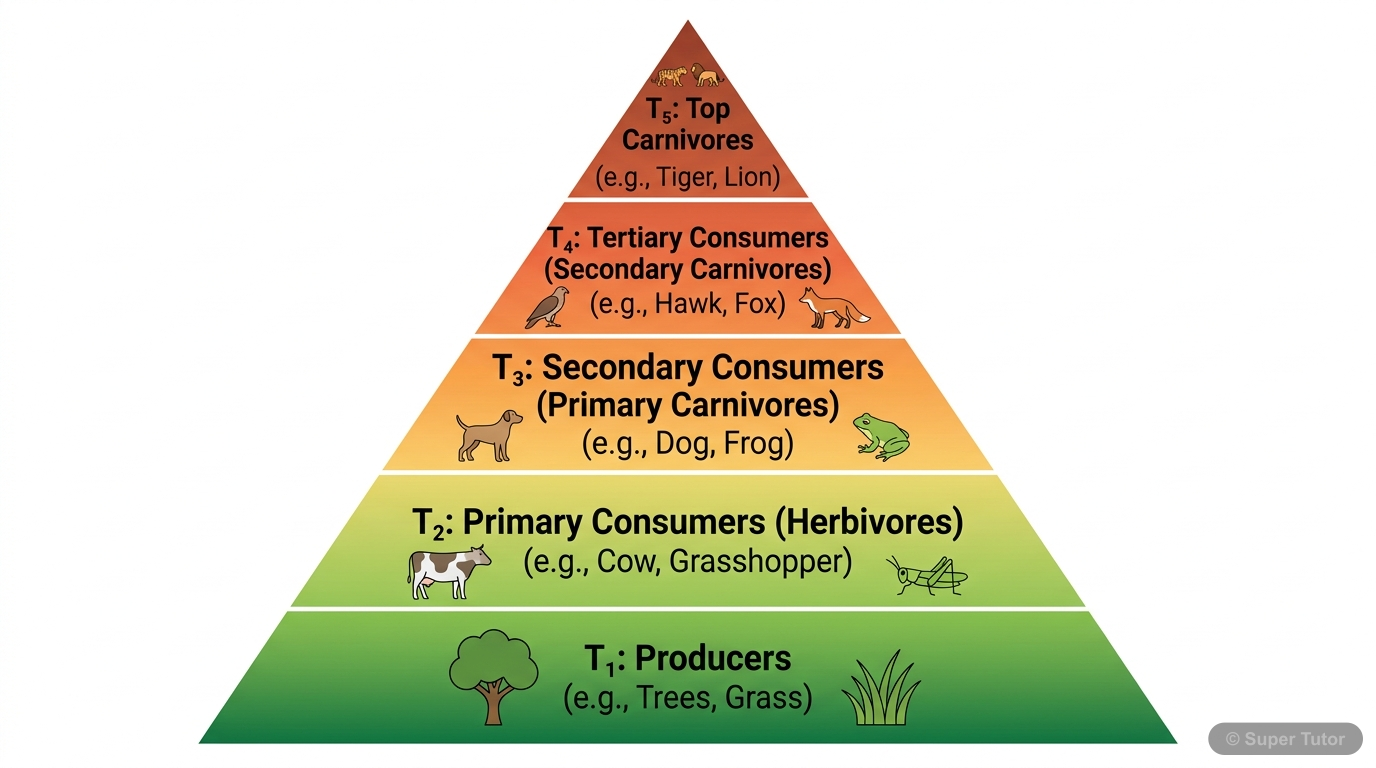
A diagram illustrating different trophic levels (T1, T2, T3, T4, T5) with examples of organisms at each level, often in a pyramid shape to hint at energy/biomass distribution.
Super Tutor

Learn better with visuals Super Tutor has hundreds of illustrations like this across every chapter — all free to try.

Get started
11 Questions Solved · 2 Sections

Intext Questions (Page 216)

1What is ozone and how does it affect any ecosystem?Show solution
Given/Concept: Ozone is a molecule composed of three atoms of oxygen (O₃). It is found mainly in the upper atmosphere (stratosphere) forming the 'ozone layer'.

Formation:
O2UV radiation2O;O+O2O3\text{O}_2 \xrightarrow{\text{UV radiation}} 2\text{O} \quad ; \quad \text{O} + \text{O}_2 \rightarrow \text{O}_3

Effect on the ecosystem:

1. Protective role: The ozone layer acts as a shield and absorbs most of the harmful ultraviolet (UV) radiation coming from the Sun, preventing it from reaching the Earth's surface.

2. If ozone is depleted: Increased UV radiation reaching the Earth can cause:
- Skin cancer and cataracts in humans and animals.
- Damage to phytoplankton and other producers in aquatic ecosystems, disrupting food chains.
- Reduced crop yields, affecting food availability.
- Mutations in organisms, disturbing biodiversity.

Conclusion: Ozone is essential for maintaining life on Earth; its depletion can severely damage every ecosystem.
2How can you help in reducing the problem of waste disposal? Give any two methods.Show solution
Two methods to reduce the problem of waste disposal:

Method 1 – Practice the 3R principle (Reduce, Reuse, Recycle):
- Reduce the amount of waste generated by avoiding unnecessary use of materials (e.g., carry cloth bags instead of plastic bags).
- Reuse items like glass bottles, paper, and containers instead of discarding them.
- Recycle materials such as paper, metal, and glass so they can be made into new products.

Method 2 – Segregate waste at source:
- Separate biodegradable waste (vegetable peels, food scraps) from non-biodegradable waste (plastic, glass, metal) at home.
- Biodegradable waste can be composted to make manure, reducing landfill burden.
- Non-biodegradable waste can be sent for proper recycling or disposal.

Conclusion: By adopting these practices individually, we can significantly reduce the pressure on waste disposal systems and protect the environment.

Exercises

1Which of the following groups contain only biodegradable items?
(a) Grass, flowers and leather
(b) Grass, wood and plastic
(c) Fruit-peels, cake and lime-juice
(d) Cake, wood and grass
Show solution
Correct Answer: (c) Fruit-peels, cake and lime-juice

Justification:
- Biodegradable items are those that can be broken down by microorganisms (bacteria, fungi) into simpler substances.
- Fruit-peels, cake, and lime-juice are all organic materials of biological origin and are completely broken down by decomposers.
- Option (a) contains leather which decomposes very slowly and is often considered non-biodegradable in practical terms; however, the best and most clearly all-biodegradable group is (c).
- Option (b) contains plastic, which is non-biodegradable.
- Option (d): Cake, wood, and grass are all biodegradable — this is also a correct group.

Note: Both (c) and (d) are fully biodegradable. The most commonly accepted answer in NCERT is (d) Cake, wood and grass, as all three are clearly plant/organic-based biodegradable items. However, (c) is equally valid. The standard NCERT answer is (d).
2Which of the following constitute a food-chain?
(a) Grass, wheat and mango
(b) Grass, goat and human
(c) Goat, cow and elephant
(d) Grass, fish and goat
Show solution
Correct Answer: (b) Grass, goat and human

Justification:
A food chain must show a feeding relationship where energy flows from producers to consumers.
- Grass (Producer) → Goat (Primary Consumer) → Human (Secondary Consumer). This is a valid food chain.
- Option (a): Grass, wheat, and mango are all producers — no feeding relationship.
- Option (c): Goat, cow, and elephant are all herbivores (primary consumers) — no sequential feeding.
- Option (d): Grass → Fish → Goat does not represent a natural feeding sequence (goats do not eat fish).
3Which of the following are environment-friendly practices?
(a) Carrying cloth-bags to put purchases in while shopping
(b) Switching off unnecessary lights and fans
(c) Walking to school instead of getting your mother to drop you on her scooter
(d) All of the above
Show solution
Correct Answer: (d) All of the above

Justification:
- (a) Carrying cloth bags reduces the use of plastic bags, which are non-biodegradable and cause serious pollution.
- (b) Switching off unnecessary lights and fans conserves electrical energy, reducing the burning of fossil fuels and lowering carbon emissions.
- (c) Walking instead of using a motor vehicle reduces fuel consumption and decreases air pollution (no exhaust emissions).

All three practices reduce environmental damage, so (d) All of the above is correct.
4What will happen if we kill all the organisms in one trophic level?Show solution
Concept: In a food chain, each trophic level depends on the one below it for energy and controls the population of the one above it.

Effects of removing all organisms from one trophic level:

Case 1 – Removal of Producers (1st trophic level):
- All herbivores (primary consumers) will lose their food source and will die.
- This will cause the collapse of the entire food chain, leading to extinction of all consumers.
- The ecosystem will completely collapse.

Case 2 – Removal of Primary Consumers (Herbivores):
- Producers (plants) will overgrow without being grazed, leading to competition among plants.
- Secondary consumers (carnivores) will lose their food and their population will decline or become extinct.
- The food chain will break down.

Case 3 – Removal of Secondary Consumers (Carnivores):
- Primary consumers (herbivores) will multiply unchecked, leading to overgrazing.
- Producers will be rapidly depleted.
- The ecosystem balance will be disturbed.

Conclusion: Removing all organisms from any trophic level disrupts the balance of the ecosystem, leading to the collapse of food chains and loss of biodiversity.
5Will the impact of removing all the organisms in a trophic level be different for different trophic levels? Can the organisms of any trophic level be removed without causing any damage to the ecosystem?Show solution
Part 1 – Will the impact differ for different trophic levels?

Yes, the impact will be different for different trophic levels.

| Trophic Level Removed | Impact |
|---|---|
| Producers (Plants) | Most severe — entire ecosystem collapses as all consumers lose their energy source. |
| Primary Consumers (Herbivores) | Severe — carnivores lose food; plants overgrow; ecosystem balance lost. |
| Secondary Consumers (Carnivores) | Herbivore population explodes; overgrazing destroys plant life; ecosystem destabilised. |
| Top Carnivores | Relatively less immediate impact, but lower trophic levels become uncontrolled over time. |

The lower the trophic level removed, the greater and more widespread the damage, because more organisms depend on it.

Part 2 – Can any trophic level be removed without damage?

No. No trophic level can be removed without causing damage to the ecosystem. Every organism plays a role in maintaining the balance of the ecosystem. The removal of any trophic level will:
- Disrupt the food chain.
- Cause population imbalances.
- Lead to loss of biodiversity.
- Ultimately destabilise the entire ecosystem.

Conclusion: All trophic levels are interdependent and essential for a stable, functioning ecosystem.
6What is biological magnification? Will the levels of this magnification be different at different levels of the ecosystem?Show solution
Biological Magnification (Biomagnification):

Biological magnification is the progressive increase in the concentration of harmful, non-biodegradable chemicals (such as pesticides like DDT, heavy metals like mercury) in the tissues of organisms at successively higher trophic levels in a food chain.

How it occurs:
- These chemicals are not broken down and are not excreted; they accumulate in fatty tissues.
- Each organism at a higher trophic level consumes many organisms from the level below, so the chemical concentration keeps increasing.

Example:
WaterPhytoplanktonSmall fishLarge fishBird/Human\text{Water} \rightarrow \text{Phytoplankton} \rightarrow \text{Small fish} \rightarrow \text{Large fish} \rightarrow \text{Bird/Human}

If DDT concentration in water = 0.003 ppb, it may reach up to 25 ppm in top predators — an increase of thousands of times.

Will magnification levels differ at different trophic levels?

Yes. The concentration of the harmful chemical:
- Is lowest at the producer level (1st trophic level).
- Increases progressively at each higher trophic level.
- Is highest at the top carnivore level (highest trophic level).

This is because each consumer eats a large number of organisms from the level below, accumulating more and more of the chemical in its body.

Conclusion: Biological magnification increases with each trophic level, making top predators (including humans) most vulnerable to toxic effects.
7What are the problems caused by the non-biodegradable wastes that we generate?Show solution
Non-biodegradable wastes are substances that cannot be broken down by biological processes (e.g., plastics, pesticides, heavy metals, glass, synthetic fibres).

Problems caused:

1. Soil pollution: Plastic and chemical wastes accumulate in soil, reducing its fertility and harming soil organisms.

2. Water pollution: Non-biodegradable chemicals and plastics enter water bodies, making water unfit for drinking and aquatic life.

3. Biological magnification: Pesticides and heavy metals enter food chains and accumulate in increasing concentrations at higher trophic levels, harming animals and humans (e.g., DDT causing reproductive failure in birds).

4. Harm to animals: Animals may accidentally ingest plastic waste, causing internal injuries or death.

5. Clogging of drains: Plastic waste blocks drainage systems, leading to waterlogging and spread of diseases.

6. Air pollution: Burning of non-biodegradable waste (e.g., plastics) releases toxic gases like dioxins and furans.

7. Long-term persistence: These wastes remain in the environment for hundreds of years, causing prolonged damage.

Conclusion: Non-biodegradable wastes pose serious and long-lasting threats to soil, water, air, and all living organisms in the ecosystem.
8If all the waste we generate is biodegradable, will this have no impact on the environment?Show solution
No, even if all waste is biodegradable, it will still have an impact on the environment.

Reasons:

1. Excess waste overwhelms decomposers: If the amount of biodegradable waste is very large, decomposers (bacteria, fungi) cannot break it down fast enough. The waste accumulates and causes pollution.

2. Foul smell and disease: Large quantities of rotting biodegradable waste produce foul odours and become breeding grounds for disease-causing organisms like flies, mosquitoes, and rats, spreading diseases.

3. Water pollution: Biodegradable waste dumped in or near water bodies decomposes and consumes dissolved oxygen (BOD increases), leading to the death of aquatic organisms.

4. Greenhouse gas emission: Decomposition of biodegradable waste produces methane (CH₄) and carbon dioxide (CO₂), which are greenhouse gases contributing to global warming and climate change.

5. Soil and groundwater contamination: Leachate from decomposing waste can seep into the soil and contaminate groundwater.

Conclusion: While biodegradable waste is less harmful than non-biodegradable waste, generating it in large quantities still has significant negative impacts on the environment. Waste minimisation is essential regardless of its nature.
9Why is damage to the ozone layer a cause for concern? What steps are being taken to limit this damage?Show solution
Why is ozone layer damage a cause for concern?

The ozone layer (present in the stratosphere, about 15–35 km above Earth) absorbs most of the harmful ultraviolet (UV) radiation from the Sun. Damage to this layer allows more UV radiation to reach the Earth's surface, causing:

1. In humans:
- Increased risk of skin cancer and sunburn.
- Cataracts and other eye disorders.
- Weakening of the immune system.

2. In plants:
- Reduced photosynthesis and crop yields.
- Damage to plant DNA.

3. In aquatic ecosystems:
- Destruction of phytoplankton (marine producers), disrupting aquatic food chains.

4. General environmental impact:
- Increased UV radiation can cause mutations in organisms.
- Disruption of entire ecosystems and loss of biodiversity.

Cause of ozone depletion:
Chlorofluorocarbons (CFCs) — used in refrigerators, air conditioners, and aerosol sprays — react with ozone molecules and break them down:
CFCUVCl;Cl+O3ClO+O2\text{CFC} \xrightarrow{\text{UV}} \text{Cl}^\bullet \quad ; \quad \text{Cl}^\bullet + \text{O}_3 \rightarrow \text{ClO}^\bullet + \text{O}_2

Steps being taken to limit damage:

1. Montreal Protocol (1987): An international agreement signed by most countries to phase out the production and use of ozone-depleting substances, especially CFCs.

2. Ban on CFCs: Many countries have banned or restricted the use of CFCs in refrigerants, aerosols, and fire extinguishers, replacing them with environment-friendly alternatives (e.g., HFCs, HCFCs).

3. Awareness campaigns: Governments and organisations spread awareness about the harmful effects of ozone depletion and encourage eco-friendly practices.

4. Research and monitoring: Continuous monitoring of the ozone layer (e.g., the Antarctic ozone hole) and research into safer chemical alternatives.

Conclusion: Damage to the ozone layer is a serious global concern because it threatens all life on Earth. International cooperation and individual responsibility are essential to protect and restore the ozone layer.

Stuck on a step?

Ask Super Tutor AI to explain any solution on this page in a simpler way — free, 24x7.

Ask a Doubt Free

Frequently Asked Questions

What are the important topics in Our Environment for Jharkhand Board Class 10 Science?
Key topics in Our Environment include Components of Our Environment, Our Environment - Complete Chapter Overview, Our Environment - Complete Concept Map. These are the concepts Jharkhand Board Class 10 examiners draw on most — study them first, then practise related questions.
How to score full marks in Our Environment — Jharkhand Board Class 10 Science?
Understand the core concepts first, then work through the 55 practice questions available for this chapter. Revise formulas and definitions regularly, and use flashcards for quick recall before the exam.
Where can I get free NCERT Solutions for Our Environment Class 10 Science?
This page has free step-by-step NCERT Solutions for every exercise question in Our Environment (Jharkhand Board Class 10 Science) — written the way examiners award marks: given, formula, working, answer.

Sources & Official References

Content is aligned to the official syllabus. Refer to the board website for the latest curriculum.

For serious students

Get the full Our Environment chapter — for free.

Quizzes, flashcards, AI doubt-solver and a step-by-step study plan for Jharkhand Board Class 10 Science.