Chapter 13 of 14
NCERT Solutions

Alternating Current

Meghalaya Board · Class 12 · Physics

NCERT Solutions for Alternating Current — Meghalaya Board Class 12 Physics.

45 questions22 flashcards5 concepts

Interactive on Super Tutor

Studying Alternating Current? Get the full interactive chapter.

Quizzes, flashcards, AI doubt-solver and a step-by-step study plan — built for ncert solutions and more.

1,000+ Class 12 students started this chapter today

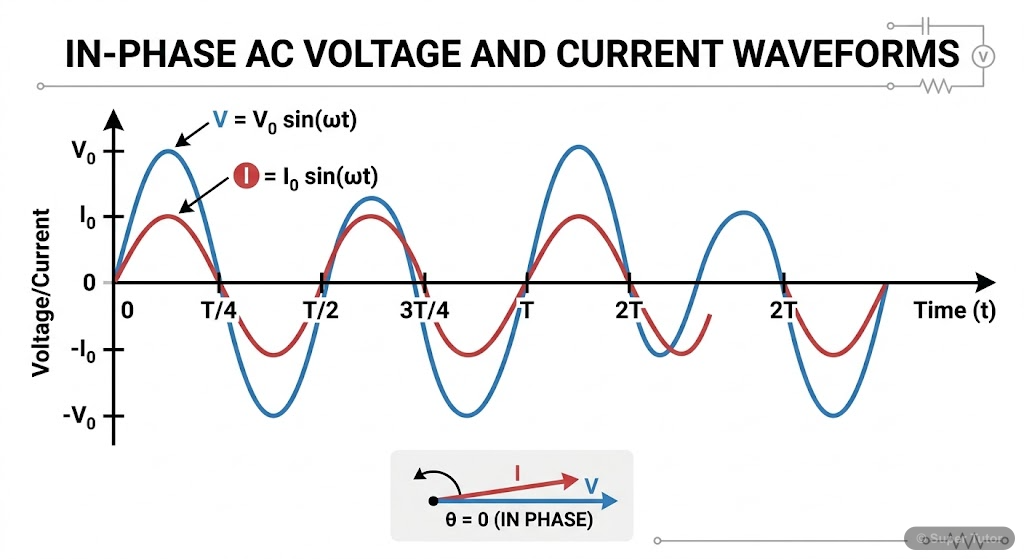
A graph showing the instantaneous voltage and current waveforms in a purely resistive AC circuit, demonstrating that they are in phase with each other.
Super Tutor

Learn better with visuals Super Tutor has hundreds of illustrations like this across every chapter — all free to try.

Get started
8 Questions Solved · 1 Section

EXERCISES

7.1A 100 Ω resistor is connected to a 220 V, 50 Hz ac supply.
(a) What is the rms value of current in the circuit?
(b) What is the net power consumed over a full cycle?
Show solution
Given:
- Resistance, R=100ΩR = 100\,\Omega
- rms voltage, V=220VV = 220\,\text{V}
- Frequency, f=50Hzf = 50\,\text{Hz}

(a) rms value of current:

Using Ohm's law for ac circuits:
I=VR=220100=2.2AI = \frac{V}{R} = \frac{220}{100} = 2.2\,\text{A}

(b) Net power consumed over a full cycle:

For a purely resistive circuit, power factor cosϕ=1\cos\phi = 1.

P=VIcosϕ=VI=220×2.2=484WP = VI\cos\phi = VI = 220 \times 2.2 = 484\,\text{W}

Alternatively, P=I2R=(2.2)2×100=484WP = I^2 R = (2.2)^2 \times 100 = 484\,\text{W}

Answer: (a) I=2.2AI = 2.2\,\text{A}, (b) P=484WP = 484\,\text{W}
7.2(a) The peak voltage of an ac supply is 300 V. What is the rms voltage?
(b) The rms value of current in an ac circuit is 10 A. What is the peak current?
Show solution
(a) rms voltage from peak voltage:

Given: Peak voltage, vm=300Vv_m = 300\,\text{V}

The relation between rms voltage and peak voltage is:
V=vm2=3002=3001.414212.1VV = \frac{v_m}{\sqrt{2}} = \frac{300}{\sqrt{2}} = \frac{300}{1.414} \approx 212.1\,\text{V}

(b) Peak current from rms current:

Given: rms current, I=10AI = 10\,\text{A}

The relation between peak current and rms current is:
im=2I=2×10=14.14Ai_m = \sqrt{2}\, I = \sqrt{2} \times 10 = 14.14\,\text{A}

Answer: (a) V212.1VV \approx 212.1\,\text{V}, (b) im14.14Ai_m \approx 14.14\,\text{A}
7.3A 44 mH inductor is connected to 220 V, 50 Hz ac supply. Determine the rms value of the current in the circuit.Show solution
Given:
- Inductance, L=44mH=44×103HL = 44\,\text{mH} = 44 \times 10^{-3}\,\text{H}
- rms voltage, V=220VV = 220\,\text{V}
- Frequency, f=50Hzf = 50\,\text{Hz}

Step 1: Calculate inductive reactance XLX_L:
XL=ωL=2πfL=2π×50×44×103X_L = \omega L = 2\pi f L = 2\pi \times 50 \times 44 \times 10^{-3}
XL=2×3.14×50×0.044=13.82ΩX_L = 2 \times 3.14 \times 50 \times 0.044 = 13.82\,\Omega

Step 2: Calculate rms current:
I=VXL=22013.8215.92AI = \frac{V}{X_L} = \frac{220}{13.82} \approx 15.92\,\text{A}

Answer: The rms value of current in the circuit is I15.92AI \approx 15.92\,\text{A}.
7.4A 60 μF capacitor is connected to a 110 V, 60 Hz ac supply. Determine the rms value of the current in the circuit.Show solution
Given:
- Capacitance, C=60μF=60×106FC = 60\,\mu\text{F} = 60 \times 10^{-6}\,\text{F}
- rms voltage, V=110VV = 110\,\text{V}
- Frequency, f=60Hzf = 60\,\text{Hz}

Step 1: Calculate capacitive reactance XCX_C:
XC=1ωC=12πfC=12π×60×60×106X_C = \frac{1}{\omega C} = \frac{1}{2\pi f C} = \frac{1}{2\pi \times 60 \times 60 \times 10^{-6}}
XC=12×3.14×60×60×106=10.0226244.2ΩX_C = \frac{1}{2 \times 3.14 \times 60 \times 60 \times 10^{-6}} = \frac{1}{0.02262} \approx 44.2\,\Omega

Step 2: Calculate rms current:
I=VXC=11044.22.49AI = \frac{V}{X_C} = \frac{110}{44.2} \approx 2.49\,\text{A}

Answer: The rms value of current in the circuit is I2.49AI \approx 2.49\,\text{A}.
7.5In Exercises 7.3 and 7.4, what is the net power absorbed by each circuit over a complete cycle. Explain your answer.Show solution
For the inductor circuit (Exercise 7.3):

In a purely inductive circuit, the current lags the voltage by ϕ=π2\phi = \dfrac{\pi}{2}.

P=VIcosϕ=VIcos(π2)=VI×0=0WP = VI\cos\phi = VI\cos\left(\frac{\pi}{2}\right) = VI \times 0 = 0\,\text{W}

For the capacitor circuit (Exercise 7.4):

In a purely capacitive circuit, the current leads the voltage by ϕ=π2\phi = \dfrac{\pi}{2}.

P=VIcosϕ=VIcos(π2)=VI×0=0WP = VI\cos\phi = VI\cos\left(\frac{\pi}{2}\right) = VI \times 0 = 0\,\text{W}

Explanation:

In a pure inductor or pure capacitor, the phase difference between voltage and current is 90°90°. The power factor cosϕ=cos90°=0\cos\phi = \cos 90° = 0. During one half of the cycle, energy is stored in the magnetic field (inductor) or electric field (capacitor), and during the other half, the same energy is returned to the source. Hence, the net power absorbed over a complete cycle is zero in both cases. The current flowing is called wattless current.

Answer: Net power absorbed = 0 W in both circuits.
7.6A charged 30 μF capacitor is connected to a 27 mH inductor. What is the angular frequency of free oscillations of the circuit?Show solution
Given:
- Capacitance, C=30μF=30×106FC = 30\,\mu\text{F} = 30 \times 10^{-6}\,\text{F}
- Inductance, L=27mH=27×103HL = 27\,\text{mH} = 27 \times 10^{-3}\,\text{H}

Formula for angular frequency of free (LC) oscillations:
ω0=1LC\omega_0 = \frac{1}{\sqrt{LC}}

Calculation:
ω0=127×103×30×106\omega_0 = \frac{1}{\sqrt{27 \times 10^{-3} \times 30 \times 10^{-6}}}
=1810×109= \frac{1}{\sqrt{810 \times 10^{-9}}}
=18.1×107= \frac{1}{\sqrt{8.1 \times 10^{-7}}}
=19×104×1= \frac{1}{9 \times 10^{-4} \times \sqrt{1}}

Let us compute: 8.1×107=8.1×103.5=2.846×103.5\sqrt{8.1 \times 10^{-7}} = \sqrt{8.1} \times 10^{-3.5} = 2.846 \times 10^{-3.5}

More carefully:
LC=27×103×30×106=810×109=8.1×10⁷LC = 27 \times 10^{-3} \times 30 \times 10^{-6} = 810 \times 10^{-9} = 8.1 \times 10^{-7}
LC=8.1×107=9×104×19×104(since 8.12.846)\sqrt{LC} = \sqrt{8.1 \times 10^{-7}} = 9 \times 10^{-4} \times \sqrt{1} \approx 9 \times 10^{-4}\,\text{(since }\sqrt{8.1}\approx 2.846\text{)}

Actually: 8.1×107=2.846×103.5\sqrt{8.1 \times 10^{-7}} = 2.846 \times 10^{-3.5}. Let me redo:
8.1×107=8.1×103.5=2.846×3.162×104=8.997×1049×104\sqrt{8.1 \times 10^{-7}} = \sqrt{8.1} \times 10^{-3.5} = 2.846 \times 3.162 \times 10^{-4} = 8.997 \times 10^{-4} \approx 9 \times 10^{-4}

ω0=19×1041.11×103rad/s\omega_0 = \frac{1}{9 \times 10^{-4}} \approx 1.11 \times 10^{3}\,\text{rad/s}

Answer: The angular frequency of free oscillations is ω01.11×10³rad/s\omega_0 \approx 1.11 \times 10^3\,\text{rad/s}.
7.7A series LCR circuit with R = 20 Ω, L = 1.5 H and C = 35 μF is connected to a variable-frequency 200 V ac supply. When the frequency of the supply equals the natural frequency of the circuit, what is the average power transferred to the circuit in one complete cycle?Show solution
Given:
- R=20ΩR = 20\,\Omega
- L=1.5HL = 1.5\,\text{H}
- C=35μF=35×106FC = 35\,\mu\text{F} = 35 \times 10^{-6}\,\text{F}
- rms voltage, V=200VV = 200\,\text{V}
- Condition: supply frequency = natural frequency (resonance)

At resonance:

At resonance, XL=XCX_L = X_C, so they cancel each other. The impedance of the circuit is:
Z=R=20ΩZ = R = 20\,\Omega

The power factor at resonance:
cosϕ=1\cos\phi = 1

rms current at resonance:
I=VZ=VR=20020=10AI = \frac{V}{Z} = \frac{V}{R} = \frac{200}{20} = 10\,\text{A}

Average power transferred:
P=VIcosϕ=200×10×1=2000WP = VI\cos\phi = 200 \times 10 \times 1 = 2000\,\text{W}

Alternatively: P=I2R=(10)2×20=2000WP = I^2 R = (10)^2 \times 20 = 2000\,\text{W}

Answer: The average power transferred to the circuit at resonance is P=2000W=2kWP = 2000\,\text{W} = 2\,\text{kW}.
7.8A series LCR circuit is connected to a variable frequency 230 V source. L = 5.0 H, C = 80 μF, R = 40 Ω.
(a) Determine the source frequency which drives the circuit in resonance.
(b) Obtain the impedance of the circuit and the amplitude of current at the resonating frequency.
(c) Determine the rms potential drops across the three elements of the circuit. Show that the potential drop across the LC combination is zero at the resonating frequency.
Show solution
Given:
- L=5.0HL = 5.0\,\text{H}
- C=80μF=80×106FC = 80\,\mu\text{F} = 80 \times 10^{-6}\,\text{F}
- R=40ΩR = 40\,\Omega
- rms voltage, V=230VV = 230\,\text{V}

---

(a) Resonant frequency:

At resonance: ω0=1LC\omega_0 = \dfrac{1}{\sqrt{LC}}

ω0=15.0×80×106=1400×106=14×104=12×102=50rad/s\omega_0 = \frac{1}{\sqrt{5.0 \times 80 \times 10^{-6}}} = \frac{1}{\sqrt{400 \times 10^{-6}}} = \frac{1}{\sqrt{4 \times 10^{-4}}} = \frac{1}{2 \times 10^{-2}} = 50\,\text{rad/s}

ω0=50rad/s\boxed{\omega_0 = 50\,\text{rad/s}}

---

(b) Impedance and amplitude of current at resonance:

At resonance, XL=XCX_L = X_C, so:
Z=R2+(XCXL)2=R2+0=R=40ΩZ = \sqrt{R^2 + (X_C - X_L)^2} = \sqrt{R^2 + 0} = R = 40\,\Omega

rms current:
I=VZ=23040=5.75AI = \frac{V}{Z} = \frac{230}{40} = 5.75\,\text{A}

Amplitude (peak) of current:
im=2I=2×5.75=8.13Ai_m = \sqrt{2}\,I = \sqrt{2} \times 5.75 = 8.13\,\text{A}

Z=40Ω,im8.13A\boxed{Z = 40\,\Omega, \quad i_m \approx 8.13\,\text{A}}

---

(c) rms potential drops across each element:

Across resistor R:
VR=IR=5.75×40=230VV_R = IR = 5.75 \times 40 = 230\,\text{V}

Inductive reactance at resonance:
XL=ω0L=50×5.0=250ΩX_L = \omega_0 L = 50 \times 5.0 = 250\,\Omega

Across inductor L:
VL=IXL=5.75×250=1437.5VV_L = IX_L = 5.75 \times 250 = 1437.5\,\text{V}

Capacitive reactance at resonance:
XC=1ω0C=150×80×106=14×103=250ΩX_C = \frac{1}{\omega_0 C} = \frac{1}{50 \times 80 \times 10^{-6}} = \frac{1}{4 \times 10^{-3}} = 250\,\Omega

Across capacitor C:
VC=IXC=5.75×250=1437.5VV_C = IX_C = 5.75 \times 250 = 1437.5\,\text{V}

Potential drop across LC combination:

Since VLV_L and VCV_C are equal in magnitude but opposite in phase (they differ by 180°180°):
VLC=VLVC=1437.51437.5=0VV_{LC} = V_L - V_C = 1437.5 - 1437.5 = 0\,\text{V}

This confirms that at resonance (XL=XCX_L = X_C), the net voltage drop across the LC combination is zero, and the entire source voltage appears across the resistor (VR=230V=VV_R = 230\,\text{V} = V).

Answer:
- VR=230VV_R = 230\,\text{V}
- VL=VC1437.5VV_L = V_C \approx 1437.5\,\text{V}
- VLC=0VV_{LC} = 0\,\text{V} at resonance.

Stuck on a step?

Ask Super Tutor AI to explain any solution on this page in a simpler way — free, 24x7.

Ask a Doubt Free

Frequently Asked Questions

What are the important topics in Alternating Current for Meghalaya Board Class 12 Physics?
Alternating Current covers several key topics that are frequently asked in Meghalaya Board Class 12 board exams. Focus on the core concepts listed on this page and practise related questions to build confidence.
How to score full marks in Alternating Current — Meghalaya Board Class 12 Physics?
Understand the core concepts first, then work through the 45 practice questions available for this chapter. Revise formulas and definitions regularly, and use flashcards for quick recall before the exam.
Where can I get free NCERT Solutions for Alternating Current Class 12 Physics?
This page has free step-by-step NCERT Solutions for every exercise question in Alternating Current (Meghalaya Board Class 12 Physics) — written the way examiners award marks: given, formula, working, answer.

Sources & Official References

Content is aligned to the official syllabus. Refer to the board website for the latest curriculum.

For serious students

Get the full Alternating Current chapter — for free.

Quizzes, flashcards, AI doubt-solver and a step-by-step study plan for Meghalaya Board Class 12 Physics.