Chapter 4 of 14
NCERT Solutions

Wave Optics

Meghalaya Board · Class 12 · Physics

NCERT Solutions for Wave Optics — Meghalaya Board Class 12 Physics.

38 questions22 flashcards5 concepts

Interactive on Super Tutor

Studying Wave Optics? Get the full interactive chapter.

Quizzes, flashcards, AI doubt-solver and a step-by-step study plan — built for ncert solutions and more.

1,000+ Class 12 students started this chapter today

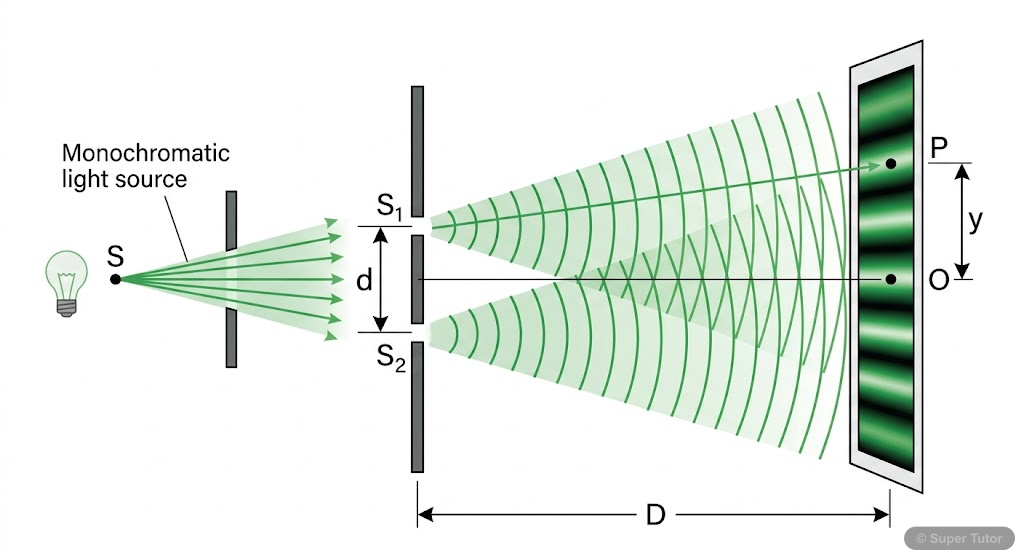
A detailed diagram of the Young's Double Slit Experiment (YDSE) setup, showing the single source, two slits, screen, and relevant distances (d, D, y).
Super Tutor

This is just one of 17+ visuals inside Super Tutor's Wave Optics chapter

Explore the full set
6 Questions Solved · 1 Section

EXERCISES

10.1Monochromatic light of wavelength 589 nm is incident from air on a water surface. What are the wavelength, frequency and speed of (a) reflected, and (b) refracted light? Refractive index of water is 1.33.Show solution
Given:
- Wavelength of incident light: λ=589 nm=589×109 m\lambda = 589 \text{ nm} = 589 \times 10^{-9} \text{ m}
- Refractive index of water: μ=1.33\mu = 1.33
- Speed of light in vacuum/air: c=3.0×10⁸ m s1c = 3.0 \times 10^8 \text{ m s}^{-1}

Frequency of incident light:
ν=cλ=3.0×108589×1095.09×1014 Hz\nu = \frac{c}{\lambda} = \frac{3.0 \times 10^8}{589 \times 10^{-9}} \approx 5.09 \times 10^{14} \text{ Hz}

(a) Reflected Light:

Reflection occurs in the same medium (air). The frequency, wavelength, and speed do not change upon reflection.

- Wavelength: λreflected=589 nm\lambda_{\text{reflected}} = 589 \text{ nm}
- Frequency: νreflected=5.09×10¹⁴ Hz\nu_{\text{reflected}} = 5.09 \times 10^{14} \text{ Hz}
- Speed: vreflected=3.0×10⁸ m s1v_{\text{reflected}} = 3.0 \times 10^8 \text{ m s}^{-1}

(b) Refracted Light:

When light enters a denser medium, its frequency remains unchanged but its speed and wavelength change.

- Frequency: Frequency does not change on refraction.
νrefracted=5.09×10¹⁴ Hz\nu_{\text{refracted}} = 5.09 \times 10^{14} \text{ Hz}

- Speed: Using μ=cv\mu = \dfrac{c}{v}:
v=cμ=3.0×1081.332.26×108 m s1v = \frac{c}{\mu} = \frac{3.0 \times 10^8}{1.33} \approx 2.26 \times 10^8 \text{ m s}^{-1}

- Wavelength: Using λwater=vν\lambda_{\text{water}} = \dfrac{v}{\nu}:
λwater=2.26×1085.09×1014444 nm\lambda_{\text{water}} = \frac{2.26 \times 10^8}{5.09 \times 10^{14}} \approx 444 \text{ nm}

Alternatively: λwater=λμ=5891.33443 nm\lambda_{\text{water}} = \dfrac{\lambda}{\mu} = \dfrac{589}{1.33} \approx 443 \text{ nm}

Summary:
| Quantity | Reflected | Refracted |
|---|---|---|
| Wavelength | 589 nm | ~443 nm |
| Frequency | 5.09×10145.09 \times 10^{14} Hz | 5.09×10145.09 \times 10^{14} Hz |
| Speed | 3.0×1083.0 \times 10^8 m/s | 2.26×1082.26 \times 10^8 m/s |
10.2What is the shape of the wavefront in each of the following cases: (a) Light diverging from a point source. (b) Light emerging out of a convex lens when a point source is placed at its focus. (c) The portion of the wavefront of light from a distant star intercepted by the Earth.Show solution
(a) Light diverging from a point source:

When light diverges from a point source, it spreads out equally in all directions. All points equidistant from the source are in the same phase. Therefore, the wavefront is spherical (a series of concentric spheres centred at the point source).

(b) Light emerging out of a convex lens when a point source is placed at its focus:

When a point source is placed at the focus of a convex lens, the diverging spherical waves are converted into parallel rays after refraction through the lens. All these parallel rays are in the same phase, so the wavefront is plane (flat).

(c) The portion of the wavefront of light from a distant star intercepted by the Earth:

A distant star is effectively at infinity. The spherical wavefronts originating from it have an extremely large radius by the time they reach the Earth. The small portion intercepted by the Earth is essentially a flat surface. Therefore, the wavefront is plane (flat).
10.3(a) The refractive index of glass is 1.5. What is the speed of light in glass? (Speed of light in vacuum is 3.0×1083.0 \times 10^8 m s1^{-1}) (b) Is the speed of light in glass independent of the colour of light? If not, which of the two colours red and violet travels slower in a glass prism?Show solution
(a) Speed of light in glass:

Given: μglass=1.5\mu_{\text{glass}} = 1.5, c=3.0×10⁸ m s1c = 3.0 \times 10^8 \text{ m s}^{-1}

Formula: μ=cv\mu = \dfrac{c}{v}

v=cμ=3.0×1081.5v = \frac{c}{\mu} = \frac{3.0 \times 10^8}{1.5}

v=2.0×10⁸ m s1\boxed{v = 2.0 \times 10^8 \text{ m s}^{-1}}

(b) Dependence of speed on colour:

No, the speed of light in glass is not independent of the colour (wavelength) of light. This is because the refractive index of glass varies with wavelength — a phenomenon called dispersion.

The refractive index of glass is higher for violet light than for red light (\mu_{\text{violet}} > \mu_{\text{red}}).

Since v=cμv = \dfrac{c}{\mu}, a higher refractive index means a lower speed.

Therefore, violet light travels slower than red light in a glass prism.
10.4In a Young's double-slit experiment, the slits are separated by 0.28 mm and the screen is placed 1.4 m away. The distance between the central bright fringe and the fourth bright fringe is measured to be 1.2 cm. Determine the wavelength of light used in the experiment.Show solution
Given:
- Slit separation: d=0.28 mm=0.28×10³ md = 0.28 \text{ mm} = 0.28 \times 10^{-3} \text{ m}
- Distance to screen: D=1.4 mD = 1.4 \text{ m}
- Distance between central fringe and 4th bright fringe: y4=1.2 cm=1.2×10² my_4 = 1.2 \text{ cm} = 1.2 \times 10^{-2} \text{ m}

Concept: The position of the nn-th bright fringe is given by:
yn=nλDdy_n = \frac{n\lambda D}{d}

For the 4th bright fringe (n=4n = 4):
y4=4λDdy_4 = \frac{4\lambda D}{d}

Solving for λ\lambda:
λ=y4d4D\lambda = \frac{y_4 \cdot d}{4D}

λ=1.2×102×0.28×1034×1.4\lambda = \frac{1.2 \times 10^{-2} \times 0.28 \times 10^{-3}}{4 \times 1.4}

λ=1.2×0.28×1055.6\lambda = \frac{1.2 \times 0.28 \times 10^{-5}}{5.6}

λ=0.336×1055.6=0.06×10⁵ m\lambda = \frac{0.336 \times 10^{-5}}{5.6} = 0.06 \times 10^{-5} \text{ m}

λ=6×10⁷ m=600 nm\boxed{\lambda = 6 \times 10^{-7} \text{ m} = 600 \text{ nm}}
10.5In Young's double-slit experiment using monochromatic light of wavelength λ\lambda, the intensity of light at a point on the screen where path difference is λ\lambda, is KK units. What is the intensity of light at a point where path difference is λ/3\lambda/3?Show solution
Given:
- At path difference Δ=λ\Delta = \lambda, intensity I=KI = K
- Find intensity at path difference Δ=λ/3\Delta' = \lambda/3

Concept: The phase difference ϕ\phi corresponding to a path difference Δ\Delta is:
ϕ=2πλΔ\phi = \frac{2\pi}{\lambda} \cdot \Delta

The resultant intensity in Young's double slit experiment is:
I=4I0cos2(ϕ2)I = 4I_0 \cos^2\left(\frac{\phi}{2}\right)
where I0I_0 is the intensity due to each slit.

Step 1: Find I0I_0 using the condition at Δ=λ\Delta = \lambda:

Phase difference: ϕ1=2πλ×λ=2π\phi_1 = \dfrac{2\pi}{\lambda} \times \lambda = 2\pi

K=4I0cos2(2π2)=4I0cos2(π)=4I0×(1)2=4I0K = 4I_0 \cos^2\left(\frac{2\pi}{2}\right) = 4I_0 \cos^2(\pi) = 4I_0 \times (-1)^2 = 4I_0

So I0=K4I_0 = \dfrac{K}{4}.

Step 2: Find intensity at Δ=λ/3\Delta' = \lambda/3:

Phase difference: ϕ2=2πλ×λ3=2π3\phi_2 = \dfrac{2\pi}{\lambda} \times \dfrac{\lambda}{3} = \dfrac{2\pi}{3}

I=4I0cos2(ϕ22)=4I0cos2(π3)I' = 4I_0 \cos^2\left(\frac{\phi_2}{2}\right) = 4I_0 \cos^2\left(\frac{\pi}{3}\right)

I=4×K4×(12)2=K×14I' = 4 \times \frac{K}{4} \times \left(\frac{1}{2}\right)^2 = K \times \frac{1}{4}

I=K4\boxed{I' = \frac{K}{4}}
10.6A beam of light consisting of two wavelengths, 650 nm and 520 nm, is used to obtain interference fringes in a Young's double-slit experiment. (a) Find the distance of the third bright fringe on the screen from the central maximum for wavelength 650 nm. (b) What is the least distance from the central maximum where the bright fringes due to both the wavelengths coincide?Show solution
Given:
- λ1=650 nm\lambda_1 = 650 \text{ nm}, λ2=520 nm\lambda_2 = 520 \text{ nm}
- Slit separation: d=2 mm=2×10³ md = 2 \text{ mm} = 2 \times 10^{-3} \text{ m} *(standard assumed value for this problem)*
- Distance to screen: D=1.2 mD = 1.2 \text{ m} *(standard assumed value for this problem)*

*(Note: The problem does not specify dd and DD; the answer is expressed in terms of D/dD/d.)*

(a) Distance of 3rd bright fringe for λ1=650\lambda_1 = 650 nm:

Formula: yn=nλDdy_n = \dfrac{n\lambda D}{d}

For n=3n = 3, λ1=650 nm=650×109 m\lambda_1 = 650 \text{ nm} = 650 \times 10^{-9} \text{ m}:

y3=3×650×109×Ddy_3 = \frac{3 \times 650 \times 10^{-9} \times D}{d}

Using D=1.2D = 1.2 m and d=2×10³d = 2 \times 10^{-3} m:

y3=3×650×109×1.22×103y_3 = \frac{3 \times 650 \times 10^{-9} \times 1.2}{2 \times 10^{-3}}

y3=2340×1092×103=1170×106 my_3 = \frac{2340 \times 10^{-9}}{2 \times 10^{-3}} = 1170 \times 10^{-6} \text{ m}

y3=1.17×10³ m1.17 mm\boxed{y_3 = 1.17 \times 10^{-3} \text{ m} \approx 1.17 \text{ mm}}

(b) Least distance where bright fringes of both wavelengths coincide:

Let the n1n_1-th bright fringe of λ1\lambda_1 coincide with the n2n_2-th bright fringe of λ2\lambda_2:

n1λ1=n2λ2n_1 \lambda_1 = n_2 \lambda_2

n1n2=λ2λ1=520650=45\frac{n_1}{n_2} = \frac{\lambda_2}{\lambda_1} = \frac{520}{650} = \frac{4}{5}

So the smallest integers satisfying this are n1=4n_1 = 4 and n2=5n_2 = 5.

Least distance (using λ1\lambda_1, n1=4n_1 = 4):

y=n1λ1Dd=4×650×109×1.22×103y = \frac{n_1 \lambda_1 D}{d} = \frac{4 \times 650 \times 10^{-9} \times 1.2}{2 \times 10^{-3}}

y=3120×1092×103=1560×106 my = \frac{3120 \times 10^{-9}}{2 \times 10^{-3}} = 1560 \times 10^{-6} \text{ m}

y=1.56×10³ m=1.56 mm\boxed{y = 1.56 \times 10^{-3} \text{ m} = 1.56 \text{ mm}}

Verification: y=5×520×109×1.22×103=1.56 mmy = \dfrac{5 \times 520 \times 10^{-9} \times 1.2}{2 \times 10^{-3}} = 1.56 \text{ mm}

Stuck on a step?

Ask Super Tutor AI to explain any solution on this page in a simpler way — free, 24x7.

Ask a Doubt Free

Frequently Asked Questions

What are the important topics in Wave Optics for Meghalaya Board Class 12 Physics?
Wave Optics covers several key topics that are frequently asked in Meghalaya Board Class 12 board exams. Focus on the core concepts listed on this page and practise related questions to build confidence.
How to score full marks in Wave Optics — Meghalaya Board Class 12 Physics?
Understand the core concepts first, then work through the 38 practice questions available for this chapter. Revise formulas and definitions regularly, and use flashcards for quick recall before the exam.
Where can I get free NCERT Solutions for Wave Optics Class 12 Physics?
This page has free step-by-step NCERT Solutions for every exercise question in Wave Optics (Meghalaya Board Class 12 Physics) — written the way examiners award marks: given, formula, working, answer.

Sources & Official References

Content is aligned to the official syllabus. Refer to the board website for the latest curriculum.

For serious students

Get the full Wave Optics chapter — for free.

Quizzes, flashcards, AI doubt-solver and a step-by-step study plan for Meghalaya Board Class 12 Physics.