Electromagnetic Induction — NCERT Solutions
Meghalaya Board · Class 12 · Physics
NCERT Solutions for Electromagnetic Induction, Meghalaya Board Class 12 Physics: 8 textbook questions solved step by step. Covers Exercises.
Interactive on Super Tutor
Studying Electromagnetic Induction? Get the full interactive chapter.
Quizzes, flashcards, AI doubt-solver and a step-by-step study plan — built for NCERT solutions and more.
Free trial, no card needed.
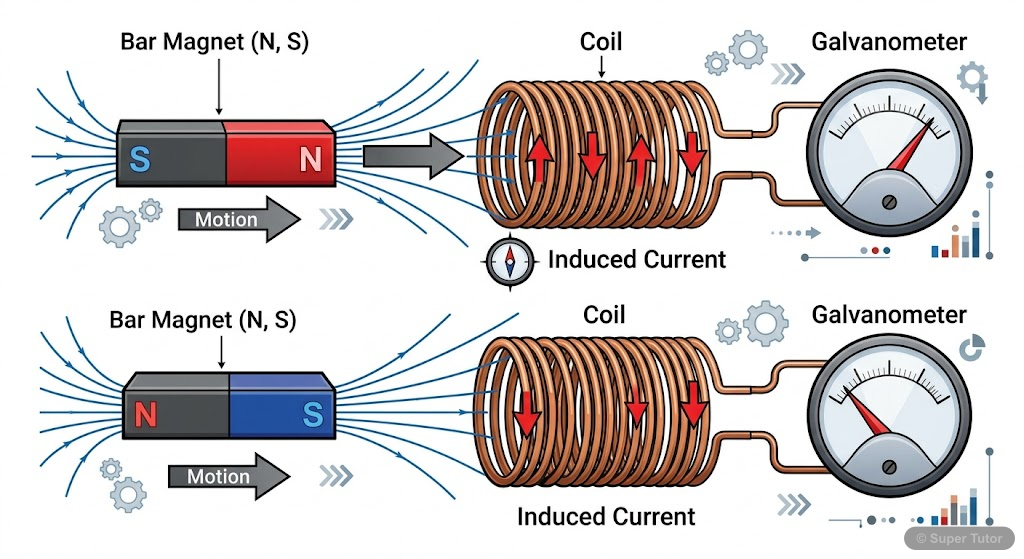
Learn better with visuals Super Tutor pairs illustrations like this with notes and quizzes for Electromagnetic Induction.
The first 4 solutions are open to read. The other 4 are free with a Super Tutor account.
Exercises
6.1Predict the direction of induced current in the situations described by the following Figs. 6.15(a) to (f).Show solution
Since the figures cannot be seen directly, the standard NCERT descriptions and answers for each part are given below, based on the well-known content of these figures.
Concept used: Lenz's Law — the induced current opposes the change in magnetic flux through the loop.
(a) A coil is moved towards a bar magnet (North pole facing the coil).
- The flux through the coil increases as it moves towards the magnet.
- To oppose the increase, the induced current must create a magnetic field opposing the magnet's field (i.e., facing the magnet with a North pole).
- Direction: The induced current flows in the coil in the anti-clockwise direction when viewed from the magnet side (i.e., along qrpq in the coil).
(b) A coil is moved away from a bar magnet (South pole facing the coil).
- The flux through the coil decreases as it moves away.
- To oppose the decrease, the induced current must attract the magnet, so it creates a South pole facing the magnet.
- Direction: The induced current flows clockwise when viewed from the magnet side (i.e., along prqp).
(c) A wire loop is placed near a solenoid carrying increasing current.
- The magnetic flux through the loop due to the solenoid increases.
- By Lenz's law, the induced current opposes the increase.
- Direction: The induced current in the loop flows in the anti-clockwise direction (as viewed from the solenoid end), i.e., along yzxy.
(d) A wire loop is placed near a solenoid carrying decreasing current.
- The magnetic flux through the loop decreases.
- By Lenz's law, the induced current opposes the decrease.
- Direction: The induced current flows clockwise (as viewed from the solenoid end), i.e., along zyxz (opposite to case (c)).
(e) A rectangular loop is moved into a region of uniform magnetic field directed into the page.
- As the loop enters the field region, the flux through it increases (into the page).
- By Lenz's law, the induced current must create flux out of the page inside the loop.
- Direction: The induced current flows anti-clockwise, i.e., along adcba.
(f) Two circular loops — current in the outer loop is increased.
- The increasing current in the outer loop increases the flux through the inner loop.
- By Lenz's law, the induced current in the inner loop opposes this increase.
- Direction: The induced current in the inner loop flows in the clockwise direction (opposite to the current in the outer loop).
6.2Use Lenz's law to determine the direction of induced current in the situations described by Fig. 6.16:
(a) A wire of irregular shape turning into a circular shape;
(b) A circular loop being deformed into a narrow straight wire.Show solution
Concept used: Lenz's Law — the induced current opposes the change in magnetic flux. A circular loop encloses the maximum area for a given perimeter, while a straight wire encloses zero area.
(a) Wire of irregular shape turning into a circular shape:
Given: A wire loop of irregular shape is deformed into a circular shape in a uniform magnetic field directed into the page (inward).
- A circle encloses the maximum area for a given perimeter.
- As the wire turns circular, the area enclosed increases, so the magnetic flux through the loop increases (into the page).
- By Lenz's law, the induced current must oppose this increase, i.e., it must create a magnetic field out of the page inside the loop.
- Using the right-hand rule, the current must flow anti-clockwise.
(b) Circular loop being deformed into a narrow straight wire:
Given: A circular loop is deformed into a narrow straight wire in a uniform magnetic field directed into the page.
- As the loop is deformed into a straight wire, the area enclosed decreases towards zero, so the magnetic flux decreases.
- By Lenz's law, the induced current must oppose this decrease, i.e., it must create a magnetic field into the page inside the loop.
- Using the right-hand rule, the current must flow clockwise.
6.3A long solenoid with 15 turns per cm has a small loop of area placed inside the solenoid normal to its axis. If the current carried by the solenoid changes steadily from 2.0 A to 4.0 A in 0.1 s, what is the induced emf in the loop while the current is changing?Show solution
Given:
- Number of turns per unit length of solenoid:
- Area of small loop:
- Change in current:
- Time interval:
Concept/Formula used:
The magnetic field inside a solenoid is:
The flux through the small loop placed inside the solenoid (normal to axis):
By Faraday's law, the induced emf:
Calculation:
The induced emf in the loop is approximately (or ).
6.4A rectangular wire loop of sides 8 cm and 2 cm with a small cut is moving out of a region of uniform magnetic field of magnitude 0.3 T directed normal to the loop. What is the emf developed across the cut if the velocity of the loop is in a direction normal to the (a) longer side, (b) shorter side of the loop? For how long does the induced voltage last in each case?Show solution
Given:
- Sides of rectangular loop: ,
- Magnetic field: (normal to loop)
- Velocity:
Concept/Formula used:
Motional emf: , where is the length of the side cutting through the field boundary.
(a) Velocity normal to the longer side (8 cm side):
The side of the loop cutting through the field boundary is the longer side ().
Duration: The loop must travel a distance equal to the shorter side () to completely exit the field.
(b) Velocity normal to the shorter side (2 cm side):
The side of the loop cutting through the field boundary is the shorter side ().
Duration: The loop must travel a distance equal to the longer side () to completely exit the field.
Free with a Super Tutor account
(a) What is the instantaneous value of the emf induced in the wire?
(b) What is the direction of the emf?
(c) Which end of the wire is at the higher electrical potential?
Free with a Super Tutor account
Free with a Super Tutor account
Free with a Super Tutor account
4 more solved questions in Electromagnetic Induction
They are free with a Super Tutor account, along with practice quizzes and flashcards for this chapter. Free to start, no card needed.
Frequently Asked Questions
What are the important topics in Electromagnetic Induction for Meghalaya Board Class 12 Physics?
Are these NCERT Solutions for Electromagnetic Induction free?
How should I revise Electromagnetic Induction for the Meghalaya Board Class 12 board exam?
Sources & Official References
Content is aligned to the official syllabus. Refer to the board website for the latest curriculum.
More resources for Electromagnetic Induction
Practice Quiz
Test yourself with a quick quiz
Important Questions
Exam-style questions with answers
Revision Notes
Key points for last-minute revision
Formula Sheet
The chapter's formulas in one place
Chapter Summary
Understand the chapter at a glance
Concept Maps
See how topics connect
Study Plan
Step-by-step plan for this chapter
Flashcards
Quick-fire cards for active recall
Syllabus
What topics to cover
For serious students
Get the full Electromagnetic Induction chapter — start free.
Quizzes, flashcards, an AI doubt solver and a study plan for Meghalaya Board Class 12 Physics. Free to start, no card needed.