Surface Areas and Volumes — Chapter Summary
Madhya Pradesh Board · Class 10 · Mathematics
Summary of Surface Areas and Volumes for Madhya Pradesh Board Class 10 Mathematics. Part of the Madhya Pradesh Board Class 10 Mathematics syllabus.
Interactive on Super Tutor
Studying Surface Areas and Volumes? Get the full interactive chapter.
Quizzes, flashcards, AI doubt-solver and a step-by-step study plan — built for chapter summary and more.
Free trial, no card needed.
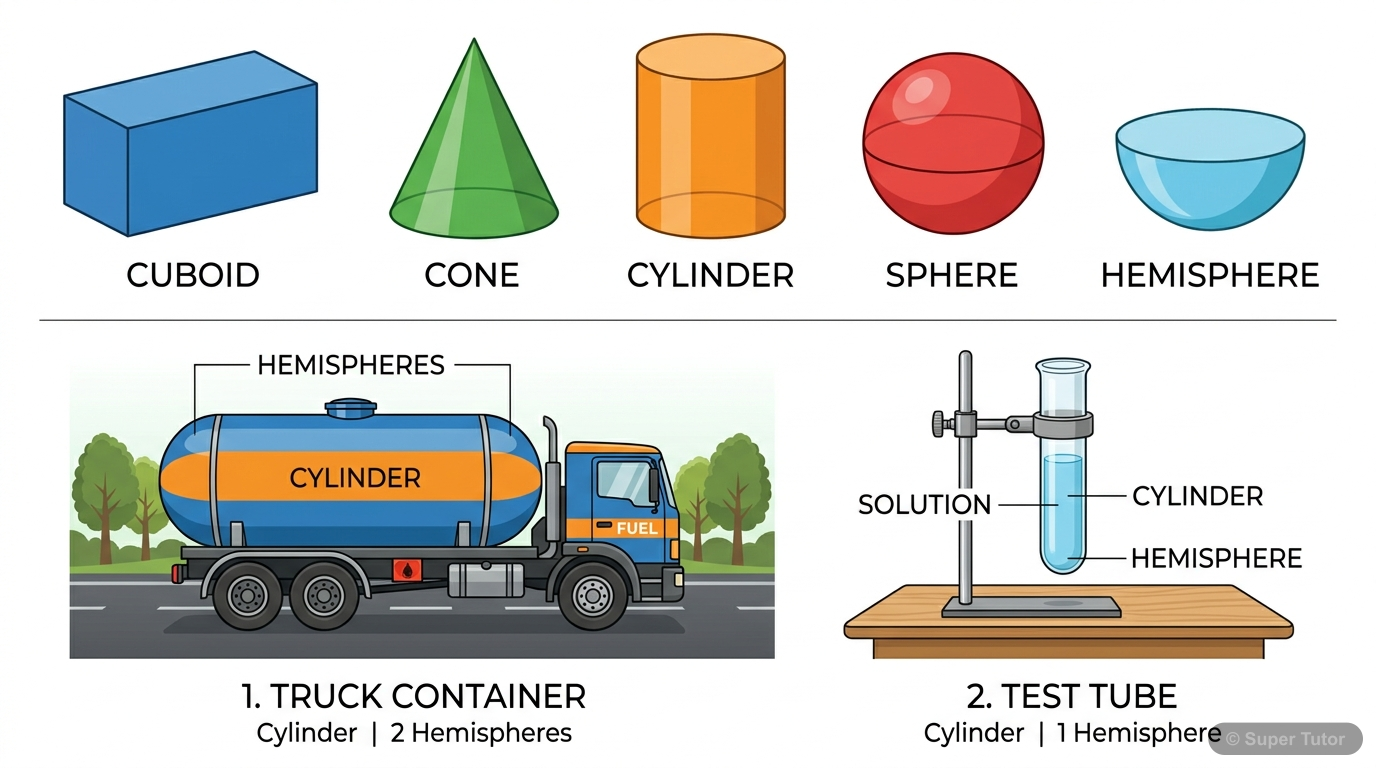
One of 3 illustrations for Surface Areas and Volumes in Super Tutor — alongside flashcards, concept maps and practice questions.
Overview
Basic solids familiar from Class IX are cuboid, cone, cylinder, and sphere. Many real objects are combinations of these solids. Surface area and volume of such objects are found by breaking them into simpler parts and applying the correct formula to each part. TSA means Total Surface Area and CSA me
Key Concepts
The curved surface area of
The curved surface area of a hemisphere is half of the surface area of a sphere, so it is 2πr².
When solids are joined
When solids are joined, only the exposed parts are counted. The joined flat faces are not included in total surface area.
For a toy formed by
For a toy formed by a cone and a hemisphere joined at their flat faces, total surface area = CSA of hemisphere + CSA of cone.
For a cube with a hemisphere
For a cube with a hemisphere fixed on top, the surface area of the block = TSA of cube – base area of hemisphere + CSA of hemisphere.
A cone mounted on a cylinder
A cone mounted on a cylinder may have a ring-shaped part of the cone base exposed when the cone base is larger than the cylinder base.
Learning Objectives
- Identify common solids formed by combining basic solids
- Find surface area of combined solids by excluding hidden or joined parts
- Apply formulas for curved surface area and total surface area of hemisphere, cone, cylinder, cube, and cuboid
- Calculate surface areas of objects such as tops, blocks, rockets, and bird-baths
- Calculate volumes of combined solids such as sheds, glasses, and toys
Frequently Asked Questions
What are the important topics in Surface Areas and Volumes for Madhya Pradesh Board Class 10 Mathematics?
How should I revise Surface Areas and Volumes for the Madhya Pradesh Board Class 10 board exam?
Sources & Official References
Content is aligned to the official syllabus. Refer to the board website for the latest curriculum.
More resources for Surface Areas and Volumes
Practice Quiz
Test yourself with a quick quiz
Important Questions
Exam-style questions with answers
Revision Notes
Key points for last-minute revision
Formula Sheet
The chapter's formulas in one place
Concept Maps
See how topics connect
Study Plan
Step-by-step plan for this chapter
Flashcards
Quick-fire cards for active recall
Syllabus
What topics to cover
NCERT Solutions
Every textbook question solved step by step
For serious students
Get the full Surface Areas and Volumes chapter — start free.
Quizzes, flashcards, an AI doubt solver and a study plan for Madhya Pradesh Board Class 10 Mathematics. Free to start, no card needed.