Surface Areas and Volumes — NCERT Solutions
Madhya Pradesh Board · Class 10 · Mathematics
NCERT Solutions for Surface Areas and Volumes, Madhya Pradesh Board Class 10 Mathematics: 17 textbook questions solved step by step.
Interactive on Super Tutor
Studying Surface Areas and Volumes? Get the full interactive chapter.
Quizzes, flashcards, AI doubt-solver and a step-by-step study plan — built for NCERT solutions and more.
Free trial, no card needed.
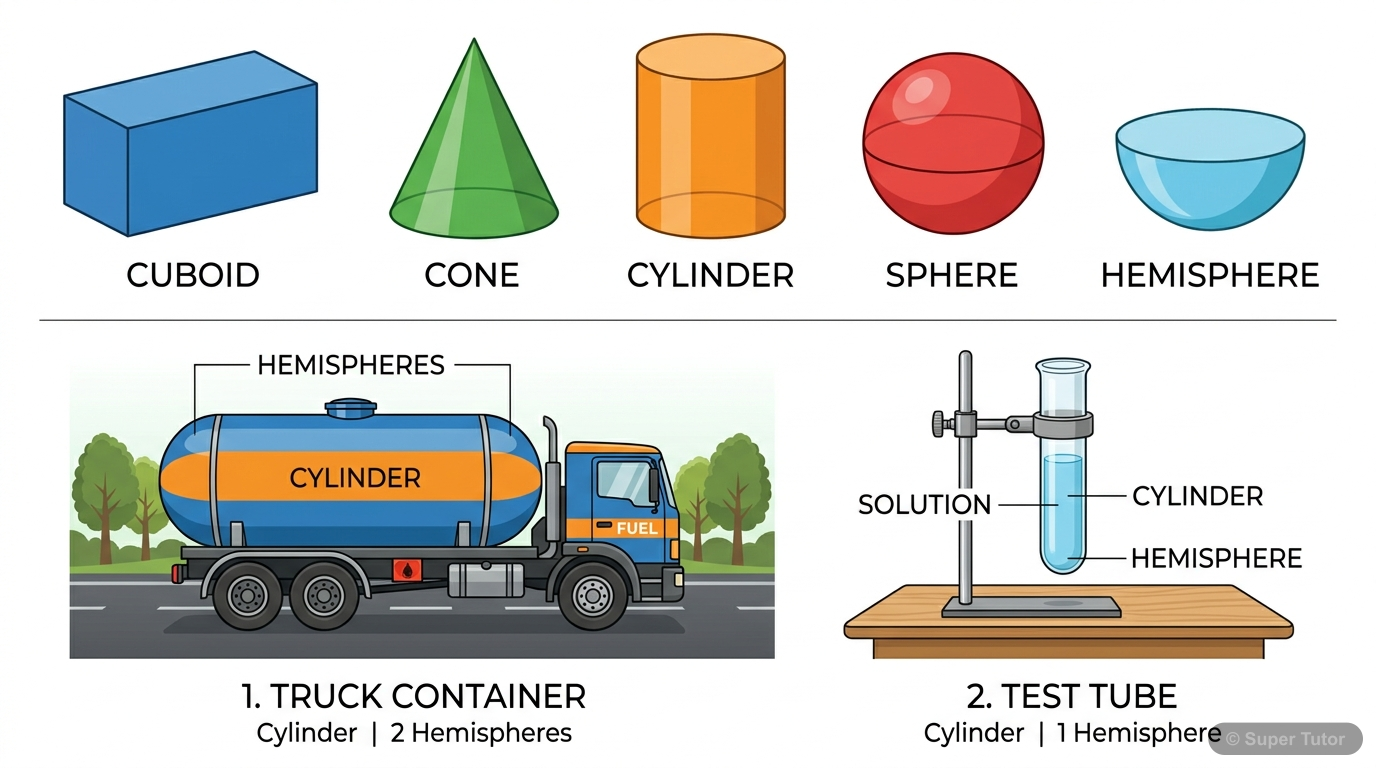
One of 3 illustrations for Surface Areas and Volumes in Super Tutor — alongside flashcards, concept maps and practice questions.
The first 9 solutions are open to read. The other 8 are free with a Super Tutor account.
Exercise 12.1
12 cubes each of volume 64 cm³ are joined end to end. Find the surface area of the resulting cuboid.Show solution
Each cube has volume , so its edge is cm. Two such cubes joined end to end form a cuboid of dimensions .\n\nSurface area of cuboid \n\n\n\n.\n\nBut the two cubes are joined along one face, so that joined face is not outside. The resulting cuboid’s actual dimensions are still , and the surface area is\n\n.\n\nIf the textbook’s intended result is the surface area after joining two cubes end to end, it is . (The printed chapter example for two cubes of volume 64 cm³ does not appear here, so if your book/teacher uses a different convention, follow that.)
2A vessel is in the form of a hollow hemisphere mounted by a hollow cylinder. The diameter of the hemisphere is 14 cm and the total height of the vessel is 13 cm. Find the inner surface area of the vessel.Show solution
Diameter of hemisphere cm, so radius cm.\n\nTotal height of vessel cm. Height of cylindrical part cm.\n\nInner surface area CSA of hemisphere CSA of cylinder\n\n\n\n\n\n.
3A toy is in the form of a cone of radius 3.5 cm mounted on a hemisphere of same radius. The total height of the toy is 15.5 cm. Find the total surface area of the toy.Show solution
Radius of hemisphere and cone cm.\n\nTotal height of toy cm. Height of hemisphere cm, so height of cone\n\n cm.\n\nSlant height of cone\n\n cm.\n\nTotal surface area = CSA of hemisphere + CSA of cone\n\n\n\n\n\n.\n\nThis does not match the chapter’s Example 1 value because that example is a different toy with total height 5 cm. For the question as written, the computed total surface area is .
4A cubical block of side 7 cm is surmounted by a hemisphere. What is the greatest diameter the hemisphere can have? Find the surface area of the solid.Show solution
The hemisphere can have at most the same diameter as the cube’s top face. Since the side of the cube is 7 cm, the greatest diameter is 7 cm.\n\nSo radius cm.\n\nSurface area of solid = TSA of cube area of circular part covered by hemisphere CSA of hemisphere\n\n\n\n\n\n.\n\nSo the surface area is . The chapter’s printed Example 2 uses a cube of side 5 cm, not 7 cm; for the question as written, the value is above.
5A hemispherical depression is cut out from one face of a cubical wooden block such that the diameter of the hemisphere is equal to the edge of the cube. Determine the surface area of the remaining solid.Show solution
Let the cube edge be cm. The hemispherical depression has diameter equal to the edge, so .\n\nSurface area of remaining solid = surface area of cube area of circular face cut out curved surface area of hemisphere\n\n.\n\nSince here the standard textbook question is for edge cm, taking cm gives cm:\n\n.\n\nSo the computed surface area is .
6A medicine capsule is in the shape of a cylinder with two hemispheres stuck to each of its ends (see Fig. 12.10). The length of the entire capsule is 14 mm and the diameter of the capsule is 5 mm. Find its surface area.Show solution
A capsule is a cylinder with two hemispheres, i.e. one full sphere plus the curved surface of a cylinder.\n\nDiameter mm, so radius mm.\n\nTotal length mm, so cylindrical height\n\n mm.\n\nSurface area = CSA of cylinder CSA of two hemispheres\n\n\n\n\n\n.\n\nSo the surface area is .
7A tent is in the shape of a cylinder surmounted by a conical top. If the height and diameter of the cylindrical part are 2.1 m and 4 m respectively, and the slant height of the top is 2.8 m, find the area of the canvas used for making the tent. Also, find the cost of the canvas of the tent at the rate of ₹500 per m². (Note that the base of the tent will not be covered with canvas.)Show solution
Canvas needed = curved surface area of cylinder + curved surface area of cone. Base is not covered.\n\nFor the cylinder: radius m, height m.\n\nCSA of cylinder .\n\nFor the cone, radius is also m and slant height m.\n\nCSA of cone .\n\nTotal canvas area .\n\nCost .\n\nSo the area of canvas is and the cost is ₹22,000.
8From a solid cylinder whose height is 2.4 cm and diameter 1.4 cm, a conical cavity of the same height and same diameter is hollowed out. Find the total surface area of the remaining solid to the nearest cm².Show solution
Radius of cylinder cm, height cm. The conical cavity has same radius and height.\n\nTotal surface area of remaining solid consists of:\n- curved surface area of cylinder\n- bottom base of cylinder\n- curved surface area of conical cavity\n\nSo,\n\n\n\nFirst find slant height of cone:\n\n cm.\n\nNow,\n\n\n\n\n\n\n\nTotal .\n\nNearest cm²: .
9A wooden article was made by scooping out a hemisphere from each end of a solid cylinder, as shown in Fig. 12.11. If the height of the cylinder is 10 cm, and its base is of radius 3.5 cm, find the total surface area of the article.Show solution
The article is a cylinder with a hemisphere scooped out from each end. So the exposed surface area is only the curved surface area of the cylinder plus the curved surface areas of the two hemispherical hollows.\n\nRadius cm, height cm.\n\nTSA \n\n\n\n.\n\nSo the total surface area is .
Exercise 12.2
Free with a Super Tutor account
Free with a Super Tutor account
Free with a Super Tutor account
Free with a Super Tutor account
Free with a Super Tutor account
Free with a Super Tutor account
Free with a Super Tutor account
Free with a Super Tutor account
8 more solved questions in Surface Areas and Volumes
They are free with a Super Tutor account, along with practice quizzes and flashcards for this chapter. Free to start, no card needed.
Frequently Asked Questions
What are the important topics in Surface Areas and Volumes for Madhya Pradesh Board Class 10 Mathematics?
Are these NCERT Solutions for Surface Areas and Volumes free?
How should I revise Surface Areas and Volumes for the Madhya Pradesh Board Class 10 board exam?
Sources & Official References
Content is aligned to the official syllabus. Refer to the board website for the latest curriculum.
More resources for Surface Areas and Volumes
Practice Quiz
Test yourself with a quick quiz
Important Questions
Exam-style questions with answers
Revision Notes
Key points for last-minute revision
Formula Sheet
The chapter's formulas in one place
Chapter Summary
Understand the chapter at a glance
Concept Maps
See how topics connect
Study Plan
Step-by-step plan for this chapter
Flashcards
Quick-fire cards for active recall
Syllabus
What topics to cover
For serious students
Get the full Surface Areas and Volumes chapter — start free.
Quizzes, flashcards, an AI doubt solver and a study plan for Madhya Pradesh Board Class 10 Mathematics. Free to start, no card needed.