Carbon and its Compounds — Flashcards
Madhya Pradesh Board · Class 10 · Science
74 flashcards for Carbon and its Compounds (Madhya Pradesh Board Class 10 Science) to test yourself on key terms and facts.
Interactive on Super Tutor
Studying Carbon and its Compounds? Get the full interactive chapter.
Quizzes, flashcards, AI doubt-solver and a step-by-step study plan — built for flashcards and more.
Free trial, no card needed.
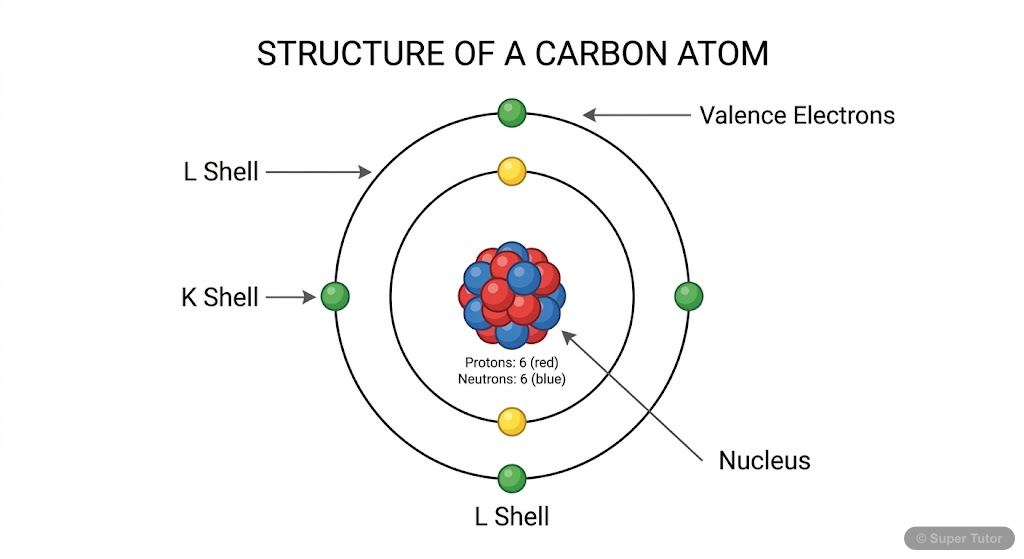
One of 22 illustrations for Carbon and its Compounds in Super Tutor — alongside flashcards, concept maps and practice questions.
What is the atomic number of carbon and why is it important in bonding?
Answer
The atomic number of carbon is 6. Carbon has four valence electrons, so it needs four more electrons to attain noble gas configuration. This makes carbon tetravalent and able to form many covalent bon…
कार्बन का परमाणु संख्या क्या है और यह बंधन में क्यों महत्वपूर्ण है?
Answer
कार्बन का परमाणु क्रमांक 6 है। कार्बन में चार संयोजी इलेक्ट्रान होते हैं, इसलिए इसे अक्रिय गैस विन्यास प्राप्त करने के लिए चार और इलेक्ट्रान की आवश्यकता होती है। यह कार्बन को चतुःसंयोजी बनाता है और कई…
Why does carbon usually form covalent bonds instead of ions?
Answer
Carbon would need to gain four electrons or lose four electrons to become stable. Gaining four electrons is difficult because the nucleus cannot hold on to ten electrons easily, and losing four electr…
कार्बन आम तौर पर आयनों के बजाय सहसंयोजक बंध क्यों बनाता है?
Answer
कार्बन को स्थिर होने के लिए चार इलेक्ट्रॉनों को प्राप्त करने या चार इलेक्ट्रॉनों को खोने की आवश्यकता होगी। चार इलेक्ट्रॉनों को प्राप्त करना मुश्किल है क्योंकि नाभिक आसानी से दस इलेक्ट्रॉनों को नहीं पक…
Why is carbon able to form so many compounds?
Answer
Carbon forms many compounds because of tetravalency and catenation. It can bond with four atoms, and it can also bond with other carbon atoms to form long chains, branched chains, and rings.
कार्बन इतने सारे यौगिक बनाने में क्यों सक्षम है?
Answer
कार्बन चतुःसंयोजकता और श्रृंखलाबद्धता के कारण कई यौगिक बनाता है। यह चार परमाणुओं के साथ बंध बना सकता है और अन्य कार्बन परमाणुओं के साथ बंध बनाकर लंबी श्रृंखला, शाखित श्रृंखला और वलय भी बना सकता है।…
What is catenation?
Answer
Catenation is the ability of an element to form bonds with its own atoms. Carbon shows catenation strongly and forms long stable chains and rings.
श्रृंखलाकरण क्या है?
Answer
समबंधन (Catenation) किसी तत्व की अपने ही परमाणुओं के साथ बंध बनाने की क्षमता है। कार्बन में समबंधन प्रबलता से दिखता है और यह लम्बी स्थिर श्रृंखलाओं और वलयों का निर्माण करता है।…
+66 more flashcards
Practise AllFrequently Asked Questions
What are the important topics in Carbon and its Compounds for Madhya Pradesh Board Class 10 Science?
How many flashcards are available for Carbon and its Compounds?
How should I revise Carbon and its Compounds for the Madhya Pradesh Board Class 10 board exam?
Sources & Official References
Content is aligned to the official syllabus. Refer to the board website for the latest curriculum.
More resources for Carbon and its Compounds
Practice Quiz
Test yourself with a quick quiz
Important Questions
Exam-style questions with answers
Revision Notes
Key points for last-minute revision
Formula Sheet
The chapter's formulas in one place
Chapter Summary
Understand the chapter at a glance
Concept Maps
See how topics connect
Study Plan
Step-by-step plan for this chapter
Syllabus
What topics to cover
NCERT Solutions
Every textbook question solved step by step
For serious students
Get the full Carbon and its Compounds chapter — start free.
Quizzes, flashcards, an AI doubt solver and a study plan for Madhya Pradesh Board Class 10 Science. Free to start, no card needed.