Carbon and its Compounds — NCERT Solutions
Madhya Pradesh Board · Class 10 · Science
NCERT Solutions for Carbon and its Compounds, Madhya Pradesh Board Class 10 Science: 23 textbook questions solved step by step.
Interactive on Super Tutor
Studying Carbon and its Compounds? Get the full interactive chapter.
Quizzes, flashcards, AI doubt-solver and a step-by-step study plan — built for NCERT solutions and more.
Free trial, no card needed.
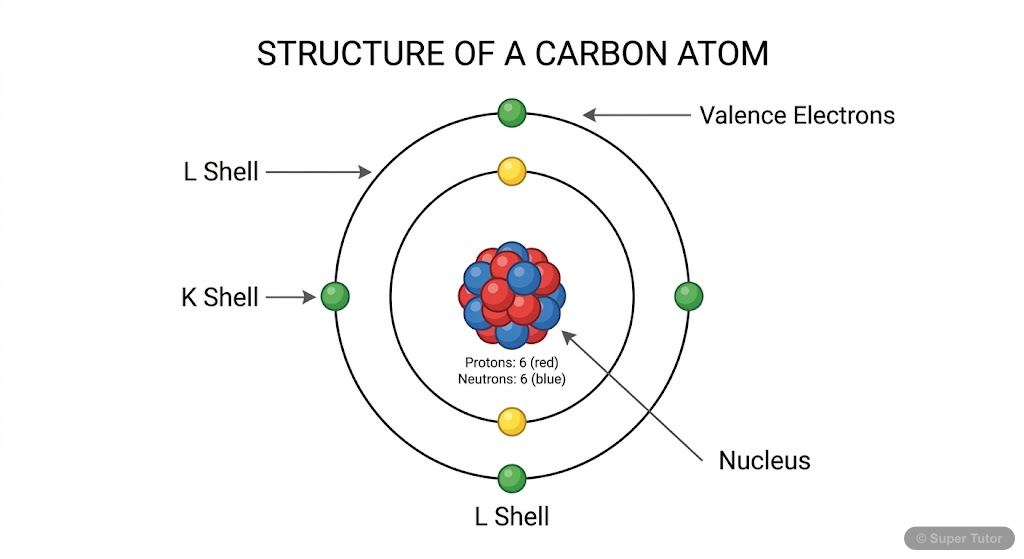
One of 22 illustrations for Carbon and its Compounds in Super Tutor — alongside flashcards, concept maps and practice questions.
The first 12 solutions are open to read. The other 11 are free with a Super Tutor account.
Questions
1What would be the electron dot structure of carbon dioxide which has the formula CO₂?Show solution
In carbon dioxide, carbon has valency 4 and each oxygen has valency 2. So the carbon atom shares two electron pairs with each oxygen atom. Therefore the structure is O=C=O, with two double bonds.
2What would be the electron dot structure of a molecule of sulphur which is made up of eight atoms of sulphur? (Hint – The eight atoms of sulphur are joined together in the form of a ring.)Show solution
The hint says the eight sulphur atoms are joined in the form of a ring. So the electron dot structure is the S₈ ring, where each sulphur atom is bonded to its two neighbouring sulphur atoms by single covalent bonds.
Questions
1How many structural isomers can you draw for pentane?Show solution
Pentane, , has two structural isomers as shown for the carbon skeletons of butane-like branching in the chapter's idea of structural isomerism.
2What are the two properties of carbon which lead to the huge number of carbon compounds we see around us?Show solution
The huge number of carbon compounds is due to two properties of carbon: tetravalency and catenation. Carbon forms four covalent bonds and can bond with other carbon atoms to form long chains, branched chains and rings.
Questions
2A mixture of oxygen and ethyne is burnt for welding. Can you tell why a mixture of ethyne and air is not used?Show solution
A mixture of oxygen and ethyne is used for welding because it burns with a very hot flame. A mixture of ethyne and air is not used because air does not supply enough oxygen for complete combustion, so the flame is not hot enough for welding.
Questions
1How would you distinguish experimentally between an alcohol and a carboxylic acid?Show solution
An alcohol and a carboxylic acid can be distinguished by simple tests:
- Litmus test: Carboxylic acids turn blue litmus red, while alcohols do not affect litmus.
- With sodium carbonate / sodium hydrogencarbonate: Carboxylic acids react to give carbon dioxide gas with effervescence, but alcohols do not.
- Smell: Many alcohols have a characteristic smell, while ethanoic acid has a sour vinegar-like smell.
So, the best chemical test is to add sodium carbonate or sodium hydrogencarbonate; only the carboxylic acid will produce carbon dioxide.
Intext Questions (Page 76–77)
1Would you be able to check if water is hard by using a detergent?Show solution
Given: Detergents are sodium salts of sulphonic acids or ammonium salts whose charged ends do not form insoluble precipitates with calcium and magnesium ions present in hard water.
Concept: Hard water contains dissolved calcium and magnesium salts. Soap forms a curdy white precipitate (scum) with hard water, but detergents do not.
Answer: No, we cannot check whether water is hard by using a detergent. This is because detergents work equally well in both hard water and soft water — they do not form an insoluble precipitate (scum) with the calcium and magnesium ions present in hard water. Therefore, detergents cannot be used to distinguish hard water from soft water. Soap, on the other hand, forms a white curdy precipitate with hard water and can be used to test for hardness.
2People use a variety of methods to wash clothes. Usually after adding the soap, they 'beat' the clothes on a stone, or beat it with a paddle, scrub with a brush or the mixture is agitated in a washing machine. Why is agitation necessary to get clean clothes?Show solution
Given: Soap molecules have a hydrophilic (water-loving) head and a hydrophobic (water-repelling/oil-loving) tail.
Concept: Cleaning action of soap — micelle formation.
Explanation:
- When soap is added to dirty clothes, the hydrophobic tails of soap molecules attach themselves to the oily/greasy dirt on the cloth fibres, while the hydrophilic heads remain directed towards the water.
- This arrangement forms clusters called micelles, with the dirt trapped inside.
- However, for the micelles to be pulled away from the surface of the cloth and dispersed into the water, mechanical energy (agitation) is required.
- Beating, scrubbing, or agitation in a washing machine provides this mechanical energy, which helps dislodge the dirt-containing micelles from the cloth surface and keeps them suspended in water.
- The dirty water is then rinsed away, leaving the clothes clean.
Conclusion: Agitation is necessary because it provides the mechanical energy needed to dislodge the micelles (containing trapped dirt) from the cloth fibres and disperse them into the water, resulting in clean clothes.
Exercises
1Ethane, with the molecular formula has
(a) 6 covalent bonds.
(b) 7 covalent bonds.
(c) 8 covalent bonds.
(d) 9 covalent bonds.Show solution
Correct option: (b) 7 covalent bonds.
Note: The question states but the answer options and context indicate it refers to Ethane, .
Justification: In ethane (), the structure is .
- There is 1 C–C bond.
- Each carbon is bonded to 3 hydrogen atoms, giving C–H bonds.
- Total covalent bonds .
2Butanone is a four-carbon compound with the functional group
(a) carboxylic acid.
(b) aldehyde.
(c) ketone.
(d) alcohol.Show solution
Correct option: (c) ketone.
Justification: Butanone () contains the carbonyl group () flanked by two carbon atoms (not at the terminal position), which is the characteristic functional group of a ketone. Its IUPAC name itself ends in '-one', confirming it is a ketone.
3While cooking, if the bottom of the vessel is getting blackened on the outside, it means that
(a) the food is not cooked completely.
(b) the fuel is not burning completely.
(c) the fuel is wet.
(d) the fuel is burning completely.Show solution
Correct option: (b) the fuel is not burning completely.
Justification: When a fuel burns completely, it produces carbon dioxide () and water (), giving a clean blue flame. When the fuel does not burn completely due to insufficient supply of oxygen, it produces carbon (soot/black carbon particles) along with carbon monoxide. This unburnt carbon deposits as black soot on the bottom of the vessel, blackening it.
4Explain the nature of the covalent bond using the bond formation in .Show solution
Given: Molecule — Chloromethane ().
Nature of Covalent Bond: A covalent bond is formed by the mutual sharing of one or more pairs of electrons between two atoms so that each atom achieves a stable, completely filled outermost (valence) shell (usually 8 electrons — octet, or 2 electrons for hydrogen — duplet).
Bond formation in :
- Carbon (C) has atomic number 6; electronic configuration: 2, 4. It has 4 valence electrons and needs 4 more to complete its octet.
- Hydrogen (H) has 1 valence electron and needs 1 more to complete its duplet.
- Chlorine (Cl) has atomic number 17; electronic configuration: 2, 8, 7. It has 7 valence electrons and needs 1 more to complete its octet.
In :
- Carbon shares one electron each with three hydrogen atoms, forming three C–H covalent bonds. Each hydrogen now has 2 electrons (duplet complete).
- Carbon shares one electron with one chlorine atom, forming one C–Cl covalent bond. Chlorine now has 8 electrons (octet complete).
- Carbon has shared 4 electrons (one with each of 3 H and one with Cl), so it now has electrons in its valence shell (octet complete).
Electron dot structure:
More clearly:
All four bonds in are single covalent bonds formed by sharing of one pair of electrons between the bonded atoms. Since the electrons are shared (not transferred), the bond is covalent in nature.
(a) ethanoic acid.
(b) .
(c) propanone.
(d) .
Free with a Super Tutor account
Free with a Super Tutor account
Free with a Super Tutor account
Free with a Super Tutor account
Free with a Super Tutor account
Free with a Super Tutor account
Free with a Super Tutor account
Free with a Super Tutor account
Free with a Super Tutor account
Free with a Super Tutor account
Free with a Super Tutor account
11 more solved questions in Carbon and its Compounds
They are free with a Super Tutor account, along with practice quizzes and flashcards for this chapter. Free to start, no card needed.
Frequently Asked Questions
What are the important topics in Carbon and its Compounds for Madhya Pradesh Board Class 10 Science?
Are these NCERT Solutions for Carbon and its Compounds free?
How should I revise Carbon and its Compounds for the Madhya Pradesh Board Class 10 board exam?
Sources & Official References
Content is aligned to the official syllabus. Refer to the board website for the latest curriculum.
More resources for Carbon and its Compounds
Practice Quiz
Test yourself with a quick quiz
Important Questions
Exam-style questions with answers
Revision Notes
Key points for last-minute revision
Formula Sheet
The chapter's formulas in one place
Chapter Summary
Understand the chapter at a glance
Concept Maps
See how topics connect
Study Plan
Step-by-step plan for this chapter
Flashcards
Quick-fire cards for active recall
Syllabus
What topics to cover
For serious students
Get the full Carbon and its Compounds chapter — start free.
Quizzes, flashcards, an AI doubt solver and a study plan for Madhya Pradesh Board Class 10 Science. Free to start, no card needed.