Carbon and its Compounds — Revision Notes
Madhya Pradesh Board · Class 10 · Science
Carbon and its Compounds revision notes for Madhya Pradesh Board Class 10 Science: 4 topics in quick points. Includes Carbon: Basic Features and Bonding.
Interactive on Super Tutor
Studying Carbon and its Compounds? Get the full interactive chapter.
Quizzes, flashcards, AI doubt-solver and a step-by-step study plan — built for revision notes and more.
Free trial, no card needed.
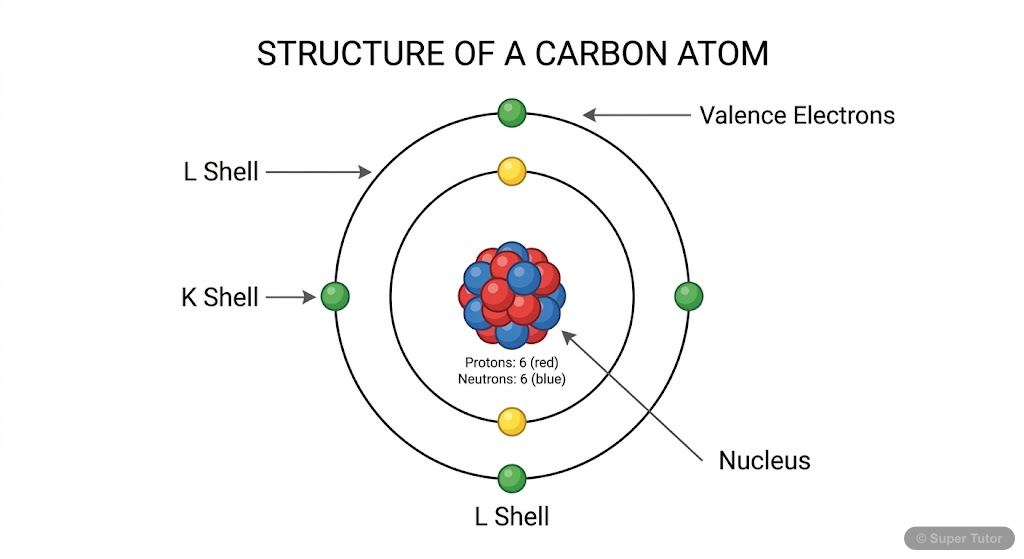
One of 22 illustrations for Carbon and its Compounds in Super Tutor — alongside flashcards, concept maps and practice questions.
Key Topics to Revise
1. Carbon: Basic Features and Bonding
- The atomic number of carbon is 6.
- Carbon has four valence electrons and needs four more or less to attain noble gas configuration.
- Carbon does not usually form ions because gaining or losing four electrons requires too much energy.
2. Allotropes of Carbon
- Carbon occurs in different forms called allotropes.
- Diamond, graphite, and fullerene are allotropes of carbon.
- Diamond has each carbon atom bonded to four other carbon atoms forming a rigid three-dimensional structure.
3. Hydrocarbons and Their Types
- Hydrocarbons contain only carbon and hydrogen.
- Hydrocarbons are classified as alkanes, alkenes, and alkynes.
- Saturated hydrocarbons have only single bonds between carbon atoms.
4. Combustion and Oxidation of Carbon Compounds
- Carbon burns in oxygen to produce carbon dioxide, heat, and light.
- Methane and ethanol also burn to give carbon dioxide, water, heat, and light.
- Saturated hydrocarbons generally burn with a clean flame.
Get complete notes with diagrams and examples
Full NotesKey Concepts
Frequently Asked Questions
What are the important topics in Carbon and its Compounds for Madhya Pradesh Board Class 10 Science?
How should I revise Carbon and its Compounds for the Madhya Pradesh Board Class 10 board exam?
Sources & Official References
Content is aligned to the official syllabus. Refer to the board website for the latest curriculum.
More resources for Carbon and its Compounds
Practice Quiz
Test yourself with a quick quiz
Important Questions
Exam-style questions with answers
Formula Sheet
The chapter's formulas in one place
Chapter Summary
Understand the chapter at a glance
Concept Maps
See how topics connect
Study Plan
Step-by-step plan for this chapter
Flashcards
Quick-fire cards for active recall
Syllabus
What topics to cover
NCERT Solutions
Every textbook question solved step by step
For serious students
Get the full Carbon and its Compounds chapter — start free.
Quizzes, flashcards, an AI doubt solver and a study plan for Madhya Pradesh Board Class 10 Science. Free to start, no card needed.