Market Equilibrium — Revision Notes
Madhya Pradesh Board · Class 12 · Economics
Market Equilibrium revision notes for Madhya Pradesh Board Class 12 Economics: 4 topics in quick points. Includes Core idea of market equilibrium, Example.
Interactive on Super Tutor
Studying Market Equilibrium? Get the full interactive chapter.
Quizzes, flashcards, AI doubt-solver and a step-by-step study plan — built for revision notes and more.
Free trial, no card needed.
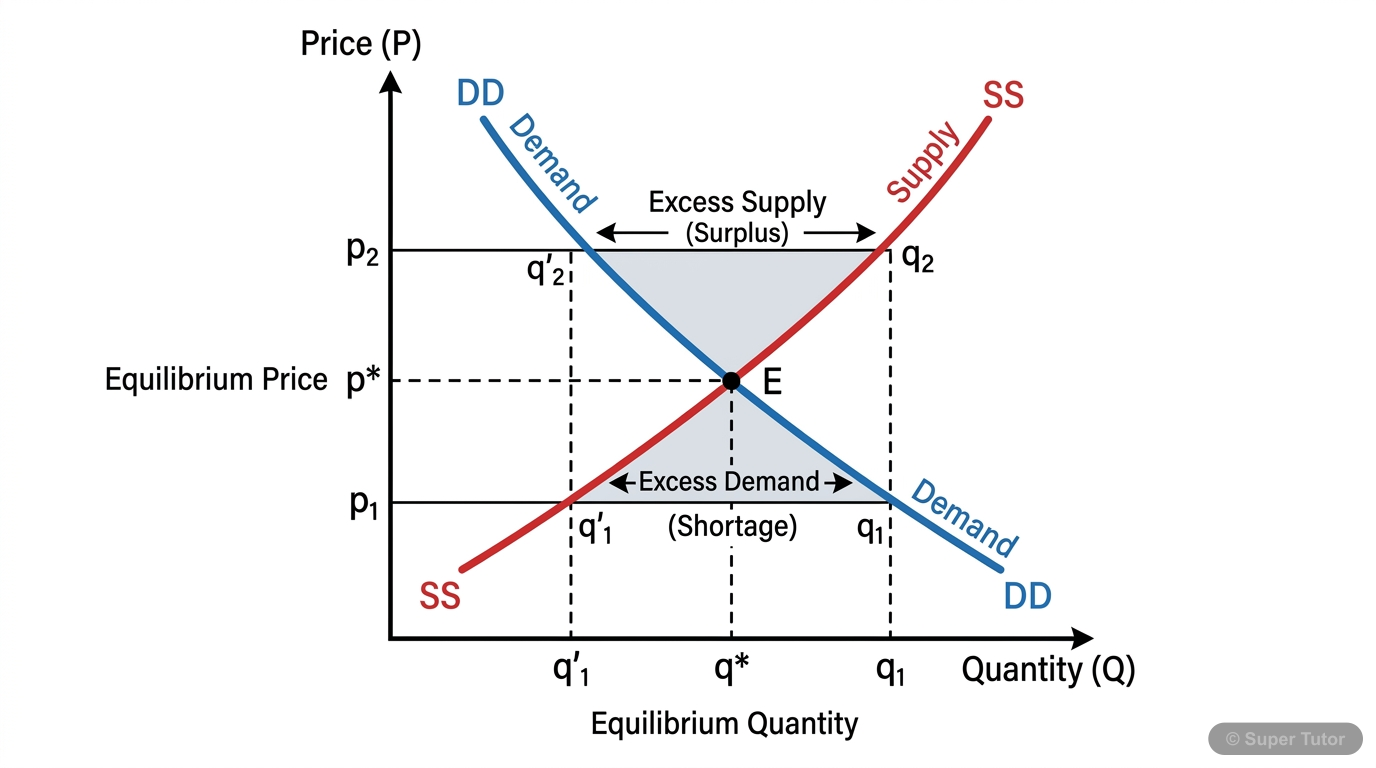
One of 11 illustrations for Market Equilibrium in Super Tutor — alongside flashcards, concept maps and practice questions.
Key Topics to Revise
1. Core idea of market equilibrium
- Equilibrium is a zero excess demand-zero excess supply situation.
- An equilibrium is a situation where the plans of all consumers and firms in the market match and the market clears.
- Market demand curve shows the quantity all consumers together wish to buy at different prices, taking price as given.
2. Example 5.1: Wheat market with fixed number of firms
- In Example 5.1, market demand is q^D = 200 - p for 0 <= p <= 200 and q^D = 0 for p > 200.
- In Example 5.1, market supply is q^S = 120 + p for p >= 10 and q^S = 0 for 0 <= p < 10.
- The equilibrium price of wheat is Rs 40 per kg.
3. Labour market and wage determination
- In the labour market, households supply labour and firms demand labour, opposite to the goods market.
- Labour here means hours of work provided by labourers, not the number of labourers.
- The wage rate is determined where market labour demand and market labour supply intersect.
4. Shifts in demand and supply
- A rightward demand shift with unchanged supply raises both equilibrium price and quantity when the number of firms is fixed.
- A leftward demand shift with unchanged supply lowers both equilibrium price and quantity when the number of firms is fixed.
- An increase in consumer income increases demand for a normal good such as clothes, causing a rightward shift in demand and no change in supply.
Get complete notes with diagrams and examples
Full NotesKey Concepts
Frequently Asked Questions
What are the important topics in Market Equilibrium for Madhya Pradesh Board Class 12 Economics?
How should I revise Market Equilibrium for the Madhya Pradesh Board Class 12 board exam?
Sources & Official References
Content is aligned to the official syllabus. Refer to the board website for the latest curriculum.
More resources for Market Equilibrium
Practice Quiz
Test yourself with a quick quiz
Important Questions
Exam-style questions with answers
Formula Sheet
The chapter's formulas in one place
Chapter Summary
Understand the chapter at a glance
Concept Maps
See how topics connect
Study Plan
Step-by-step plan for this chapter
Flashcards
Quick-fire cards for active recall
Syllabus
What topics to cover
NCERT Solutions
Every textbook question solved step by step
For serious students
Get the full Market Equilibrium chapter — start free.
Quizzes, flashcards, an AI doubt solver and a study plan for Madhya Pradesh Board Class 12 Economics. Free to start, no card needed.