Open Economy Macroeconomics (Part 2) — Syllabus
Madhya Pradesh Board · Class 12 · Economics
What Open Economy Macroeconomics (Part 2) covers in Madhya Pradesh Board Class 12 Economics: 4 topics, for the 2026-27 session.
Interactive on Super Tutor
Studying Open Economy Macroeconomics? Get the full interactive chapter.
Quizzes, flashcards, AI doubt-solver and a step-by-step study plan — built for syllabus and more.
Free trial, no card needed.
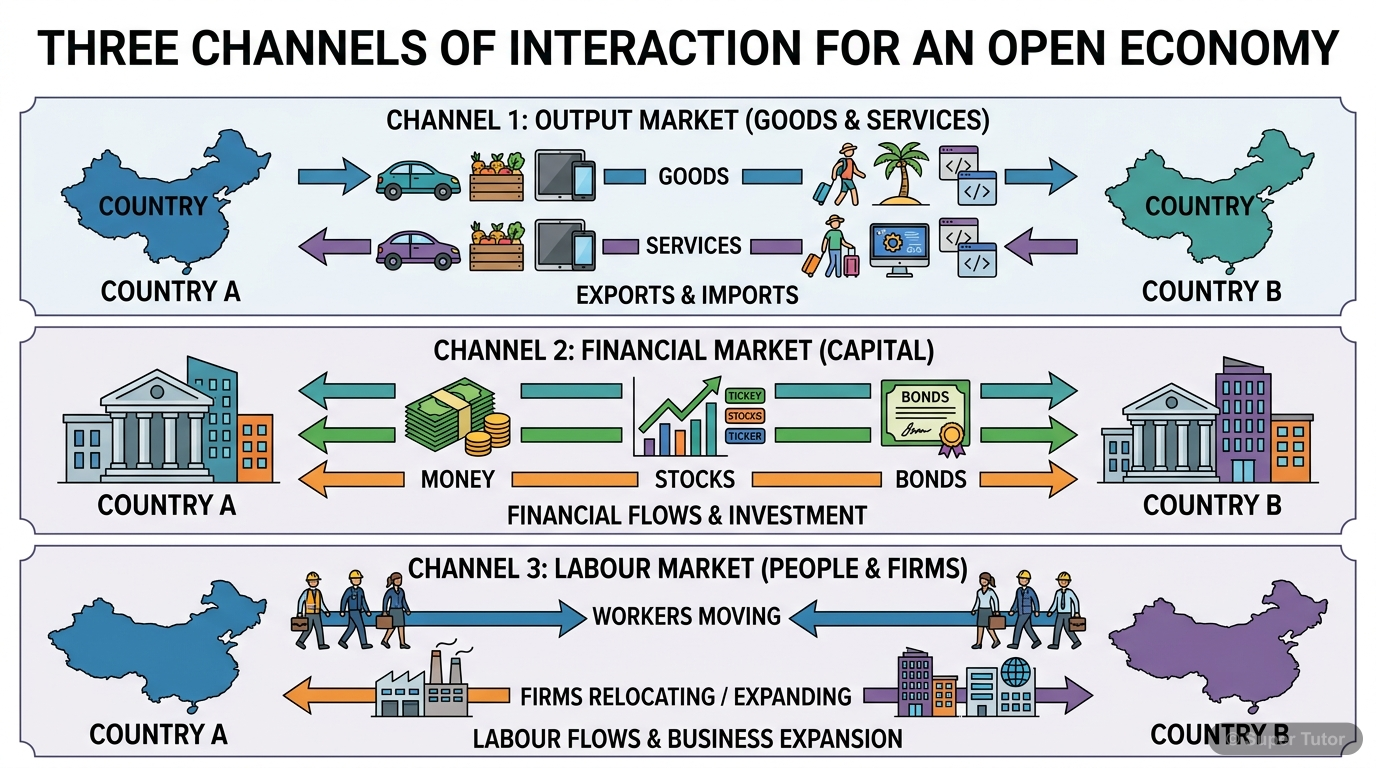
Learn better with visuals Super Tutor pairs illustrations like this with notes and quizzes for Open Economy Macroeconomics.
Topics in Open Economy Macroeconomics
1. Meaning of an Open Economy
- An open economy interacts with other countries through goods, services, financial assets, and labour movement.
- Three linkages connect an open economy with the rest of the world: output market, financial market, and labour market.
- Trade in goods and services allows consumers and producers to choose between domestic and foreign products.
2. Balance of Payments and Current Account
- Balance of Payments records transactions in goods, services, and assets between residents of a country and the rest of the world for a specified time period, usually a year.
- In the older classification, BoP has two main accounts: current account and capital account.
- In the newer BPM6 classification, BoP has three accounts: current account, financial account, and capital account.
3. Capital Account and BoP Balance
- Capital Account records all international transactions of assets.
- Assets include money, stocks, bonds, and government debt.
- Items in the capital account include FDIs, FIIs, external borrowings, and assistance.
4. Foreign Exchange Market and Demand-Supply of Currency
- The foreign exchange market is the market in which national currencies are traded for one another.
- Participants include commercial banks, foreign exchange brokers, other authorised dealers, and monetary authorities.
- The market itself is worldwide.
Key Concepts
Central concept: Open Economy Macroeconomics
Work through every topic in Open Economy Macroeconomics with notes and quizzes
Start This ChapterFrequently Asked Questions
What are the important topics in Open Economy Macroeconomics for Madhya Pradesh Board Class 12 Economics?
How should I revise Open Economy Macroeconomics for the Madhya Pradesh Board Class 12 board exam?
Sources & Official References
Content is aligned to the official syllabus. Refer to the board website for the latest curriculum.
More resources for Open Economy Macroeconomics
Practice Quiz
Test yourself with a quick quiz
Important Questions
Exam-style questions with answers
Revision Notes
Key points for last-minute revision
Formula Sheet
The chapter's formulas in one place
Chapter Summary
Understand the chapter at a glance
Concept Maps
See how topics connect
Study Plan
Step-by-step plan for this chapter
Flashcards
Quick-fire cards for active recall
NCERT Solutions
Every textbook question solved step by step
For serious students
Get the full Open Economy Macroeconomics chapter — start free.
Quizzes, flashcards, an AI doubt solver and a study plan for Madhya Pradesh Board Class 12 Economics. Free to start, no card needed.