Open Economy Macroeconomics (Part 2) — Chapter Summary
Madhya Pradesh Board · Class 12 · Economics
Summary of Open Economy Macroeconomics (Part 2) for Madhya Pradesh Board Class 12 Economics. Part of the Madhya Pradesh Board Class 12 Economics syllabus.
Interactive on Super Tutor
Studying Open Economy Macroeconomics? Get the full interactive chapter.
Quizzes, flashcards, AI doubt-solver and a step-by-step study plan — built for chapter summary and more.
Free trial, no card needed.
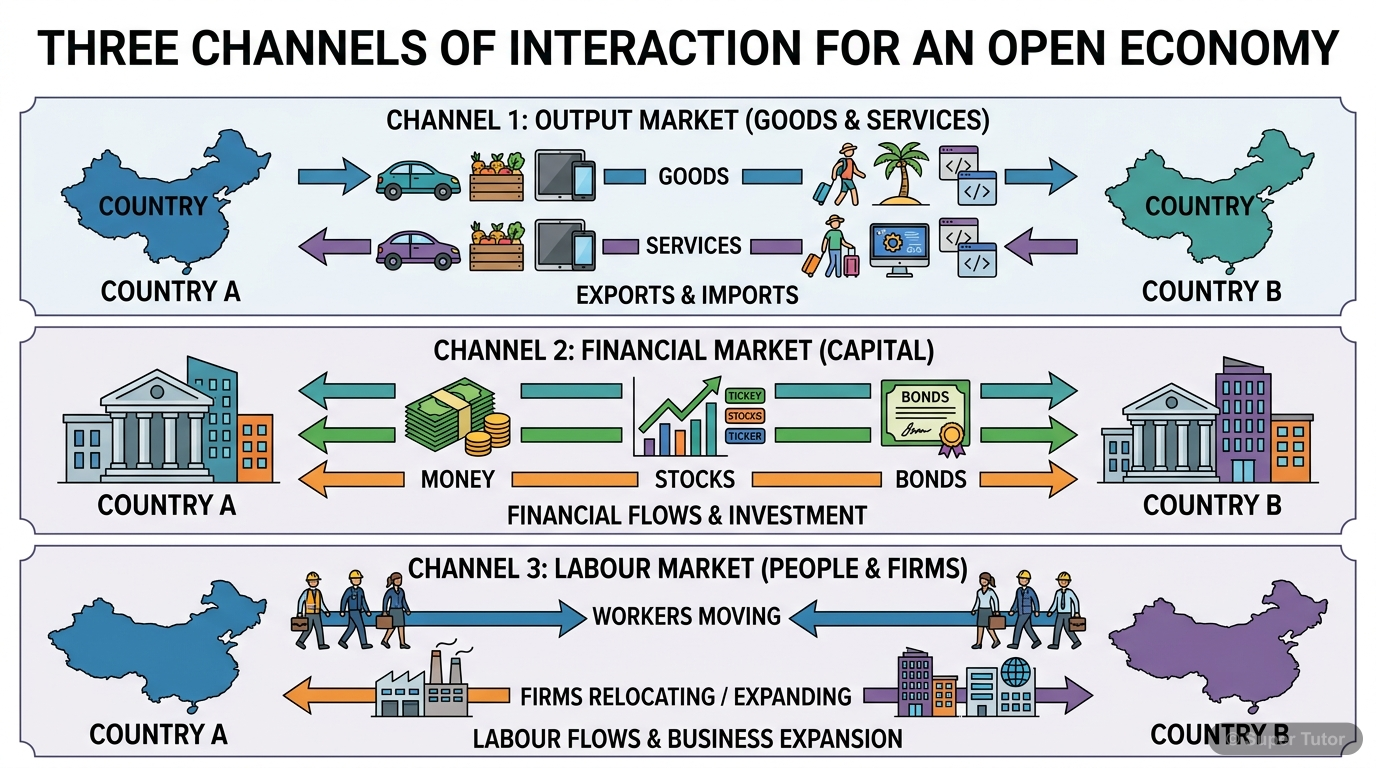
Learn better with visuals Super Tutor pairs illustrations like this with notes and quizzes for Open Economy Macroeconomics.
Overview
An open economy interacts with other countries through goods, services, and financial assets. Its main features are foreign trade, foreign exchange, balance of payments, and exchange rate determination. The chapter explains how international transactions are recorded, how currencies are exchanged, a
Key Concepts
An open economy interacts with other
An open economy interacts with other countries through output market, financial market, and labour market. In practical macroeconomics, the focus is m
The balance of payments is
The balance of payments is the record of transactions in goods, services, and assets between residents of a country and the rest of the world for a sp
The current account records trade
The current account records trade in goods and services and transfer payments. Its two components are balance of trade and balance on invisibles.
Balance of trade is the difference
Balance of trade is the difference between the value of exports of goods and imports of goods. Export of goods is a credit item and import of goods is
Net invisibles are the difference between
Net invisibles are the difference between exports and imports of invisibles. Invisibles include services, transfers, and factor income. Factor income
Learning Objectives
- Understand the meaning of an open economy and its major linkages with the rest of the world.
- Explain the balance of payments and its main accounts.
- Distinguish between current account and capital account transactions.
- Interpret surplus and deficit in balance of payments and current account.
- Understand the foreign exchange market and exchange rate.
Frequently Asked Questions
What are the important topics in Open Economy Macroeconomics for Madhya Pradesh Board Class 12 Economics?
How should I revise Open Economy Macroeconomics for the Madhya Pradesh Board Class 12 board exam?
Sources & Official References
Content is aligned to the official syllabus. Refer to the board website for the latest curriculum.
More resources for Open Economy Macroeconomics
Practice Quiz
Test yourself with a quick quiz
Important Questions
Exam-style questions with answers
Revision Notes
Key points for last-minute revision
Formula Sheet
The chapter's formulas in one place
Concept Maps
See how topics connect
Study Plan
Step-by-step plan for this chapter
Flashcards
Quick-fire cards for active recall
Syllabus
What topics to cover
NCERT Solutions
Every textbook question solved step by step
For serious students
Get the full Open Economy Macroeconomics chapter — start free.
Quizzes, flashcards, an AI doubt solver and a study plan for Madhya Pradesh Board Class 12 Economics. Free to start, no card needed.