Open Economy Macroeconomics (Part 2) — NCERT Solutions
Madhya Pradesh Board · Class 12 · Economics
NCERT Solutions for Open Economy Macroeconomics (Part 2), Madhya Pradesh Board Class 12 Economics: 19 textbook questions solved step by step.
Interactive on Super Tutor
Studying Open Economy Macroeconomics? Get the full interactive chapter.
Quizzes, flashcards, AI doubt-solver and a step-by-step study plan — built for NCERT solutions and more.
Free trial, no card needed.
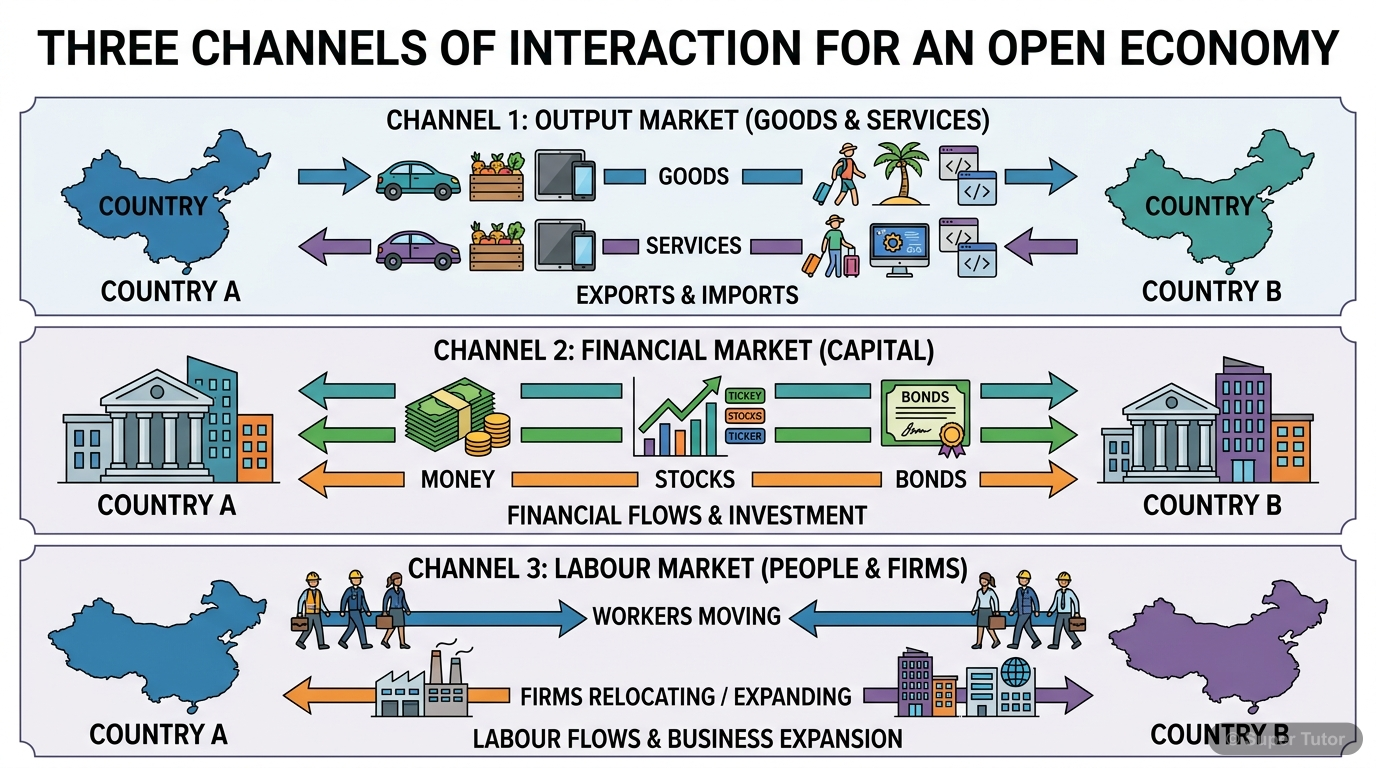
Learn better with visuals Super Tutor pairs illustrations like this with notes and quizzes for Open Economy Macroeconomics.
The first 10 solutions are open to read. The other 9 are free with a Super Tutor account.
Exercises — Chapter 6: Open Economy Macroeconomics
1Differentiate between balance of trade and current account balance.Show solution
Balance of Trade vs. Current Account Balance:
| Basis | Balance of Trade | Current Account Balance |
|---|---|---|
| Scope | Records only exports and imports of visible/merchandise goods (physical goods). | Records exports and imports of goods plus services (invisibles), plus net factor income from abroad, plus net current transfers. |
| Coverage | Narrower concept — only merchandise trade. | Broader concept — includes balance of trade as a component. |
| Components | Export of goods − Import of goods. | Balance of Trade + Balance of Services + Net Factor Income + Net Current Transfers. |
| Relationship | It is a part of the current account. | It includes the balance of trade. |
Example: If India exports goods worth ₹500 cr and imports goods worth ₹600 cr, the balance of trade is −₹100 cr (deficit). But if India also earns ₹80 cr from services exports (net), the current account deficit would be only −₹20 cr.
Conclusion: The current account balance is a more comprehensive measure of a country's trade position than the balance of trade.
2What are official reserve transactions? Explain their importance in the balance of payments.Show solution
Official Reserve Transactions:
Official reserve transactions refer to the transactions carried out by the central bank (monetary authority) of a country by buying or selling foreign exchange reserves (foreign currencies, gold, Special Drawing Rights — SDRs) in order to finance the overall deficit or surplus in the Balance of Payments (BoP).
- When there is a BoP deficit (overall balance is negative), the central bank sells foreign exchange reserves to bridge the gap.
- When there is a BoP surplus (overall balance is positive), the central bank buys foreign exchange reserves, adding to its stock.
Importance in the Balance of Payments:
- Balancing item: The BoP must always balance. Official reserve transactions act as the balancing item that ensures the BoP accounts to zero. They accommodate any gap left after all autonomous transactions (current account + capital account) are recorded.
- Indicator of BoP position: If official reserves are declining, it signals a BoP deficit; if they are rising, it signals a BoP surplus. Thus, they indicate the overall health of a country's external accounts.
- Exchange rate stability: Under a fixed exchange rate system, official reserve transactions are crucial for maintaining the pegged exchange rate. The central bank uses reserves to intervene in the foreign exchange market.
- Under flexible exchange rates: In a purely flexible system, official reserve transactions are zero because the exchange rate adjusts automatically. However, in a managed float, they are non-zero as the central bank intervenes to moderate exchange rate fluctuations.
Conclusion: Official reserve transactions are the mechanism through which the central bank settles the net imbalance in the BoP, making them a critical tool of external economic management.
3Distinguish between the nominal exchange rate and the real exchange rate. If you were to decide whether to buy domestic goods or foreign goods, which rate would be more relevant? Explain.Show solution
Nominal Exchange Rate:
The nominal exchange rate is the price of one currency in terms of another currency. It tells us how many units of domestic currency are needed to buy one unit of foreign currency (or vice versa). It does not account for differences in price levels between countries.
For example: ₹80 = 1 US Dollar is a nominal exchange rate.
Real Exchange Rate:
The real exchange rate adjusts the nominal exchange rate for the relative price levels of the two countries. It measures the relative price of goods of two countries — i.e., how many units of domestic goods are needed to buy one unit of foreign goods.
where:
- = nominal exchange rate (units of domestic currency per unit of foreign currency)
- = foreign price level
- = domestic price level
| Basis | Nominal Exchange Rate | Real Exchange Rate |
|---|---|---|
| Definition | Price of one currency in terms of another | Relative price of goods of two countries |
| Price levels | Does not consider price levels | Adjusts for relative price levels |
| Use | Currency conversion | Comparing purchasing power / competitiveness |
Which rate is more relevant for deciding whether to buy domestic or foreign goods?
The real exchange rate is more relevant for this decision.
Reason: The decision to buy domestic or foreign goods depends on their relative prices in real terms, not just the currency conversion rate. The real exchange rate tells us how expensive foreign goods are relative to domestic goods after accounting for price levels in both countries.
- If the real exchange rate is high (foreign goods are expensive relative to domestic goods), it is better to buy domestic goods.
- If the real exchange rate is low (foreign goods are cheap relative to domestic goods), it may be better to buy foreign goods.
The nominal rate alone can be misleading — even if the nominal rate is favourable, high foreign prices may make foreign goods expensive in real terms.
4Suppose it takes 1.25 yen to buy a rupee, and the price level in Japan is 3 and the price level in India is 1.2. Calculate the real exchange rate between India and Japan (the price of Japanese goods in terms of Indian goods). (Hint: First find out the nominal exchange rate as a price of yen in rupees).Show solution
Given:
- 1.25 yen = 1 rupee
- Price level in Japan,
- Price level in India,
Step 1: Find the nominal exchange rate (price of yen in rupees)
If 1.25 yen = 1 rupee, then:
So the nominal exchange rate rupees per yen.
Step 2: Calculate the real exchange rate
The real exchange rate (price of Japanese goods in terms of Indian goods) is:
Interpretation: The real exchange rate is 2, meaning 1 unit of Japanese goods costs 2 units of Indian goods. Japanese goods are relatively expensive compared to Indian goods in real terms.
5Explain the automatic mechanism by which BoP equilibrium was achieved under the gold standard.Show solution
Gold Standard and Automatic BoP Adjustment:
Under the gold standard, each country fixed the value of its currency in terms of gold, and currencies were freely convertible into gold. This created a fixed exchange rate system among all countries on the gold standard.
Automatic Adjustment Mechanism (Price-Specie-Flow Mechanism — David Hume):
Suppose Country A has a BoP deficit (imports > exports):
Step 1 — Gold outflow:
Country A pays for its excess imports by exporting gold. Gold flows out of Country A and into the surplus country (Country B).
Step 2 — Money supply changes:
- In Country A: Gold outflow → Money supply falls (since money supply was linked to gold stock).
- In Country B: Gold inflow → Money supply rises.
Step 3 — Price level changes:
- In Country A: Falling money supply → Price level falls (deflation).
- In Country B: Rising money supply → Price level rises (inflation).
Step 4 — Trade balance adjusts:
- Country A's goods become cheaper → exports increase, imports decrease.
- Country B's goods become more expensive → its exports decrease, imports increase.
Step 5 — BoP equilibrium restored:
The deficit in Country A's BoP is automatically corrected as exports rise and imports fall. Gold flows stop when BoP is balanced.
Conclusion: The gold standard provided an automatic, self-correcting mechanism for BoP adjustment through gold flows, changes in money supply, and consequent changes in price levels and trade flows — without any deliberate government policy.
6How is the exchange rate determined under a flexible exchange rate regime?Show solution
Determination of Exchange Rate under Flexible Exchange Rate Regime:
Under a flexible (floating) exchange rate system, the exchange rate is determined entirely by the forces of demand and supply in the foreign exchange market, without any government or central bank intervention.
Demand for Foreign Exchange:
Foreign exchange is demanded for:
- Importing goods and services
- Capital outflows (investing abroad)
- Tourism, remittances abroad, etc.
The demand curve for foreign exchange is downward sloping — as the exchange rate (price of foreign currency) rises, imports become costlier, so demand for foreign currency falls.
Supply of Foreign Exchange:
Foreign exchange is supplied by:
- Exporting goods and services
- Capital inflows (foreign investment)
- Remittances received from abroad, etc.
The supply curve of foreign exchange is upward sloping — as the exchange rate rises, exports become cheaper for foreigners, so more foreign exchange flows in.
Equilibrium Exchange Rate:
The exchange rate is determined at the point where demand for foreign exchange = supply of foreign exchange.
- If demand for foreign exchange exceeds supply → domestic currency depreciates (exchange rate rises).
- If supply of foreign exchange exceeds demand → domestic currency appreciates (exchange rate falls).
Key Feature: The exchange rate adjusts automatically to clear the market. There is no need for official reserve transactions, so the BoP always balances through exchange rate movements.
Conclusion: Under a flexible exchange rate regime, the equilibrium exchange rate is determined purely by market forces of demand and supply, and it changes continuously in response to shifts in these forces.
7Differentiate between devaluation and depreciation.Show solution
Devaluation vs. Depreciation:
| Basis | Devaluation | Depreciation |
|---|---|---|
| Meaning | A deliberate, official reduction in the value of a country's currency relative to other currencies. | A market-driven fall in the value of a currency relative to other currencies. |
| Exchange rate system | Occurs under a fixed exchange rate system. | Occurs under a flexible (floating) exchange rate system. |
| Who decides | Decided by the government/central bank as a matter of policy. | Determined by market forces of demand and supply. |
| Nature | Deliberate and policy-driven. | Automatic and market-driven. |
| Example | Government announces that ₹60 = 1. | Due to excess demand for dollars, the rupee falls from ₹80 = 1 in the market. |
Common Feature: Both devaluation and depreciation result in the domestic currency becoming less valuable relative to foreign currencies, making exports cheaper and imports more expensive.
Conclusion: The key distinction is that devaluation is a policy action under a fixed rate system, while depreciation is a market outcome under a flexible rate system.
8Would the central bank need to intervene in a managed floating system? Explain why.Show solution
Yes, the central bank does need to intervene in a managed floating (dirty floating) system.
What is Managed Floating?
Managed floating is a hybrid system — it is primarily a flexible exchange rate system where the exchange rate is determined by market forces, but the central bank intervenes occasionally to moderate excessive fluctuations.
Why does the central bank intervene?
- To prevent excessive volatility: In a pure float, exchange rates can fluctuate wildly due to speculation, sudden capital flows, or external shocks. Excessive volatility creates uncertainty for businesses and traders. The central bank intervenes to smooth out these fluctuations.
- To prevent misalignment: Sometimes market-determined exchange rates may deviate significantly from their fundamental values (overvaluation or undervaluation). The central bank intervenes to bring the rate closer to a level consistent with economic fundamentals.
- To protect export competitiveness: If the domestic currency appreciates too rapidly, exports become expensive and uncompetitive. The central bank may sell domestic currency (buy foreign currency) to prevent excessive appreciation.
- To manage inflation: A sharp depreciation can cause imported inflation (rising prices of imported goods). The central bank may sell foreign exchange to support the domestic currency and contain inflation.
- To maintain confidence: Orderly exchange rate movements maintain confidence among investors and trading partners.
How does the central bank intervene?
- To prevent depreciation: Sells foreign exchange (buys domestic currency) from its reserves.
- To prevent appreciation: Buys foreign exchange (sells domestic currency), adding to reserves.
Conclusion: Since official reserve transactions are not equal to zero in a managed float, the central bank must maintain adequate foreign exchange reserves and use them judiciously to moderate exchange rate movements. This is why managed floating is also called dirty floating.
9Are the concepts of demand for domestic goods and domestic demand for goods the same?Show solution
No, the concepts of demand for domestic goods and domestic demand for goods are not the same. They differ as follows:
Domestic Demand for Goods:
This refers to the total demand by residents of a country for all goods — both domestically produced goods and imported goods.
where , , include spending on both domestic and foreign (imported) goods.
Demand for Domestic Goods:
This refers to the total demand for goods produced within the country — by both domestic residents and foreigners (through exports). It excludes demand for imported goods but includes foreign demand (exports).
where:
- = exports (foreign demand for domestic goods)
- = imports (domestic demand for foreign goods, which must be subtracted)
Key Difference:
| Concept | Includes | Excludes |
|---|---|---|
| Domestic Demand for Goods | Demand by domestic residents for all goods (domestic + imported) | Foreign demand |
| Demand for Domestic Goods | Demand for domestically produced goods by all (residents + foreigners) | Demand for imported goods |
In an open economy, the two differ by the net exports :
Conclusion: The two concepts coincide only in a closed economy where there are no imports or exports. In an open economy, they are distinct, and the distinction is crucial for national income determination.
10What is the marginal propensity to import when ? What is the relationship between the marginal propensity to import and the aggregate demand function?Show solution
Given:
Marginal Propensity to Import (MPM):
The marginal propensity to import is the change in imports per unit change in income:
Differentiating with respect to :
This means for every ₹1 increase in income, imports increase by ₹0.06.
Relationship between MPM and the Aggregate Demand (AD) Function:
In an open economy, the aggregate demand for domestic goods is:
Since (where ), substituting:
The consumption function:
So:
where is autonomous expenditure and is the slope of the AD function.
Key Relationship:
- The MPM reduces the slope of the AD function. The slope of AD in an open economy is instead of just (as in a closed economy).
- A higher MPM means a flatter AD curve (smaller slope), which leads to a smaller multiplier in the open economy.
- Imports act as a leakage from the income-expenditure flow, just like savings and taxes.
Conclusion: The MPM is the coefficient of in the import function. It reduces the slope of the AD function, thereby reducing the value of the open economy multiplier compared to the closed economy multiplier.
Free with a Super Tutor account
Free with a Super Tutor account
Free with a Super Tutor account
Free with a Super Tutor account
Free with a Super Tutor account
Free with a Super Tutor account
Free with a Super Tutor account
Free with a Super Tutor account
Free with a Super Tutor account
9 more solved questions in Open Economy Macroeconomics
They are free with a Super Tutor account, along with practice quizzes and flashcards for this chapter. Free to start, no card needed.
Frequently Asked Questions
What are the important topics in Open Economy Macroeconomics for Madhya Pradesh Board Class 12 Economics?
Are these NCERT Solutions for Open Economy Macroeconomics free?
How should I revise Open Economy Macroeconomics for the Madhya Pradesh Board Class 12 board exam?
Sources & Official References
Content is aligned to the official syllabus. Refer to the board website for the latest curriculum.
More resources for Open Economy Macroeconomics
Practice Quiz
Test yourself with a quick quiz
Important Questions
Exam-style questions with answers
Revision Notes
Key points for last-minute revision
Formula Sheet
The chapter's formulas in one place
Chapter Summary
Understand the chapter at a glance
Concept Maps
See how topics connect
Study Plan
Step-by-step plan for this chapter
Flashcards
Quick-fire cards for active recall
Syllabus
What topics to cover
For serious students
Get the full Open Economy Macroeconomics chapter — start free.
Quizzes, flashcards, an AI doubt solver and a study plan for Madhya Pradesh Board Class 12 Economics. Free to start, no card needed.