Electromagnetic Induction — Practice Quiz
Madhya Pradesh Board · Class 12 · Physics
Try a 4-question quiz on Electromagnetic Induction for Madhya Pradesh Board Class 12 Physics: tap an answer to check it and see why.
Interactive on Super Tutor
Studying Electromagnetic Induction? Get the full interactive chapter.
Quizzes, flashcards, AI doubt-solver and a step-by-step study plan — built for practice quiz and more.
Free trial, no card needed.
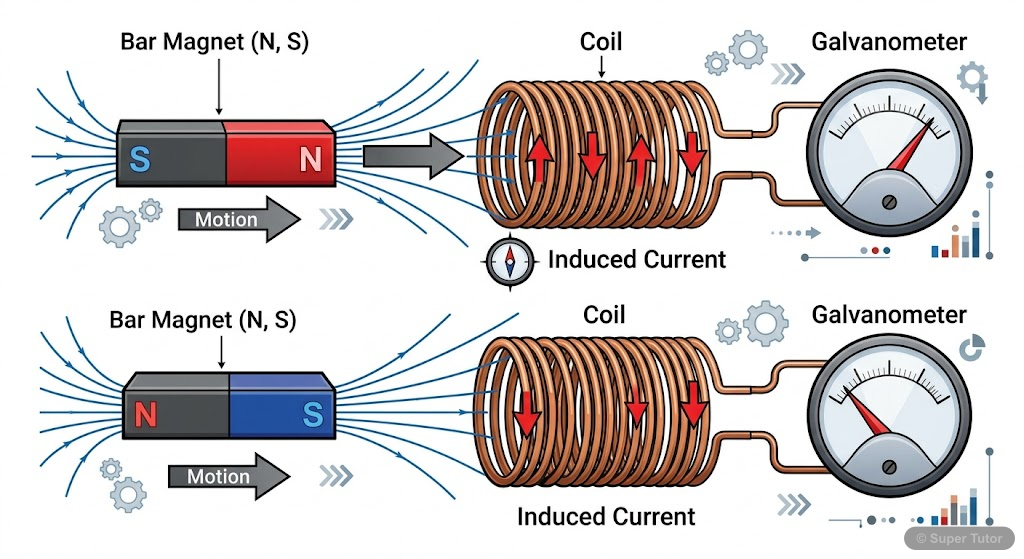
Learn better with visuals Super Tutor pairs illustrations like this with notes and quizzes for Electromagnetic Induction.
Quick Quiz: Electromagnetic Induction
0/4Tap an answer to check it instantly. No sign-up needed for these 4.
Who discovered the phenomenon of electromagnetic induction?
The SI unit of magnetic flux is:
According to Lenz's law, the direction of induced current is such that it:
The magnetic flux through a surface is given by the formula:
Sample Questions
Which of the following can cause electromagnetic induction? (Select all correct answers)
Show answer
Moving a magnet towards a coil, Rotating a coil in a magnetic field, Changing the current in a nearby coil
Electromagnetic induction occurs whenever there is a change in magnetic flux. This can happen by moving a magnet relative to a coil, rotating a coil in a magnetic field, or changing the current (and thus magnetic field) in a nearby coil. Keeping both stationary with constant current produces no flux change.
Faraday's law of electromagnetic induction is expressed as:
Show answer
ε = -dφB/dt
Faraday's law states that the induced EMF is equal to the negative rate of change of magnetic flux with time. The negative sign indicates the direction as per Lenz's law, and 'd' represents the differential (rate of change).
The motional EMF in a rod of length l moving with velocity v perpendicular to magnetic field B is:
Show answer
ε = Blv
When a conductor of length l moves with velocity v perpendicular to a magnetic field B, the motional EMF induced is ε = Blv. This can be derived from Faraday's law or from the Lorentz force on the charge carriers.
Self-inductance is a measure of:
Show answer
Opposition to change in current
Self-inductance (L) is a measure of a coil's opposition to changes in current flowing through it. It's the electromagnetic analogue of inertia in mechanics, resisting both increase and decrease in current.
+114 more questions on Electromagnetic Induction (Madhya Pradesh Board Class 12 Physics)
Practise AllFrequently Asked Questions
What are the important topics in Electromagnetic Induction for Madhya Pradesh Board Class 12 Physics?
How many practice questions are there for Electromagnetic Induction?
Sources & Official References
Content is aligned to the official syllabus. Refer to the board website for the latest curriculum.
More resources for Electromagnetic Induction
Important Questions
Exam-style questions with answers
Revision Notes
Key points for last-minute revision
Formula Sheet
The chapter's formulas in one place
Chapter Summary
Understand the chapter at a glance
Concept Maps
See how topics connect
Study Plan
Step-by-step plan for this chapter
Flashcards
Quick-fire cards for active recall
Syllabus
What topics to cover
NCERT Solutions
Every textbook question solved step by step
For serious students
Get the full Electromagnetic Induction chapter — start free.
Quizzes, flashcards, an AI doubt solver and a study plan for Madhya Pradesh Board Class 12 Physics. Free to start, no card needed.