Nucle — Practice Quiz
Madhya Pradesh Board · Class 12 · Physics
Try a 4-question quiz on Nucle for Madhya Pradesh Board Class 12 Physics: tap an answer to check it and see why. 93 questions in the full chapter test.
Interactive on Super Tutor
Studying Nucle? Get the full interactive chapter.
Quizzes, flashcards, AI doubt-solver and a step-by-step study plan — built for practice quiz and more.
Free trial, no card needed.
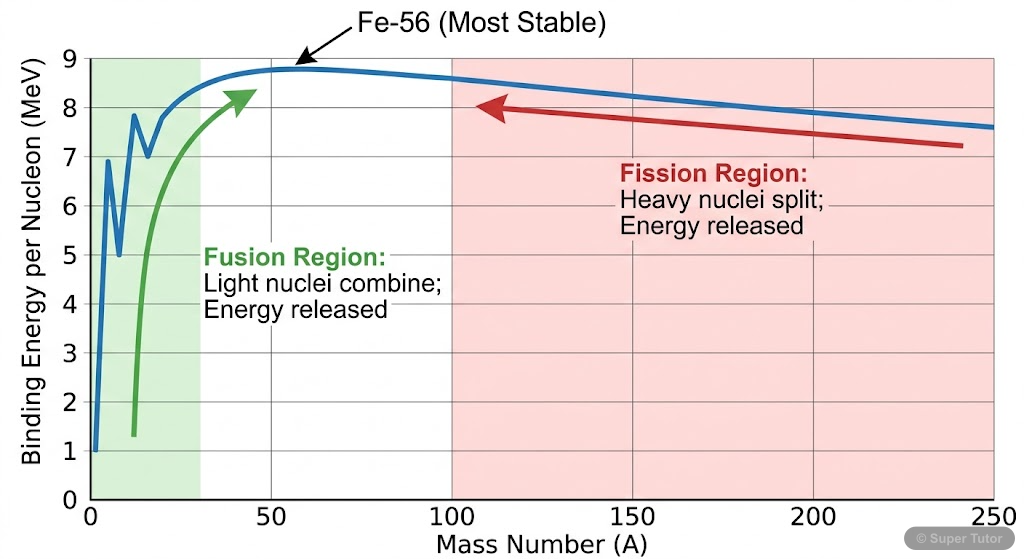
One of 15 illustrations for Nucle in Super Tutor — alongside flashcards, concept maps and practice questions.
Quick Quiz: Nucle
0/4Tap an answer to check it instantly. No sign-up needed for these 4.
What is the unit used to express atomic masses?
The mass number A of a nucleus represents:
The radius of a nucleus is given by the formula R = R₀A^(1/3). What is the value of R₀?
What is mass defect?
Sample Questions
Which particles are found in the nucleus of an atom?
Show answer
Protons, Neutrons
The nucleus contains only protons and neutrons, collectively called nucleons. Electrons are found outside the nucleus in electron shells. Photons are electromagnetic radiation and are not constituent particles of atoms.
Which of the following are types of radioactive decay?
Show answer
Alpha decay, Beta decay, Gamma decay
The three main types of radioactive decay are: α-decay (emission of helium nucleus), β-decay (emission of electrons or positrons), and γ-decay (emission of high-energy photons). Delta and epsilon decays are not recognized types of radioactive decay.
Einstein's mass-energy equivalence relation is:
Show answer
E = mc²
Einstein's famous mass-energy equivalence relation is E = mc², where E is energy, m is mass, and c is the speed of light in vacuum. This relation is fundamental to understanding nuclear binding energy and nuclear reactions.
Isotopes are atoms that have:
Show answer
Same number of protons but different number of neutrons
Isotopes are different forms of the same element, having the same atomic number (same number of protons) but different mass numbers (different number of neutrons). They have identical chemical properties but different physical properties.
+89 more questions on Nucle (Madhya Pradesh Board Class 12 Physics)
Practise AllFrequently Asked Questions
What are the important topics in Nucle for Madhya Pradesh Board Class 12 Physics?
How many practice questions are there for Nucle?
Sources & Official References
Content is aligned to the official syllabus. Refer to the board website for the latest curriculum.
More resources for Nucle
Important Questions
Exam-style questions with answers
Revision Notes
Key points for last-minute revision
Formula Sheet
The chapter's formulas in one place
Chapter Summary
Understand the chapter at a glance
Concept Maps
See how topics connect
Study Plan
Step-by-step plan for this chapter
Flashcards
Quick-fire cards for active recall
Syllabus
What topics to cover
NCERT Solutions
Every textbook question solved step by step
For serious students
Get the full Nucle chapter — start free.
Quizzes, flashcards, an AI doubt solver and a study plan for Madhya Pradesh Board Class 12 Physics. Free to start, no card needed.