Production — Important Questions
NIOS · Class 10 · Economics
44 important questions from Production for NIOS Class 10 Economics, with answers. Includes multiple choice questions. Written for the board exams 2027.
Interactive on Super Tutor
Studying Production? Get the full interactive chapter.
Quizzes, flashcards, AI doubt-solver and a step-by-step study plan — built for important questions and more.
Free trial, no card needed.
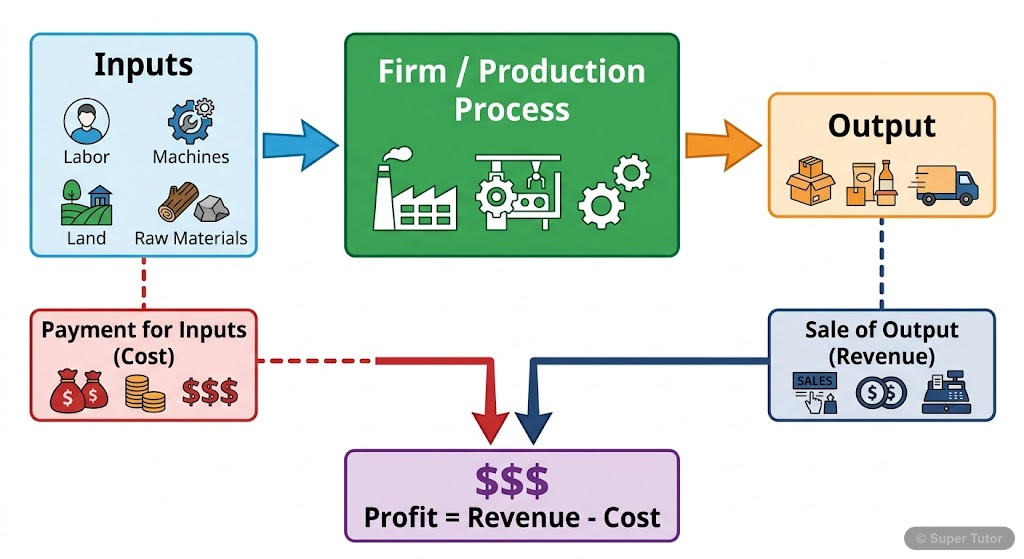
Learn better with visuals Super Tutor pairs illustrations like this with notes and quizzes for Production.
Important Questions from Production
A worker in a bakery only does the task of kneading dough, while others bake and pack the bread. This is an example of which type of division of labour?
Show answer
Process Based Division of Labour
Step 1: Identify the two types of division of labour — product based and process based. Step 2: In product based division, a single worker specialises in making one complete product (e.g., a potter making pots). Step 3: In process based division, the production of one commodity is split into many processes, and each worker handles only one or two processes. Step 4: In this bakery example, bread-making is divided into multiple processes — kneading, baking, packing — and different workers handle each process. Step 5: No single worker makes the complete bread. This is clearly Process Based Divisi
If 3 units of labour produce a Total Product of 36 units, what is the Average Product (AP) at this level?
Show answer
12
Step 1: Recall the formula for Average Product: AP = TP ÷ L, where L is the number of labour units. Step 2: Given values: TP = 36, L = 3. Step 3: Apply the formula: AP = 36 ÷ 3 = 12. Step 4: Option A (36) is the TP itself, not AP. Option B (14) is the MP at L=3 (from the textbook table), not AP. Option D (108) results from multiplying TP × L, which is incorrect. Step 5: AP tells us output per worker. With 3 workers producing 36 units, each worker on average contributes 12 units. Answer is 12.
Which of the following is the best example of a 'Firm' as defined in economics?
Show answer
Bata Shoe Company producing and selling shoes
Step 1: Recall the definition — a firm is an INDIVIDUAL production unit that produces goods or services for sale in the market. Step 2: 'The entire shoe manufacturing sector' and 'All companies producing automobiles' describe INDUSTRIES (groups of firms), not a single firm. Step 3: 'The agriculture sector' is also an industry-level concept. Step 4: Bata Shoe Company is one specific, individual production unit that produces shoes for sale — this perfectly matches the definition of a firm. Step 5: Remember: Firm = individual unit; Industry = all firms producing the same type of good.
Maruti-Suzuki Limited is a joint venture between an Indian company and a Japanese company, with the Japanese company holding more than 50% of the capital. How is this classified?
Show answer
Foreign Production Unit (Collaboration)
Step 1: Identify the key features — joint ownership between Indian and foreign partners, with foreigners holding more than 50% capital. Step 2: A Collaboration is a production unit jointly owned by residents and non-residents. Step 3: Since foreigners hold more than 50% of total capital, it is classified as a foreign production unit. Step 4: A Multinational (MNC) has its main office in one country and operations in many countries — Maruti-Suzuki is specifically a joint venture, making it a Collaboration. Step 5: Departmental enterprises are government-run. Indigenous units are fully owned by I
+40 more questions on Production (NIOS Class 10 Economics)
Practise AllFrequently Asked Questions
What are the important topics in Production for NIOS Class 10 Economics?
How many important questions are there in Production?
Sources & Official References
Content is aligned to the official syllabus. Refer to the board website for the latest curriculum.
More resources for Production
Practice Quiz
Test yourself with a quick quiz
Revision Notes
Key points for last-minute revision
Formula Sheet
The chapter's formulas in one place
Chapter Summary
Understand the chapter at a glance
Concept Maps
See how topics connect
Study Plan
Step-by-step plan for this chapter
Flashcards
Quick-fire cards for active recall
Syllabus
What topics to cover
For serious students
Get the full Production chapter — start free.
Quizzes, flashcards, an AI doubt solver and a study plan for NIOS Class 10 Economics. Free to start, no card needed.