Indian Weavers — Chapter Summary
NIOS · Class 10 · English
Summary of Indian Weavers for NIOS Class 10 English. Key concepts: The poem describes birth, The first stanza shows and The second stanza shows.
Interactive on Super Tutor
Studying Indian Weavers? Get the full interactive chapter.
Quizzes, flashcards, AI doubt-solver and a step-by-step study plan — built for chapter summary and more.
Free trial, no card needed.
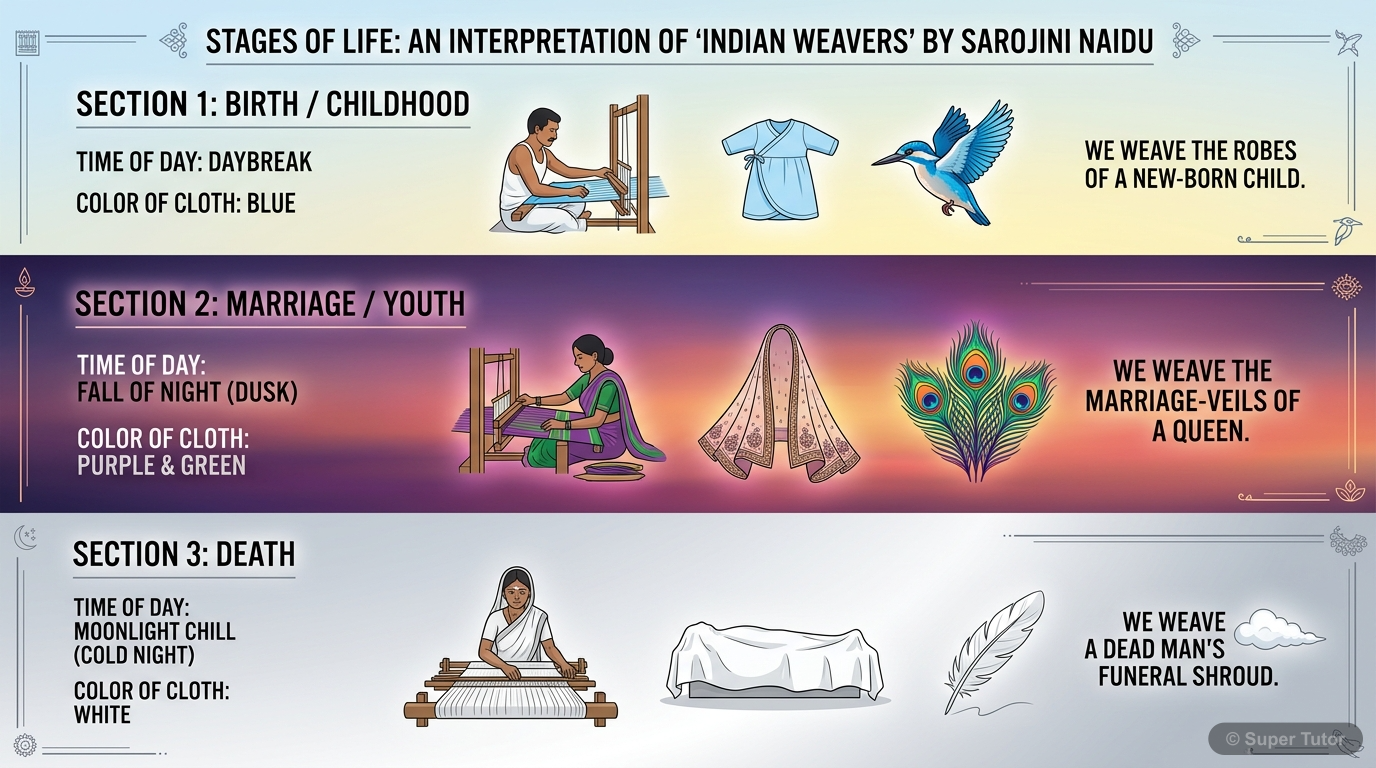
One of 3 illustrations for Indian Weavers in Super Tutor — alongside flashcards, concept maps and practice questions.
Overview
The poem presents weaving as a symbol of human life. Three stages of life are linked with three different times of day and three different colours of cloth: birth with blue at break of day, marriage with purple and green at fall of night, and death with white in the moonlight chill. The poem also us
Key Concepts
The poem describes birth
The poem describes birth, marriage, and death as the three main stages of human life. Each stage is linked with a cloth of a different colour and a di
The first stanza shows the weavers
The first stanza shows the weavers working at break of day. They weave blue robes for a new-born child. The blue colour is compared to the wing of a h
The second stanza shows the weavers
The second stanza shows the weavers at fall of night. They weave purple and green marriage veils for a queen. The cloth is compared to the plumes of a
The third stanza shows the weavers
The third stanza shows the weavers in the moonlight chill. They weave a white funeral shroud for a dead man. The cloth is compared to a feather and a
A simile is a comparison between
A simile is a comparison between two different things using the words 'as' or 'like'. The poem uses three similes: blue as the wing of halcyon wild, l
Learning Objectives
- To understand how the poem connects weaving with the stages of life
- To identify the three central themes: birth, marriage, and death
- To recognise similes used in the poem
- To observe how repetition creates rhythm
- To appreciate imagery and mood in poetry
Frequently Asked Questions
What are the important topics in Indian Weavers for NIOS Class 10 English?
How should I revise Indian Weavers for the NIOS Class 10 board exam?
Sources & Official References
Content is aligned to the official syllabus. Refer to the board website for the latest curriculum.
More resources for Indian Weavers
For serious students
Get the full Indian Weavers chapter — start free.
Quizzes, flashcards, an AI doubt solver and a study plan for NIOS Class 10 English. Free to start, no card needed.