Indian Weavers — Important Questions
NIOS · Class 10 · English
44 important questions from Indian Weavers for NIOS Class 10 English, with answers. Written for the board exams 2027.
Interactive on Super Tutor
Studying Indian Weavers? Get the full interactive chapter.
Quizzes, flashcards, AI doubt-solver and a step-by-step study plan — built for important questions and more.
Free trial, no card needed.
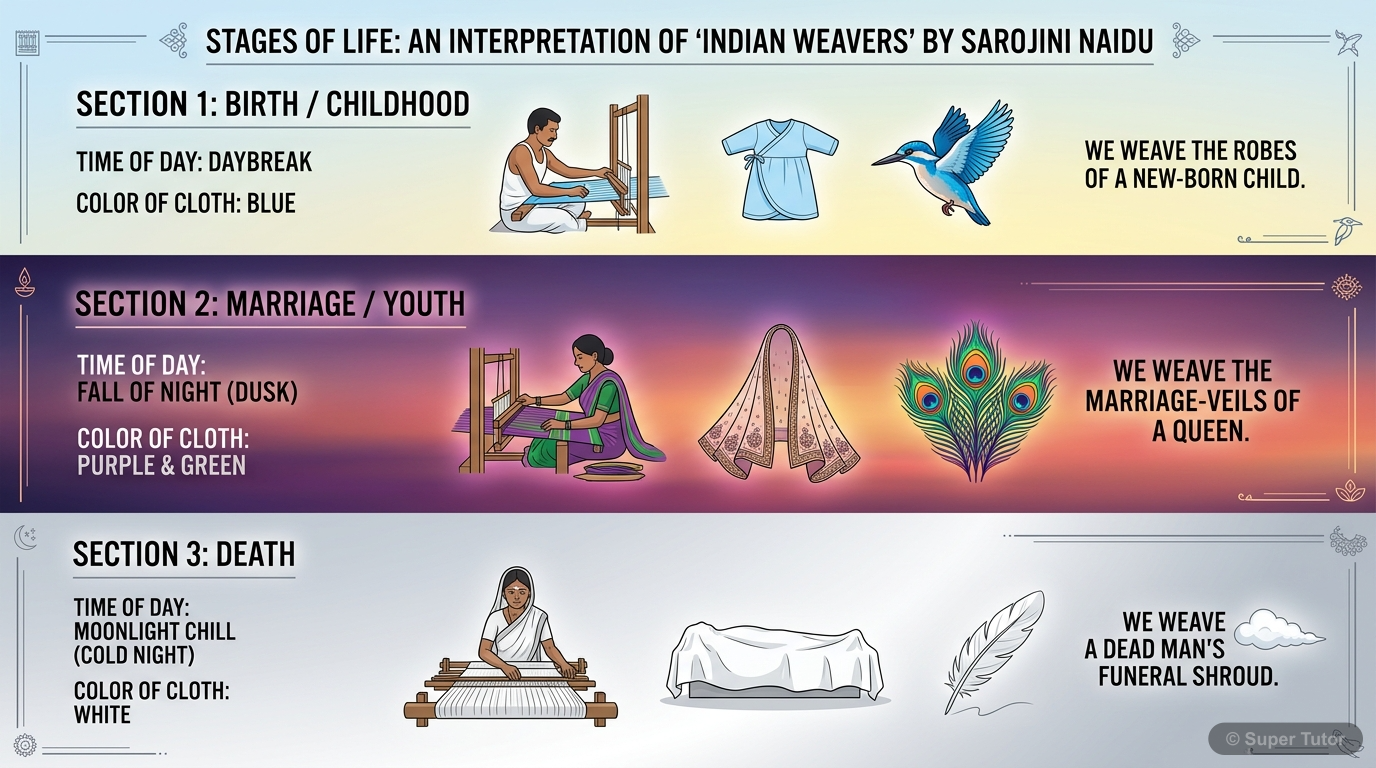
One of 3 illustrations for Indian Weavers in Super Tutor — alongside flashcards, concept maps and practice questions.
Important Questions from Indian Weavers
Which bird's feathers are mentioned in the second stanza?
Show answer
Peacock
The second stanza mentions 'Like the plumes of a peacock, purple and green' when describing the marriage veil. Peacock feathers (plumes) are colorful and bright, symbolizing the joy and beauty of marriage. Halcyon is mentioned in the first stanza, while eagle and dove are not mentioned in the poem at all.
What does the word 'gay' mean in the context of this poem?
Show answer
Bright and cheerful
In the context of this poem, 'gay' means bright and cheerful. This is an older usage of the word. The bright, cheerful garment reflects the joy and happiness associated with the birth of a child. The word indicates the weavers' mood of cheerfulness, not sadness, expense, or size of the garment.
Which literary device is primarily used in the line 'Blue as the wing of halcyon wild'?
Show answer
Simile
The line 'Blue as the wing of halcyon wild' is a simile because it compares the blue cloth to the halcyon's wing using the word 'as'. A simile always uses 'like' or 'as' for comparison. It's not a metaphor (which doesn't use 'like' or 'as'), not alliteration (repetition of sounds), and not personification (giving human qualities to non-human things).
What creates the rhythm in this poem?
Show answer
Repetition of words and phrases
The rhythm in this poem is created by the repetition of words and phrases like 'Weavers, weaving', 'Why do you weave', and 'We weave'. This repetition creates a musical beat similar to the rhythm of weaving. Long sentences, difficult vocabulary, and short stanzas don't create rhythm - it's specifically the repeated pattern of words that gives the poem its musical quality.
+40 more questions on Indian Weavers (NIOS Class 10 English)
Practise AllFrequently Asked Questions
What are the important topics in Indian Weavers for NIOS Class 10 English?
How many important questions are there in Indian Weavers?
Sources & Official References
Content is aligned to the official syllabus. Refer to the board website for the latest curriculum.
More resources for Indian Weavers
For serious students
Get the full Indian Weavers chapter — start free.
Quizzes, flashcards, an AI doubt solver and a study plan for NIOS Class 10 English. Free to start, no card needed.