Communicable and Life Style Disease — Important Questions
NIOS · Class 10 · Home Science
45 important questions from Communicable and Life Style Disease for NIOS Class 10 Home Science, with answers. Includes multiple choice questions.
Interactive on Super Tutor
Studying Communicable and Life Style Disease? Get the full interactive chapter.
Quizzes, flashcards, AI doubt-solver and a step-by-step study plan — built for important questions and more.
Free trial, no card needed.
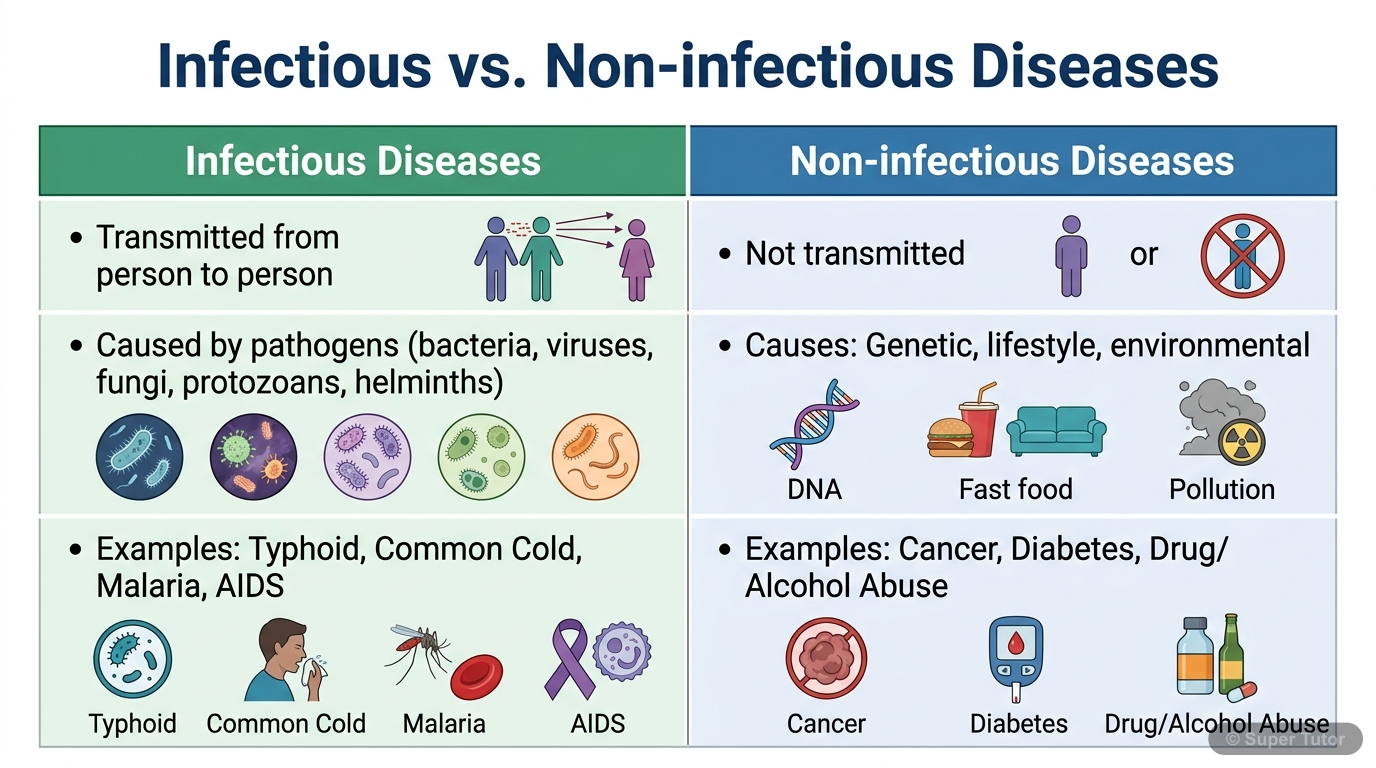
An illustration from Super Tutor's Communicable and Life Style Disease chapter — alongside flashcards, concept maps and practice questions.
Important Questions from Communicable and Life Style Disease
The white blood cells in our body protect us from diseases by producing:
Show answer
Antibodies
Step 1: Our body has a defense system that protects us from harmful germs. Step 2: White blood cells (WBCs) are the main soldiers of this defense system. Step 3: When germs enter the body, WBCs produce special substances called antibodies. Step 4: These antibodies fight and destroy the germs, preventing disease. Step 5: Hormones regulate body functions, enzymes help in digestion, and vitamins support nutrition — none of them are produced by WBCs to fight germs.
Which of the following is a correct preventive measure for communicable diseases?
Show answer
Boiling drinking water for 10 minutes
Step 1: Communicable diseases can spread through contaminated water. Step 2: Boiling water for 10 minutes kills most disease-causing germs, making it safe to drink. Step 3: Eating raw, uncovered food exposes you to germs carried by flies and dust. Step 4: Visiting crowded places during an epidemic increases the risk of catching airborne diseases. Step 5: Using the same utensils as a sick person is a form of indirect contact that spreads disease. Hence, boiling water is the safest preventive measure among the options.
HIV/AIDS is a disease that attacks the body's:
Show answer
Natural defense (immune) system
Step 1: HIV stands for Human Immunodeficiency Virus. Step 2: This virus specifically attacks the body's immune system, which is our natural defense against infections. Step 3: When the immune system is weakened, the body cannot fight even minor infections effectively. Step 4: When HIV has completely destroyed the immune system, the condition is called AIDS (Acquired Immuno Deficiency Syndrome). Step 5: The digestive, skeletal, and respiratory systems are not the direct target of the HIV virus.
Which of the following is NOT a way through which HIV/AIDS spreads?
Show answer
Shaking hands with an infected person
Step 1: HIV is transmitted only through specific body fluids like blood, sexual fluids, and from mother to child. Step 2: Sexual contact with an infected person, use of infected needles, and blood transfusion are all confirmed ways HIV spreads. Step 3: Shaking hands involves only skin contact — HIV cannot survive outside the body easily and does not spread through casual touch. Step 4: Similarly, sharing food, coughing, sneezing, and using the same toilet seat do NOT spread HIV. Step 5: It is important to know how HIV does NOT spread to reduce stigma and fear around infected people.
+41 more questions on Communicable and Life Style Disease (NIOS Class 10 Home Science)
Practise AllFrequently Asked Questions
What are the important topics in Communicable and Life Style Disease for NIOS Class 10 Home Science?
How many important questions are there in Communicable and Life Style Disease?
Sources & Official References
Content is aligned to the official syllabus. Refer to the board website for the latest curriculum.
More resources for Communicable and Life Style Disease
For serious students
Get the full Communicable and Life Style Disease chapter — start free.
Quizzes, flashcards, an AI doubt solver and a study plan for NIOS Class 10 Home Science. Free to start, no card needed.