Motivation And Emotion — Important Questions
NIOS · Class 10 · Psychology
44 important questions from Motivation And Emotion for NIOS Class 10 Psychology, with answers. Includes multiple choice questions.
Interactive on Super Tutor
Studying Motivation And Emotion? Get the full interactive chapter.
Quizzes, flashcards, AI doubt-solver and a step-by-step study plan — built for important questions and more.
Free trial, no card needed.
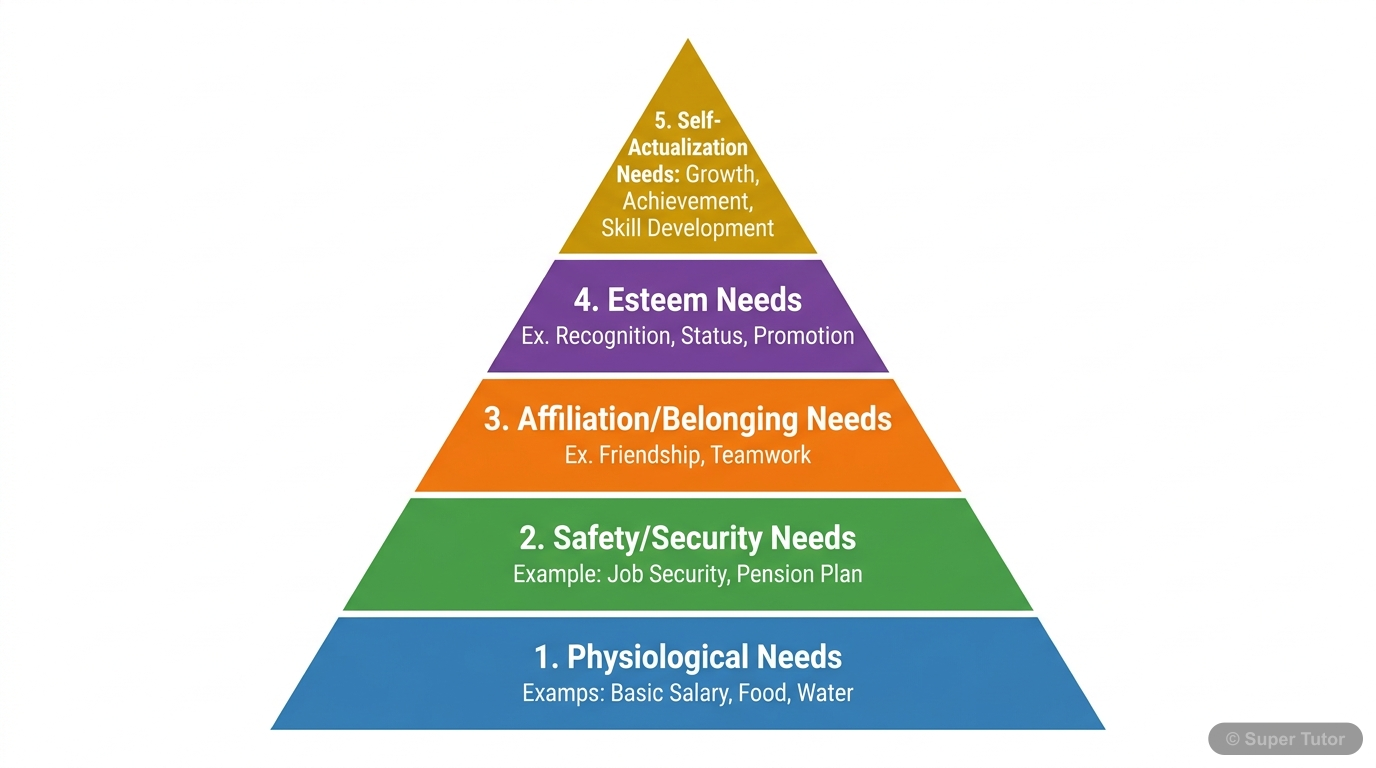
Learn better with visuals Super Tutor pairs illustrations like this with notes and quizzes for Motivation And Emotion.
Important Questions from Motivation And Emotion
Nelson Mandela spent 27 years in prison fighting against apartheid, inspired by Mahatma Gandhi's philosophy of justice and equal opportunity. Which social motive does the chapter primarily associate with Mandela's behaviour?
Show answer
Power motive — striving to influence, control, and create impact on others in service of justice
Step 1 – Understand Mandela's actions: Mandela dedicated his life to ending apartheid and creating equal opportunity. His goal was to influence the political system and the lives of millions of people. Step 2 – Match to the correct motive: The Power motive is defined as the need to strive for impact on others, to influence, control, and persuade. Mandela sought to reshape society and influence the direction of his country. Step 3 – Clarify the nuance: The chapter notes that Mandela's power motive was in service of justice — it was not about selfish control but about collective freedom. This is
Which of the following statements about the universality of basic emotional expressions is CORRECT, according to the chapter?
Show answer
The six primary emotions — fear, anger, sadness, surprise, disgust, and happiness — are expressed in the same basic way across all cultures
Step 1 – Recall the chapter's claim: Research shows that six basic emotions are expressed universally — people across the world (Indians, Americans, Germans, Japanese) express these emotions in the same basic way using similar facial and muscular movements. Step 2 – Identify the six primary emotions: Fear, Anger, Sadness, Surprise, Disgust, and Happiness. Each is associated with a unique set of facial expressions. Step 3 – Distinguish from display rules: While the basic expressions are universal, display rules (culturally approved ways of showing emotions) DO differ across cultures. For exampl
Priya receives a gift she does not like at all, but she smiles warmly and thanks the giver politely. The chapter refers to this type of emotional display as:
Show answer
Making of emotion — displaying a socially appropriate emotion that is not genuinely felt
Step 1 – Understand the scenario: Priya does NOT actually feel happy about the gift, yet she smiles and thanks the giver. There is a mismatch between what she feels internally and what she shows externally. Step 2 – Recall the chapter's term: The chapter specifically uses the phrase 'making of emotion' to describe situations where a person displays a socially appropriate emotion that is not genuinely felt. Step 3 – Connect to display rules: Display rules are culturally learned guidelines about how and when to show emotions. Priya is following the display rule that says 'be polite and grateful
Which of the following correctly describes the THREE components of emotion as outlined in the chapter?
Show answer
Physiological changes, behavioural or expressive changes, and subjective feelings (emotional feelings)
Step 1 – Recall the three components from the chapter: The chapter clearly identifies three components of emotion: (1) Physiological Changes — bodily reactions like increased heart rate, perspiration, pupil dilation, faster breathing; (2) Behavioural and Expressive Changes — outward signs like facial expressions, gestures, postures, running away; (3) Subjective Feelings (Emotional Feelings) — the personal, conscious experience of the emotion, including labelling it as happy, sad, or angry. Step 2 – Verify Option B: All three elements in Option B match exactly what the chapter states. Step 3 –
+40 more questions on Motivation And Emotion (NIOS Class 10 Psychology)
Practise AllFrequently Asked Questions
What are the important topics in Motivation And Emotion for NIOS Class 10 Psychology?
How many important questions are there in Motivation And Emotion?
Sources & Official References
Content is aligned to the official syllabus. Refer to the board website for the latest curriculum.
More resources for Motivation And Emotion
For serious students
Get the full Motivation And Emotion chapter — start free.
Quizzes, flashcards, an AI doubt solver and a study plan for NIOS Class 10 Psychology. Free to start, no card needed.