Fundamentals of Management
NIOS · Class 12 · Business Studies
Most important questions from Fundamentals of Management for NIOS Class 12 Business Studies board exam 2026. MCQs, short answer, and long answer questions with marks.
Interactive on Super Tutor
Studying Fundamentals of Management? Get the full interactive chapter.
Quizzes, flashcards, AI doubt-solver and a step-by-step study plan — built for important questions and more.
1,000+ Class 12 students started this chapter today
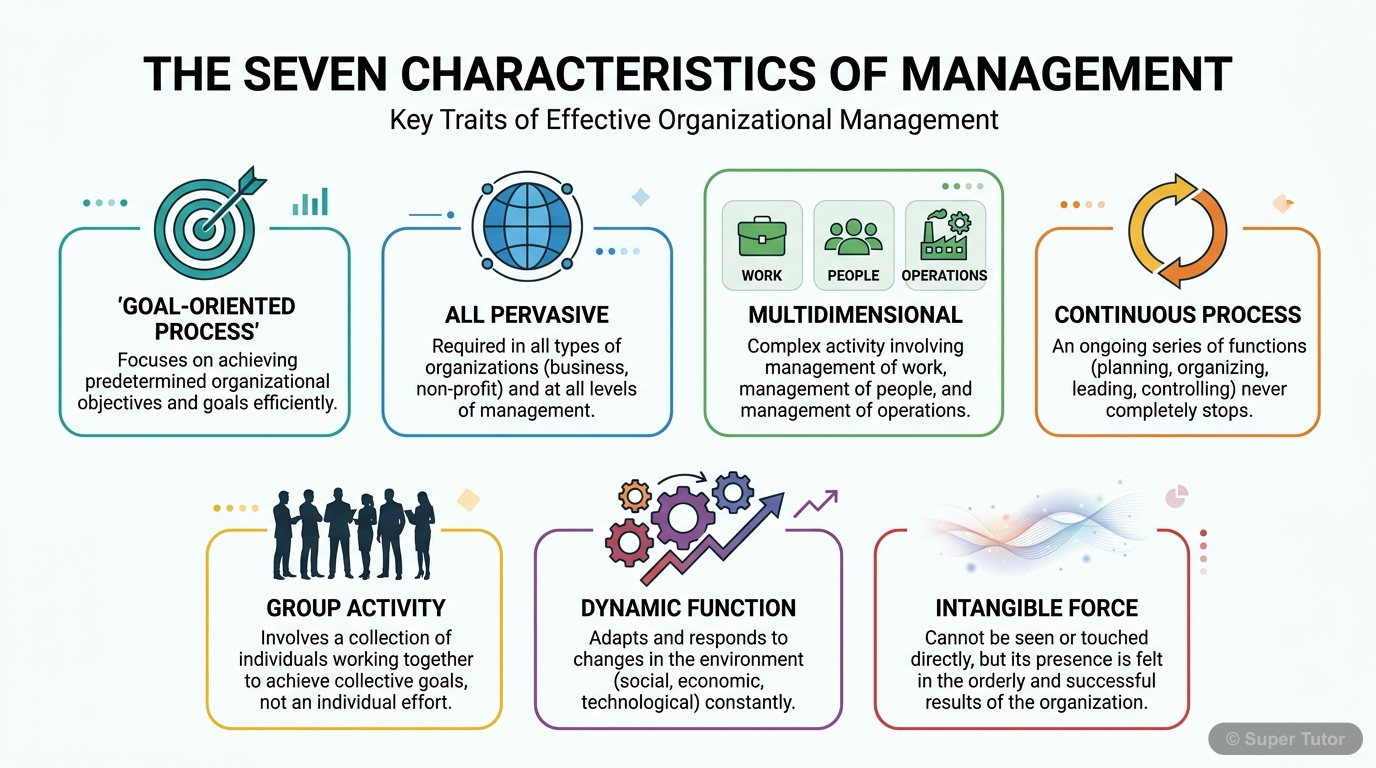
Learn better with visuals Super Tutor has hundreds of illustrations like this across every chapter — all free to try.
Get startedSample Questions
According to Fayol's principle of 'Scalar Chain', what does the 'Gang Plank' allow?
Show answer
Two employees at the same level to communicate directly in emergencies.
Step 1: Fayol's Scalar Chain is the formal line of authority from the highest to the lowest rank in an organisation. Step 2: Normally, all communication must follow this chain. Step 3: However, Fayol recognised that strictly following the chain in urgent situations can cause delays. Step 4: He suggested the 'Gang Plank' — a direct horizontal communication channel between employees at the same level when an emergency requires it. Step 5: This keeps the scalar chain intact for normal communication while allowing flexibility in emergencies.
Which of the following is NOT a characteristic of management?
Show answer
Management is tangible and easily visible.
Step 1: Go through each option and check if it is a valid characteristic of management. Step 2: 'Universal' — True. Management is needed in every type of organisation. Step 3: 'Continuous process' — True. Management is ongoing as long as the organisation exists. Step 4: 'Goal directed' — True. All management activities are aimed at achieving organisational goals. Step 5: 'Tangible and easily visible' — FALSE. Management is INTANGIBLE. You cannot see management directly; you can only feel its presence through rules, outputs, and work climate. Therefore, Option C is the one that is NOT a charact
The Differential Piece Rate Plan was introduced by Taylor to:
Show answer
Motivate workers by paying higher rates to efficient workers and lower rates to less efficient ones.
Step 1: The Differential Piece Rate Plan is one of Taylor's key techniques. Step 2: Under this plan, two different wage rates are set — a higher rate for workers who meet or exceed the standard output, and a lower rate for those who fall below it. Step 3: For example, if standard output is 100 units and two rates are ₹1 and ₹0.75: a worker producing 120 units earns ₹120 (at ₹1/unit), while a worker producing 80 units earns only ₹60 (at ₹0.75/unit). Step 4: This creates a financial incentive for workers to improve their efficiency. Step 5: It is not about equal wages or reducing workers — it is
Under Taylor's Functional Foremanship, which specialist foreman is responsible for maintaining the planned speed of production?
Show answer
Speed Boss
Step 1: Functional Foremanship is Taylor's technique where a worker is supervised by several specialist foremen, each expert in a specific area. Step 2: There are 8 foremen divided under Planning and Production departments. Step 3: Under the Production Department, the Speed Boss is responsible for maintaining the planned speed of production and investigating causes of delay. Step 4: The Gang Boss arranges workers and materials; the Repair Boss maintains machines; and the Inspector checks quality of output. Step 5: The Route Clerk belongs to the Planning Department and determines the route of r
+40 more questions available
Practice AllFrequently Asked Questions
What are the important topics in Fundamentals of Management for NIOS Class 12 Business Studies?
How to score full marks in Fundamentals of Management — NIOS Class 12 Business Studies?
How many important questions are there in Fundamentals of Management?
Sources & Official References
Content is aligned to the official syllabus. Refer to the board website for the latest curriculum.
More resources for Fundamentals of Management
Practice Quiz
Test yourself with a quick quiz
Revision Notes
Key points for last-minute revision
Formula Sheet
All formulas in one place
Chapter Summary
Understand the chapter at a glance
Concept Maps
See how topics connect visually
Study Plan
Step-by-step plan to ace this chapter
Flashcards
Quick-fire cards for active recall
Syllabus
What topics to cover
NCERT Solutions
Every textbook question solved step by step
For serious students
Get the full Fundamentals of Management chapter — for free.
Quizzes, flashcards, AI doubt-solver and a step-by-step study plan for NIOS Class 12 Business Studies.