Forms of Business Organisations — Important Questions
NIOS · Class 12 · Business Studies
45 important questions from Forms of Business Organisations for NIOS Class 12 Business Studies, with answers. Includes multiple choice questions.
Interactive on Super Tutor
Studying Forms of Business Organisations? Get the full interactive chapter.
Quizzes, flashcards, AI doubt-solver and a step-by-step study plan — built for important questions and more.
Free trial, no card needed.
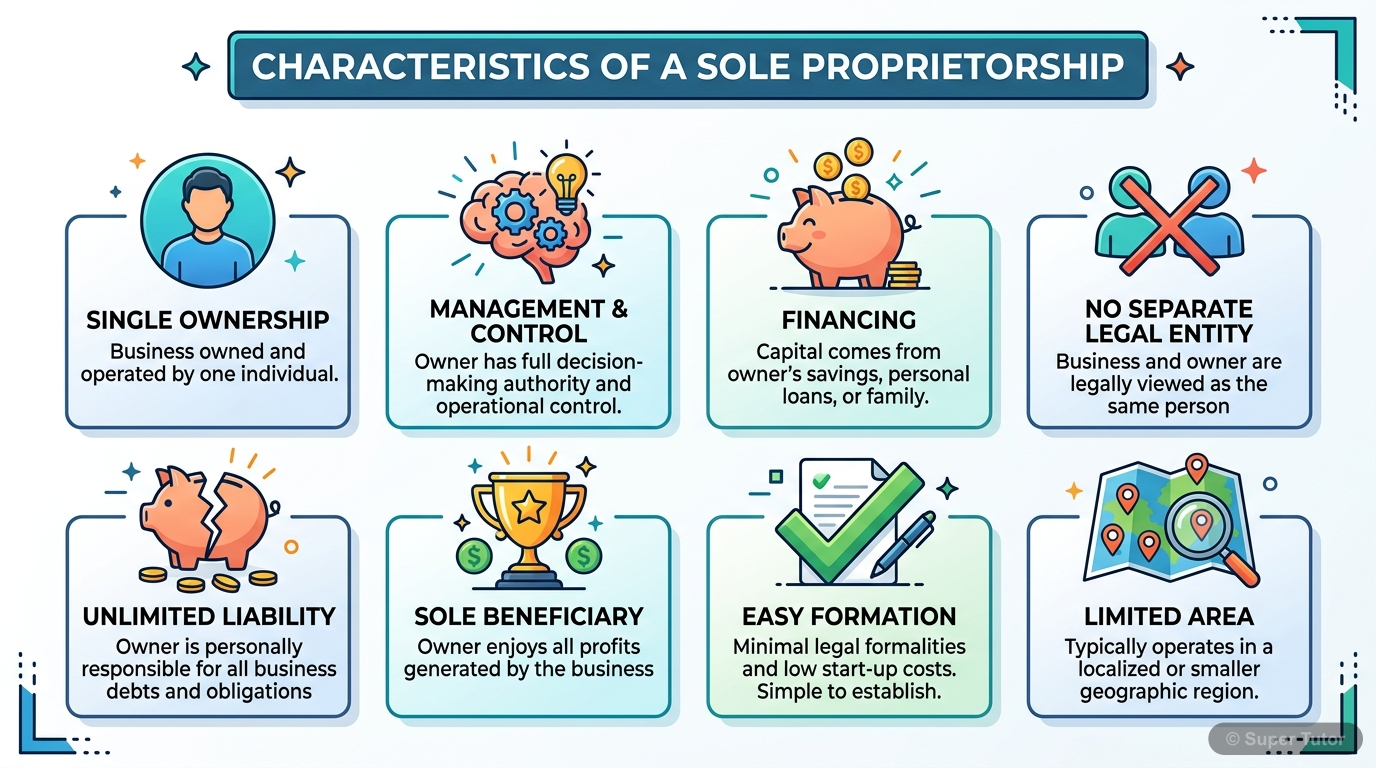
Learn better with visuals Super Tutor pairs illustrations like this with notes and quizzes for Forms of Business Organisations.
Important Questions from Forms of Business Organisations
Which of the following is NOT a characteristic of a Cooperative Society?
Show answer
Profit maximisation as the primary objective
Step 1: The question asks which option is NOT a characteristic of cooperative societies. Step 2: Cooperative societies are fundamentally different from other business forms because their PRIMARY objective is SERVICE to members, not profit maximisation. Step 3: Options A, B, and D are all genuine characteristics — voluntary membership, one-man one-vote democracy, and compulsory registration are all real features. Step 4: While cooperative societies do earn some profit, it is NOT their main goal. The surplus is distributed as bonus or kept as reserve. Step 5: This is a common exam question — alw
In the absence of a Partnership Deed, what rate of interest is allowed on a loan given by a partner to the firm?
Show answer
6% per annum
Step 1: When there is no written Partnership Deed, the Indian Partnership Act 1932 provides default rules. Step 2: As per these rules, a partner who gives a LOAN to the firm (beyond their capital contribution) is entitled to interest at 6% per annum. Step 3: It is important to distinguish: No interest is allowed on CAPITAL contribution in the absence of an agreement. Step 4: But interest on LOAN is allowed at 6% even without an agreement. Step 5: This is a frequently tested fact — memorise the figure 6% specifically for loans, and 'no interest' for capital.
Which form of business organisation is MOST suitable when a business requires manual skills like handicrafts, jewellery making, or tailoring?
Show answer
Sole Proprietorship
Step 1: The question mentions businesses involving manual skills and personal craftsmanship. Step 2: Sole proprietorship is most suitable when: the market is small/localised, capital requirement is small, and the business involves personal manual skills. Step 3: Handicrafts, jewellery, tailoring, and haircutting are classic examples given for sole proprietorship suitability in the textbook. Step 4: Joint Stock Companies require large capital and are for large-scale operations — not suitable. Step 5: Cooperative societies focus on collective benefit for members. Partnership involves sharing — b
Ramesh publicly behaves as though he is a partner of XYZ firm, although he is not officially one. Due to this, a third party suffers a loss. What type of partner is Ramesh considered to be?
Show answer
Partner by Estoppel
Step 1: Let us carefully read the situation — Ramesh gives an IMPRESSION through his own conduct/behaviour that he is a partner. Step 2: When a person's OWN behaviour or conduct leads others to believe he is a partner, he is a PARTNER BY ESTOPPEL. Step 3: He is fully liable if any third party suffers because of this false representation. Step 4: PARTNER BY HOLDING OUT is different — here the FIRM declares that a certain person is a partner, and that person doesn't deny it. Step 5: Nominal partner only lends their name officially; sleeping partner is a real partner who doesn't participate. Rame
+41 more questions on Forms of Business Organisations (NIOS Class 12 Business Studies)
Practise AllFrequently Asked Questions
What are the important topics in Forms of Business Organisations for NIOS Class 12 Business Studies?
How many important questions are there in Forms of Business Organisations?
Sources & Official References
Content is aligned to the official syllabus. Refer to the board website for the latest curriculum.
More resources for Forms of Business Organisations
For serious students
Get the full Forms of Business Organisations chapter — start free.
Quizzes, flashcards, an AI doubt solver and a study plan for NIOS Class 12 Business Studies. Free to start, no card needed.