Business Support Services — Practice Quiz
NIOS · Class 12 · Business Studies
Try a 4-question quiz on Business Support Services for NIOS Class 12 Business Studies: tap an answer to check it and see why.
Interactive on Super Tutor
Studying Business Support Services? Get the full interactive chapter.
Quizzes, flashcards, AI doubt-solver and a step-by-step study plan — built for practice quiz and more.
Free trial, no card needed.
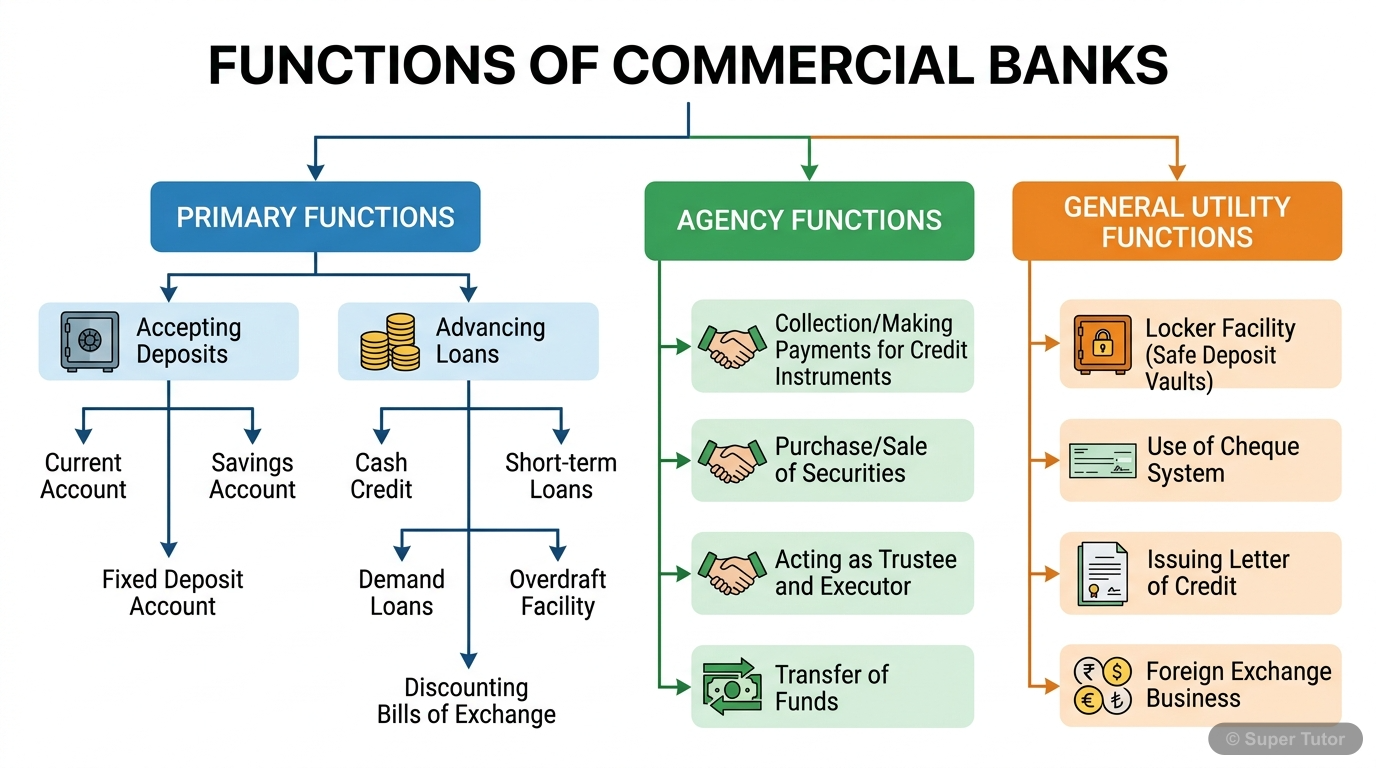
An illustration from Super Tutor's Business Support Services chapter — alongside flashcards, concept maps and practice questions.
Quick Quiz: Business Support Services
0/4Tap an answer to check it instantly. No sign-up needed for these 4.
Which of the following best describes the primary role of business support services?
Which type of bank account offers the highest rate of interest among the following?
Ravi deposits ₹2,000 every month for 5 years in his bank account. Which type of account is Ravi using?
RTGS (Real Time Gross Settlement) transactions have a minimum amount requirement. What is this minimum amount?
Sample Questions
Which of the following is NOT a function of the Reserve Bank of India (RBI)?
Show answer
Accepting deposits from the general public directly
Step 1: The RBI is the central bank of India and is known as the 'bankers' bank' and 'banker to the government'. Step 2: RBI issues currency notes and regulates money supply — this is a core RBI function. Step 3: RBI acts as banker to the government, maintaining records of government receipts and payments — this is correct. Step 4: RBI regulates and supervises all banking institutions — this is a key function of RBI. Step 5: RBI does NOT deal directly with the general public. It does not accept deposits from individuals. This is the function of commercial banks. Therefore, Option C is NOT a fu
Sanjana insures her shop against fire for ₹10 lakh. A fire damages the shop and the repair cost is ₹3 lakh. How much can Sanjana claim from the insurance company?
Show answer
₹3 lakh (actual loss)
Step 1: This question is based on the Principle of Indemnity in insurance. Step 2: The Principle of Indemnity states that the insured can only be compensated for the actual loss suffered — not more, not less. Step 3: The insured sum is ₹10 lakh, but the actual damage is only ₹3 lakh. Step 4: According to the principle, compensation = actual loss OR sum insured, whichever is LOWER. Step 5: Since ₹3 lakh (actual loss) is lower than ₹10 lakh (insured amount), Sanjana can claim only ₹3 lakh. Insurance does not allow profit from a claim.
Which principle of insurance requires both the insured and insurer to disclose all relevant and material information?
Show answer
Principle of Utmost Good Faith
Step 1: In insurance, each principle addresses a specific requirement of a valid contract. Step 2: Principle of Insurable Interest — the insured must have a financial interest in the subject matter. Step 3: Principle of Subrogation — ownership of damaged property passes to the insurer after claim is settled. Step 4: Principle of Contribution — when insured with multiple insurers, each shares the loss proportionately. Step 5: Principle of Utmost Good Faith (Uberrimae Fidei) — both parties must disclose ALL relevant facts. For example, in life insurance, the insured must honestly reveal health c
A Life Insurance policy under which the sum assured is paid to the policy holder on surviving the policy term OR to the heirs on death of the insured is called:
Show answer
Endowment Policy
Step 1: Compare different types of life insurance policies. Step 2: Whole-life Policy — premium is paid throughout life or for a fixed term; amount is paid ONLY to heirs after death. It does not cover survival benefit during the policy term. Step 3: Money Back Policy — gives periodic payments (e.g., 20% every 5 years) during the policy term itself. Step 4: Group Insurance Scheme — provides life insurance to a group of people (e.g., company employees) at low cost. Step 5: Endowment Policy — runs for a limited period. If the insured survives, the sum is paid to the insured. If the insured dies b
+41 more questions on Business Support Services (NIOS Class 12 Business Studies)
Practise AllFrequently Asked Questions
What are the important topics in Business Support Services for NIOS Class 12 Business Studies?
How many practice questions are there for Business Support Services?
Sources & Official References
Content is aligned to the official syllabus. Refer to the board website for the latest curriculum.
More resources for Business Support Services
For serious students
Get the full Business Support Services chapter — start free.
Quizzes, flashcards, an AI doubt solver and a study plan for NIOS Class 12 Business Studies. Free to start, no card needed.