Planning and Organising — Practice Quiz
NIOS · Class 12 · Business Studies
Try a 4-question quiz on Planning and Organising for NIOS Class 12 Business Studies: tap an answer to check it and see why.
Interactive on Super Tutor
Studying Planning and Organising? Get the full interactive chapter.
Quizzes, flashcards, AI doubt-solver and a step-by-step study plan — built for practice quiz and more.
Free trial, no card needed.
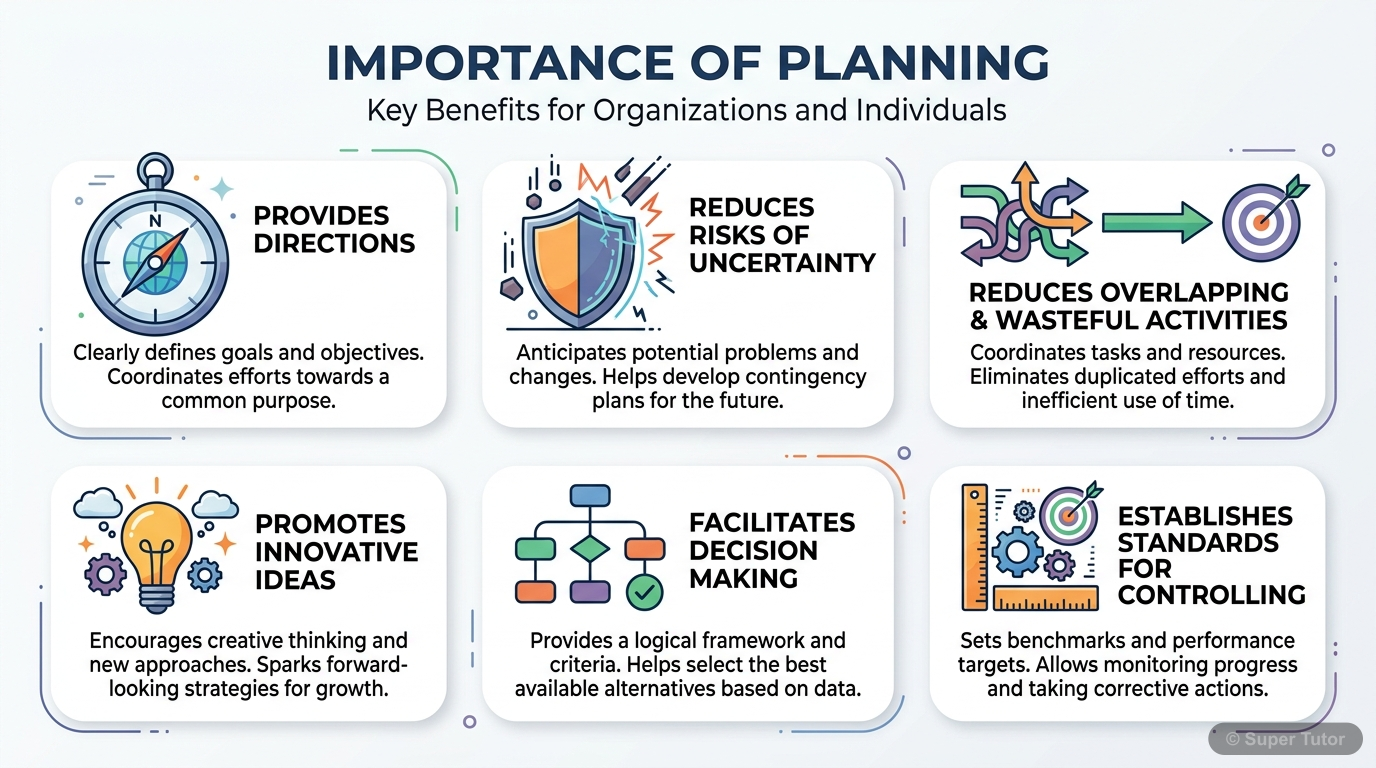
Learn better with visuals Super Tutor pairs illustrations like this with notes and quizzes for Planning and Organising.
Quick Quiz: Planning and Organising
0/4Tap an answer to check it instantly. No sign-up needed for these 4.
Planning is defined as the process of setting future objectives and deciding on the ways and means of achieving them. Which of the following best describes the primary purpose of planning?
Which feature of planning states that it is required at all levels of management and for all functional areas?
A sugar factory revised its production plan from 1,000 tons to 800 tons due to unexpected snowfall that destroyed the sugarcane crop. Which feature of planning does this example illustrate?
Which of the following is a limitation of planning?
Sample Questions
What is the FIRST step in the planning process?
Show answer
Establishment of Objectives
Step 1: The planning process follows a specific sequence. Step 2: According to the chapter, the planning process starts with 'Establishment of Objectives' – all plans begin by clearly defining what the organisation wants to achieve. Step 3: Making Assumptions (Step 2), Evaluation of Alternatives (Step 4), and Selection of Course of Action (Step 5) all come AFTER objectives are set. Step 4: You cannot plan anything without first knowing your goal, just like you cannot plan a journey without knowing your destination. Step 5: Therefore, Establishment of Objectives is the first and most fundamenta
Tata adopted the strategy of launching the Nano car to attract middle-income group customers. Which type of plan does this represent?
Show answer
Strategy
Step 1: The chapter defines Strategy as a comprehensive plan formulated by considering competitors and the market environment for optimum utilisation of resources. Step 2: The Tata Nano example is directly given in the chapter under 'Strategy' – it was a plan to attract a new customer segment (middle-income group). Step 3: A Policy is a general guideline for decision-making. A Budget is a numerical/financial plan. A Procedure is a sequence of steps for doing work. Step 4: Since launching a cheaper car to beat competition and attract new customers is a broad, comprehensive business plan, it is
A company has a rule that says 'No Smoking on Company Premises.' Which type of plan does this represent?
Show answer
Rule
Step 1: The chapter defines Rules as plans that clearly indicate what IS to be done and what is NOT to be done in a particular situation. Step 2: 'No Smoking on Company Premises' is a clear, strict guideline about what is NOT allowed. The chapter even gives 'No Smoking in a factory' as an example of a Rule. Step 3: A Policy is a general statement that guides decision-making (broader). A Programme is a plan for accomplishing a specific objective over time. A Method is a standardised way of performing a task. Step 4: Since this statement gives a strict, specific directive about behaviour, it is
A Cash Budget estimates expected cash inflows and outflows over a period. Which type of plan is a budget?
Show answer
A statement of expected results expressed in numerical terms
Step 1: The chapter defines Budget as 'a statement of expected results expressed in numerical terms.' Step 2: Budgets can be in financial terms (money), labour hours, machine hours, or units of product. Step 3: 'A general statement that guides decision-making' is the definition of a Policy. 'A sequence of steps' is the definition of a Procedure. 'A comprehensive plan to face competition' is the definition of a Strategy. Step 4: Since a Cash Budget estimates cash inflows and outflows (numbers/financial figures), it perfectly matches the definition of a Budget. Step 5: Therefore, the correct ans
+40 more questions on Planning and Organising (NIOS Class 12 Business Studies)
Practise AllFrequently Asked Questions
What are the important topics in Planning and Organising for NIOS Class 12 Business Studies?
How many practice questions are there for Planning and Organising?
Sources & Official References
Content is aligned to the official syllabus. Refer to the board website for the latest curriculum.
More resources for Planning and Organising
For serious students
Get the full Planning and Organising chapter — start free.
Quizzes, flashcards, an AI doubt solver and a study plan for NIOS Class 12 Business Studies. Free to start, no card needed.