Co-ordination And Controlling — Practice Quiz
NIOS · Class 12 · Business Studies
Try a 4-question quiz on Co-ordination And Controlling for NIOS Class 12 Business Studies: tap an answer to check it and see why.
Interactive on Super Tutor
Studying Co-ordination And Controlling? Get the full interactive chapter.
Quizzes, flashcards, AI doubt-solver and a step-by-step study plan — built for practice quiz and more.
Free trial, no card needed.
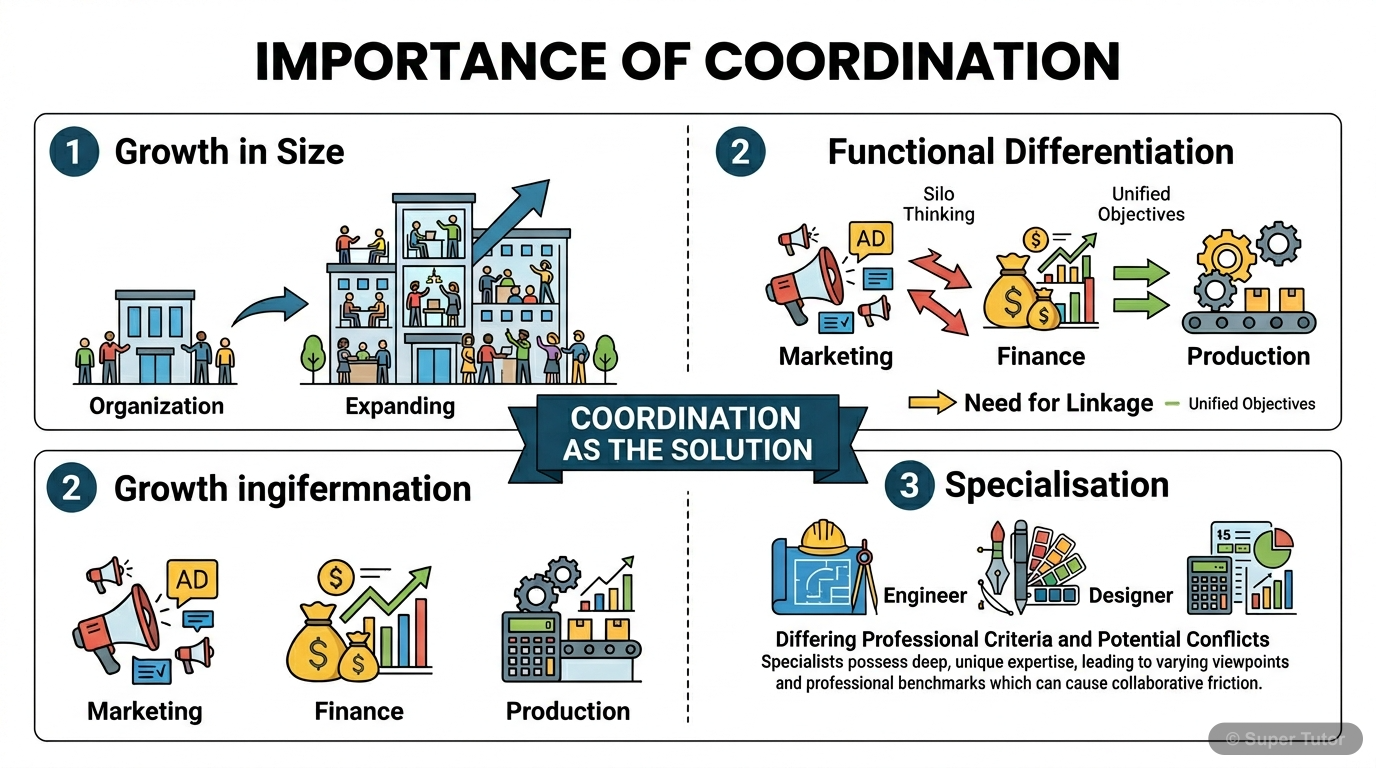
Learn better with visuals Super Tutor pairs illustrations like this with notes and quizzes for Co-ordination And Controlling.
Quick Quiz: Co-ordination And Controlling
0/4Tap an answer to check it instantly. No sign-up needed for these 4.
Which of the following best describes the meaning of 'Co-ordination' in management?
Co-ordination is called the 'essence of management' because:
As the size of an organisation grows, the need for co-ordination:
According to Henri Fayol, controlling consists of:
Sample Questions
Which of the following is the FIRST step in the process of control?
Show answer
Establishment of standards
Step 1: The control process follows a fixed sequence of steps. Step 2: Before you can measure or compare anything, you need a benchmark or target — this is called a 'standard'. Step 3: For example, a supervisor tells a worker to sew 20 trousers per day — this is the standard being set. Step 4: Only after standards are set can performance be measured (Step 2), compared (Step 3), deviations detected (Step 4), and corrective action taken (Step 5). Step 5: Without standards, control is meaningless — you would not know what to compare actual performance against.
In the control process, after comparing actual performance with standards, a manager notices a deviation. What should be the NEXT immediate step?
Show answer
Detect and analyse the reasons for the deviation
Step 1: The control process has five steps: Setting standards → Measuring performance → Comparing with standards → Detecting reasons for deviations → Taking corrective action. Step 2: After comparison reveals a deviation, the manager must first find out WHY the deviation occurred. Step 3: This is important because the cause may be unrealistic standards (not the employee's fault), faulty machinery, poor instructions, or genuine inefficiency. Step 4: Taking corrective action without knowing the cause may lead to wrong decisions — for example, punishing an employee when the machine was faulty. St
Which characteristic of control states that it is not a one-time exercise but a regular ongoing function?
Show answer
Control is a Continuous Process
Step 1: Each characteristic of control has a specific meaning. Step 2: 'All Pervasive' means control is exercised at all levels and in all departments. Step 3: 'Forward Looking' means control helps ensure future performance conforms to plans. Step 4: 'Planning is the Basis of Control' means standards come from plans. Step 5: 'Continuous Process' specifically refers to the fact that control is an ongoing, dynamic function — it involves regular review of performance and is not done just once. The period of control depends on the nature and amount of work.
The statement 'Without planning, control is blind' means:
Show answer
Control cannot function without the standards and targets provided by planning
Step 1: Planning and controlling are interdependent — they are two sides of the same coin. Step 2: Planning sets goals, objectives, and standards against which performance is measured. Step 3: If there are no plans (no standards), a manager has nothing to compare actual performance against — hence control becomes 'blind' or purposeless. Step 4: For example, if there is no target of 20 trousers per day, the supervisor cannot judge whether 18 trousers is good or bad performance. Step 5: This does NOT mean planning is more important — both are equally essential. They support each other.
+41 more questions on Co-ordination And Controlling (NIOS Class 12 Business Studies)
Practise AllFrequently Asked Questions
What are the important topics in Co-ordination And Controlling for NIOS Class 12 Business Studies?
How many practice questions are there for Co-ordination And Controlling?
Sources & Official References
Content is aligned to the official syllabus. Refer to the board website for the latest curriculum.
More resources for Co-ordination And Controlling
For serious students
Get the full Co-ordination And Controlling chapter — start free.
Quizzes, flashcards, an AI doubt solver and a study plan for NIOS Class 12 Business Studies. Free to start, no card needed.