Data Communication and Networking — Important Questions
NIOS · Class 12 · Computer Science
45 important questions from Data Communication and Networking for NIOS Class 12 Computer Science, with answers. Includes multiple choice questions.
Interactive on Super Tutor
Studying Data Communication and Networking? Get the full interactive chapter.
Quizzes, flashcards, AI doubt-solver and a step-by-step study plan — built for important questions and more.
Free trial, no card needed.
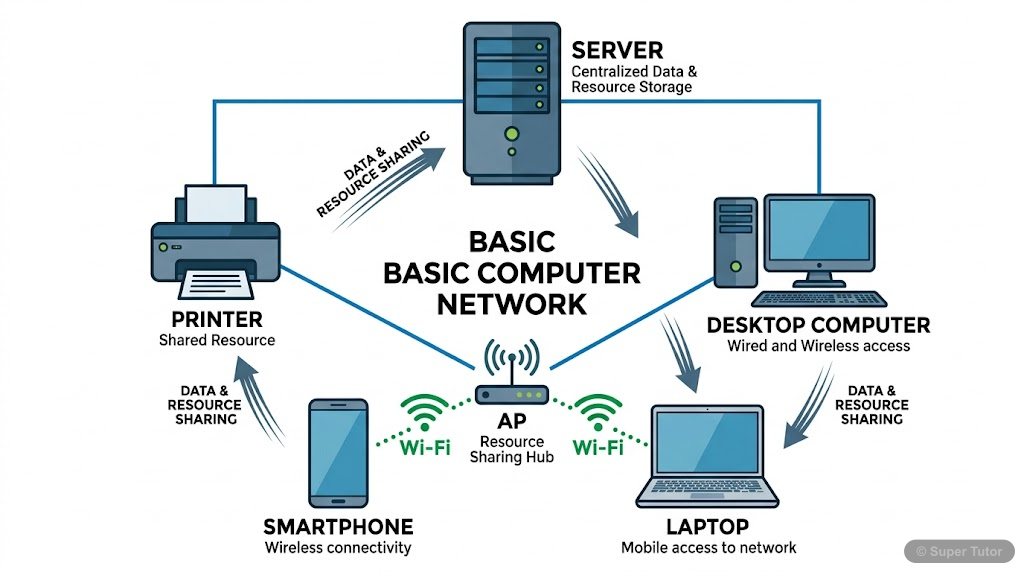
Learn better with visuals Super Tutor pairs illustrations like this with notes and quizzes for Data Communication and Networking.
Important Questions from Data Communication and Networking
What does a MODEM do in a computer network?
Show answer
It converts digital data to analog and analog to digital
Step 1: MODEM stands for MOdulator-DEModulator. Step 2: Computers work with digital data (0s and 1s), but traditional telephone lines carry analog signals. Step 3: Modulation: When sending data, the modem converts digital signals from the computer into analog signals that can travel over telephone lines. Step 4: Demodulation: When receiving data, the modem converts the incoming analog signals back into digital signals that the computer can understand. Step 5: So a modem acts as a translator between digital computers and analog communication lines.
Which type of network covers the LARGEST geographical area?
Show answer
WAN (Wide Area Network)
Step 1: Computer networks are classified based on their geographical coverage. Step 2: LAN (Local Area Network) covers a small area like a single building or group of buildings — for example, a school computer lab. Step 3: MAN (Metropolitan Area Network) covers a city or campus — for example, a network connecting all branches of a bank in a city. Step 4: WAN (Wide Area Network) covers the largest area — it can span an entire country or even the whole world. Step 5: The Internet itself is the best-known example of a WAN. So WAN covers the largest geographical area.
In which network topology are ALL computers connected to a single central cable called a backbone?
Show answer
Bus Topology
Step 1: Network topology describes how computers are physically connected to each other. Step 2: In Bus Topology, all computers are connected to a single cable called the backbone or bus, with terminators at each end. Step 3: Data travels along this single cable and every computer receives it, but only the intended computer processes it. Step 4: In Star Topology, all computers connect to a central hub or switch. In Ring Topology, computers are connected in a circle. In Mesh Topology, every computer connects to every other computer. Step 5: Bus topology uses the least amount of cable and is cos
Which network topology uses a central hub or switch, where every computer has a dedicated connection to that central device?
Show answer
Star Topology
Step 1: In Star Topology, every computer (node) is connected to a central device — usually a hub or a switch. Step 2: No computer is directly connected to another; all communication passes through the central hub. Step 3: This makes it easy to add new computers, troubleshoot problems, and isolate faults — if one computer's cable fails, only that computer is affected. Step 4: However, if the central hub fails, the entire network goes down. Step 5: Star topology is very commonly used in home and office networks today because of its reliability and ease of management.
+41 more questions on Data Communication and Networking (NIOS Class 12 Computer Science)
Practise AllFrequently Asked Questions
What are the important topics in Data Communication and Networking for NIOS Class 12 Computer Science?
How many important questions are there in Data Communication and Networking?
Sources & Official References
Content is aligned to the official syllabus. Refer to the board website for the latest curriculum.
More resources for Data Communication and Networking
For serious students
Get the full Data Communication and Networking chapter — start free.
Quizzes, flashcards, an AI doubt solver and a study plan for NIOS Class 12 Computer Science. Free to start, no card needed.