Data Communication and Networking — Flashcards
NIOS · Class 12 · Computer Science
24 flashcards for Data Communication and Networking (NIOS Class 12 Computer Science) to test yourself on key terms and facts.
Interactive on Super Tutor
Studying Data Communication and Networking? Get the full interactive chapter.
Quizzes, flashcards, AI doubt-solver and a step-by-step study plan — built for flashcards and more.
Free trial, no card needed.
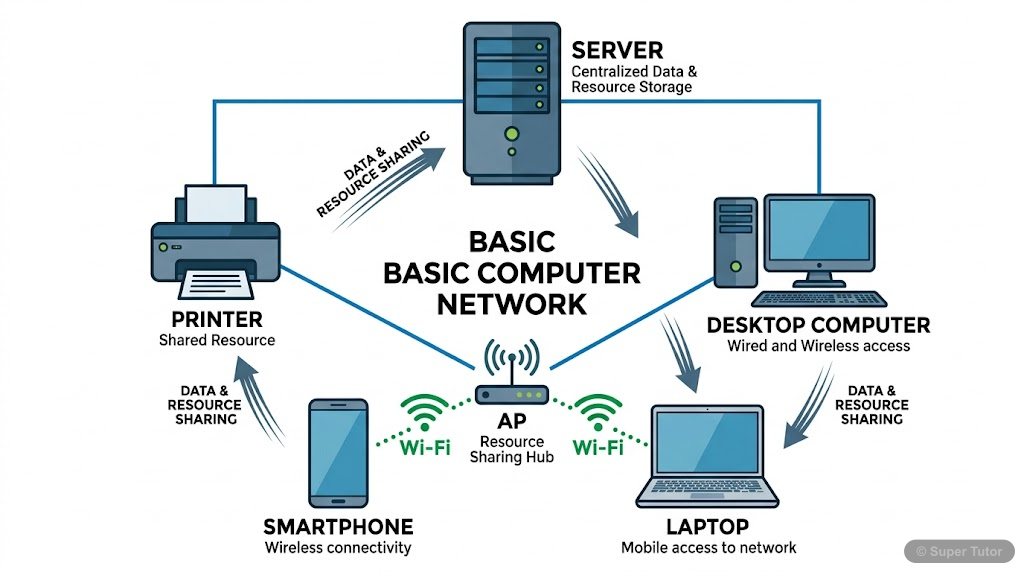
Learn better with visuals Super Tutor pairs illustrations like this with notes and quizzes for Data Communication and Networking.
What are the three basic elements of a data communication system?
Answer
The three basic elements are: 1. Transmitter - converts information into suitable form for transmission 2. Channel - the physical medium (cable, wireless, optical fiber) used to send information 3. Re…
Explain the difference between simplex, half-duplex, and full-duplex transmission modes with real-world examples.
Answer
SIMPLEX (One-way only): - Data flows in only one direction - Receiver cannot respond - Example: Television broadcast, radio HALF-DUPLEX (Two-way, but not simultaneous): - Data can flow both direction…
Why is digital transmission preferred over analog transmission in modern computer networks?
Answer
Digital transmission advantages over analog: 1. CLARITY: Uses discrete states (0s and 1s) - less susceptible to noise and interference 2. EFFICIENCY: Data is represented as simple binary signals 3. A…
What is bandwidth and how does it affect data transmission? Explain the three classes of bandwidth.
Answer
BANDWIDTH: The range of frequencies that make up a signal, determining how much data can be transmitted. THREE CLASSES OF BANDWIDTH: 1. NARROWBAND (≤ 64 Kbps) - Also called DS-0 channel - Sufficient…
A school wants to set up internet for 500 students. If narrowband can handle 64 Kbps and each student needs 2 Mbps during peak hours, calculate minimum bandwidth required and suggest suitable transmis
Answer
CALCULATION: Bandwidth needed = 500 students × 2 Mbps = 1000 Mbps = 1 Gbps Narrowband capacity = 64 Kbps = 0.064 Mbps Narrowband connections needed = 1000 ÷ 0.064 = 15,625 connections (not practical!
Compare twisted pair, coaxial cable, and optical fiber cables in terms of speed, distance, cost, and security.
Answer
TRANSMISSION MEDIA COMPARISON: TWISTED PAIR: - Speed: Slow (≤ 100 Mbps) - Distance: Short (< 100 meters) - Cost: Cheapest - Security: Vulnerable to interference - Use: Local phone lines, LAN COAXIAL…
What is the purpose of a modem and how does it enable computer communication over telephone lines?
Answer
MODEM PURPOSE: Modem = Modulator-Demodulator Enables digital computers to communicate over analog telephone lines. TWO-WAY CONVERSION PROCESS: 1. MODULATION (Digital → Analog): - Computer sends d…
What is RJ45 connector and why is it important for Ethernet networking?
Answer
RJ45 CONNECTOR: DEFINITION: RJ45 = Registered Jack 45 A standardized connector used for Ethernet networking Looks like a slightly wider version of a telephone jack PHYSICAL CHARACTERISTICS: - 8 pin …
+16 more flashcards
Practise AllFrequently Asked Questions
What are the important topics in Data Communication and Networking for NIOS Class 12 Computer Science?
How many flashcards are available for Data Communication and Networking?
How should I revise Data Communication and Networking for the NIOS Class 12 board exam?
Sources & Official References
Content is aligned to the official syllabus. Refer to the board website for the latest curriculum.
More resources for Data Communication and Networking
For serious students
Get the full Data Communication and Networking chapter — start free.
Quizzes, flashcards, an AI doubt solver and a study plan for NIOS Class 12 Computer Science. Free to start, no card needed.