Sequences and Series — Important Questions
NIOS · Class 12 · Mathematics
45 important questions from Sequences and Series for NIOS Class 12 Mathematics, with answers. Includes multiple choice questions.
Interactive on Super Tutor
Studying Sequences and Series? Get the full interactive chapter.
Quizzes, flashcards, AI doubt-solver and a step-by-step study plan — built for important questions and more.
Free trial, no card needed.
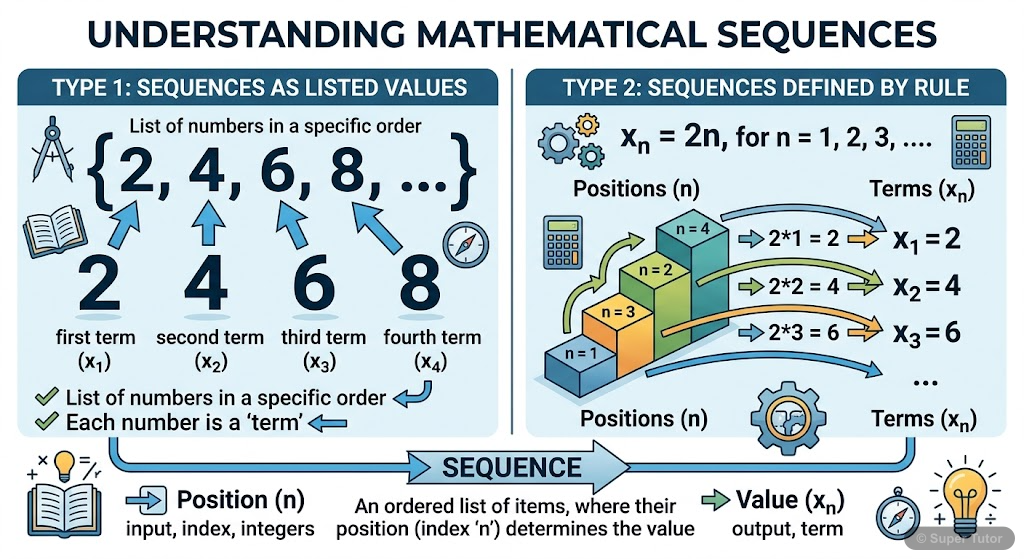
Learn better with visuals Super Tutor pairs illustrations like this with notes and quizzes for Sequences and Series.
Important Questions from Sequences and Series
How many terms of the GP 3, 3², 3³, ... are needed so that their sum exceeds 1000?
Show answer
6
Step 1: This is a GP with a = 3, r = 3. Sum formula: Sn = a(rⁿ - 1)/(r - 1) = 3(3ⁿ - 1)/2. Step 2: We need Sn > 1000, so 3(3ⁿ - 1)/2 > 1000, giving 3ⁿ - 1 > 666.67, so 3ⁿ > 667.67. Step 3: Check n=5: 3⁵ = 243. S5 = 3(243-1)/2 = 3×242/2 = 363. Not exceeding 1000. Step 4: Check n=6: 3⁶ = 729. S6 = 3(729-1)/2 = 3×728/2 = 1092 > 1000. ✓ Step 5: So 6 terms are needed. Students often make arithmetic errors with powers of 3; note 3⁶ = 729, not 648.
The 4th term of a GP is 2/3 and the 7th term is 16/81. Find the common ratio.
Show answer
2/3
Step 1: Let a be the first term and r be the common ratio. Then t4 = ar³ = 2/3 and t7 = ar⁶ = 16/81. Step 2: Divide t7 by t4: (ar⁶)/(ar³) = (16/81)/(2/3). Step 3: r³ = (16/81) × (3/2) = 48/162 = 8/27. Step 4: Therefore r = ∛(8/27) = 2/3. Step 5: Verify: t4 = ar³ = 2/3 and t7 = ar⁶ = ar³ × r³ = (2/3)(8/27) = 16/81. ✓ A common error is to compute t7/t4 = r⁴ instead of r³.
If the sum of an infinite GP is 4 and the sum of the squares of its terms is 16/3, find the first term.
Show answer
3
Step 1: Let first term be a and common ratio r. Sum S = a/(1-r) = 4, so a = 4(1-r). Step 2: The squares of the GP terms a², a²r², a²r⁴,... form a GP with first term a² and common ratio r². Sum of squares = a²/(1-r²) = 16/3. Step 3: a²/(1-r²) = a²/[(1-r)(1+r)] = [a/(1-r)] × [a/(1+r)] = 4 × [a/(1+r)] = 16/3. Step 4: So a/(1+r) = 4/3. Also a/(1-r) = 4. Dividing: (1-r)/(1+r) = 1/3, giving 3-3r = 1+r, so 4r = 2, r = 1/2. Step 5: Therefore a = 4(1 - 1/2) = 4 × 1/2 = 2. Wait - let me recheck: a/(1-r) = 4 with r=1/2 gives a = 4×1/2 = 2. But a/(1+r) = 2/(3/2) = 4/3. ✓. Hmm, first term = 2. Let me re-ex
Three numbers form an AP. Their sum is 24 and their product is 440. Find the largest number.
Show answer
11
Step 1: Let the three numbers in AP be (a-d), a, (a+d). Their sum = 3a = 24, so a = 8. Step 2: Product = (a-d)(a)(a+d) = a(a² - d²) = 440. Step 3: 8(64 - d²) = 440, so 64 - d² = 55, giving d² = 9, d = ±3. Step 4: When d = 3: numbers are 5, 8, 11. When d = -3: numbers are 11, 8, 5. Step 5: In both cases, the three numbers are 5, 8, 11. The largest number is 11. A common mistake is to forget to use a as the middle term or to make errors expanding (a-d)(a+d) = a²-d².
+41 more questions on Sequences and Series (NIOS Class 12 Mathematics)
Practise AllFrequently Asked Questions
What are the important topics in Sequences and Series for NIOS Class 12 Mathematics?
How many important questions are there in Sequences and Series?
Sources & Official References
Content is aligned to the official syllabus. Refer to the board website for the latest curriculum.
More resources for Sequences and Series
For serious students
Get the full Sequences and Series chapter — start free.
Quizzes, flashcards, an AI doubt solver and a study plan for NIOS Class 12 Mathematics. Free to start, no card needed.