Sets — Important Questions
NIOS · Class 12 · Mathematics
45 important questions from Sets for NIOS Class 12 Mathematics, with answers. Includes multiple choice questions. Written for the board exams 2027.
Interactive on Super Tutor
Studying Sets? Get the full interactive chapter.
Quizzes, flashcards, AI doubt-solver and a step-by-step study plan — built for important questions and more.
Free trial, no card needed.
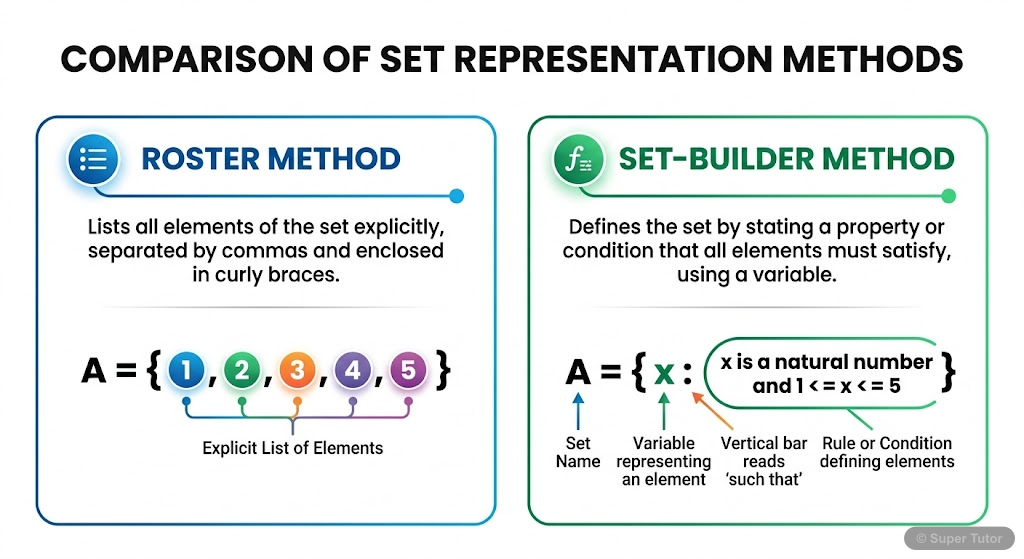
Learn better with visuals Super Tutor pairs illustrations like this with notes and quizzes for Sets.
Important Questions from Sets
If U = {1,2,3,...,10}, A = {1,3,5,7,9} and B = {2,3,5,7}, then (A ∩ B)' equals:
Show answer
{1, 2, 4, 6, 8, 9, 10}
Step 1: First find A ∩ B = elements common to both A and B = {3, 5, 7}. Step 2: The complement of a set means all elements in U that are NOT in that set. Step 3: (A ∩ B)' = U - (A ∩ B) = {1,2,3,4,5,6,7,8,9,10} - {3,5,7}. Step 4: (A ∩ B)' = {1, 2, 4, 6, 8, 9, 10}, which has 7 elements. This can also be verified using De Morgan's law: (A∩B)' = A'∪B'.
Which of the following correctly represents the interval {x ∈ R : -3 ≤ x < 5}?
Show answer
[-3, 5)
Step 1: The set is {x ∈ R : -3 ≤ x < 5}. Identify the boundary conditions. Step 2: At x = -3, the condition is ≤ (less than or equal), meaning -3 IS included. A closed bracket [ is used for included endpoints. Step 3: At x = 5, the condition is < (strictly less than), meaning 5 is NOT included. An open bracket ( is used for excluded endpoints. Step 4: Therefore the interval notation is [-3, 5). Common mistake: Swapping open and closed brackets — remember [ ] means endpoint included, ( ) means endpoint excluded.
If A = {x : x ∈ Z and x² - 5x + 6 = 0} and B = {2, 3, 4}, then which statement is correct?
Show answer
A ⊂ B (A is a proper subset of B)
Step 1: Solve x² - 5x + 6 = 0 to find set A. Step 2: Factor: (x-2)(x-3) = 0, giving x = 2 or x = 3. Both are integers, so A = {2, 3}. Step 3: B = {2, 3, 4}. Check: every element of A (2 and 3) is in B ✓. Step 4: But A ≠ B because 4 ∈ B but 4 ∉ A. So A is a proper subset of B, written A ⊂ B. Common mistake: Thinking A = B without checking if B has extra elements not in A.
Given U = {1,2,3,4,5,6,7,8}, A = {1,2,5,6} and B = {2,3,6,7}. Using De Morgan's Law, (A ∪ B)' equals:
Show answer
{4, 8}
Step 1: Find A ∪ B = {1,2,3,5,6,7} (all elements in A or B). Step 2: (A∪B)' = U - (A∪B) = {1,2,3,4,5,6,7,8} - {1,2,3,5,6,7} = {4, 8}. Step 3: Verify using De Morgan's Law: A' = {3,4,7,8} and B' = {1,4,5,8}. A'∩B' = {4,8} ✓. Step 4: Both methods give the same answer {4, 8}, confirming De Morgan's Law: (A∪B)' = A'∩B'. Common mistake: Taking A'∪B' instead of A'∩B' when verifying De Morgan's Law.
+41 more questions on Sets (NIOS Class 12 Mathematics)
Practise AllFrequently Asked Questions
What are the important topics in Sets for NIOS Class 12 Mathematics?
How many important questions are there in Sets?
Sources & Official References
Content is aligned to the official syllabus. Refer to the board website for the latest curriculum.
More resources for Sets
For serious students
Get the full Sets chapter — start free.
Quizzes, flashcards, an AI doubt solver and a study plan for NIOS Class 12 Mathematics. Free to start, no card needed.