Some Special Sequences — Important Questions
NIOS · Class 12 · Mathematics
45 important questions from Some Special Sequences for NIOS Class 12 Mathematics, with answers. Includes multiple choice questions.
Interactive on Super Tutor
Studying Some Special Sequences? Get the full interactive chapter.
Quizzes, flashcards, AI doubt-solver and a step-by-step study plan — built for important questions and more.
Free trial, no card needed.
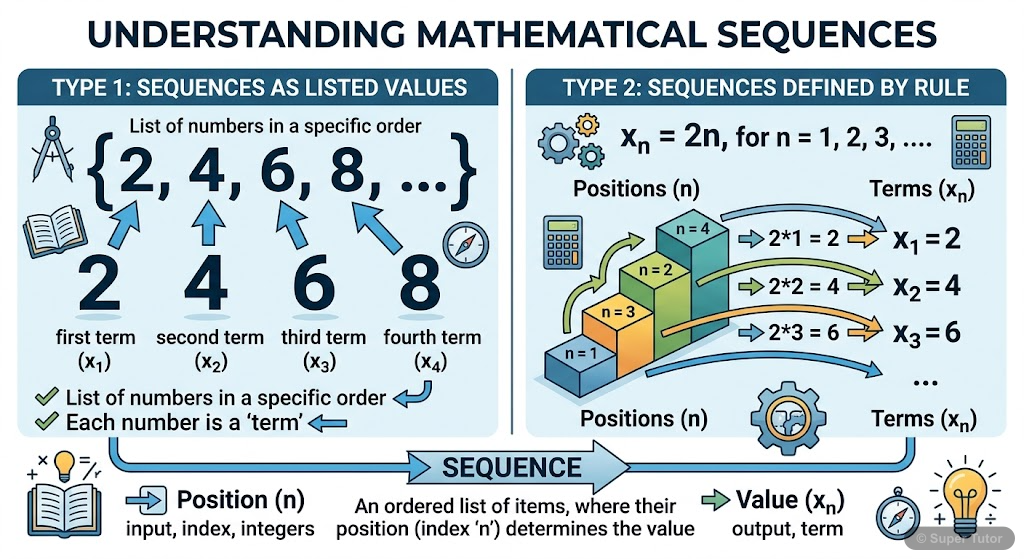
Learn better with visuals Super Tutor pairs illustrations like this with notes and quizzes for Some Special Sequences.
Important Questions from Some Special Sequences
The nth term of a series is tₙ = n³ + 3n² + 2n. What is the sum of the first n terms?
Show answer
n(n+1)(n+2)(n+3)/4
Step 1: tₙ = n³+3n²+2n = n(n²+3n+2) = n(n+1)(n+2). Step 2: Sₙ = Σn(n+1)(n+2). Step 3: This is a product of 3 consecutive integers. Use Σn(n+1)(n+2) = n(n+1)(n+2)(n+3)/4. Step 4: Alternatively, expand: Σ(n³+3n²+2n) = [n(n+1)/2]²+3·n(n+1)(2n+1)/6+2·n(n+1)/2. Step 5: After simplification, both methods give n(n+1)(n+2)(n+3)/4. This elegant formula applies to products of consecutive integers.
Find the sum 1/(1·3) + 1/(3·5) + 1/(5·7) + ... to 10 terms.
Show answer
10/21
Step 1: The nth term tₙ = 1/[(2n-1)(2n+1)]. Use partial fractions: 1/[(2n-1)(2n+1)] = (1/2)[1/(2n-1) - 1/(2n+1)]. Step 2: Write out terms: t₁=(1/2)[1-1/3], t₂=(1/2)[1/3-1/5], ..., t₁₀=(1/2)[1/19-1/21]. Step 3: This is a telescoping series. Sum = (1/2)[1 - 1/(2×10+1)] = (1/2)[1 - 1/21]. Step 4: = (1/2)(20/21) = 10/21. Step 5: The key technique is partial fractions leading to telescoping cancellation.
The sum of the series 2·3² + 3·4² + 4·5² + ... to n terms equals which expression?
Show answer
n(n+1)(n+2)(3n+7)/12
Step 1: The nth term: tₙ = (n+1)(n+2)² = (n+1)(n²+4n+4) = n³+5n²+8n+4. Step 2: Sₙ = Σn³ + 5Σn² + 8Σn + 4Σ1. Step 3: = n²(n+1)²/4 + 5n(n+1)(2n+1)/6 + 8n(n+1)/2 + 4n. Step 4: Factor out n(n+1)/12: = n(n+1)[3n(n+1) + 10(2n+1) + 48]/12 + 4n = n(n+1)[3n²+3n+20n+10+48]/12 + 4n. Step 5: After careful algebra, this simplifies to n(n+1)(n+2)(3n+7)/12.
The identity Σr³ = (Σr)² holds for sum from r=1 to n. Which of the following is NOT a valid consequence of this identity?
Show answer
Σr³ is always equal to Σr for any n
Step 1: The identity states Σr³ = (Σr)². Step 2: Σr = n(n+1)/2, so Σr³ = [n(n+1)/2]² = n²(n+1)²/4. This confirms option A is valid. Step 3: For n=10: Σr³ = 55² = 3025 and (Σr)² = 55² = 3025, confirming option B. Step 4: For n=1: Σr³ = 1 = Σr = 1, confirming option D. Step 5: Option C is wrong. Σr³ = (Σr)² only equals Σr when Σr = 1, i.e., only for n=1. For n=2: Σr³=9, Σr=3, they are not equal. So saying they are always equal is false.
+41 more questions on Some Special Sequences (NIOS Class 12 Mathematics)
Practise AllFrequently Asked Questions
What are the important topics in Some Special Sequences for NIOS Class 12 Mathematics?
How many important questions are there in Some Special Sequences?
Sources & Official References
Content is aligned to the official syllabus. Refer to the board website for the latest curriculum.
More resources for Some Special Sequences
For serious students
Get the full Some Special Sequences chapter — start free.
Quizzes, flashcards, an AI doubt solver and a study plan for NIOS Class 12 Mathematics. Free to start, no card needed.