Principle of Mathematical Induction — Revision Notes
NIOS · Class 12 · Mathematics
Principle of Mathematical Induction revision notes for NIOS Class 12 Mathematics: 4 topics in quick points. Part of the NIOS Class 12 Mathematics syllabus.
Interactive on Super Tutor
Studying Principle of Mathematical Induction? Get the full interactive chapter.
Quizzes, flashcards, AI doubt-solver and a step-by-step study plan — built for revision notes and more.
Free trial, no card needed.
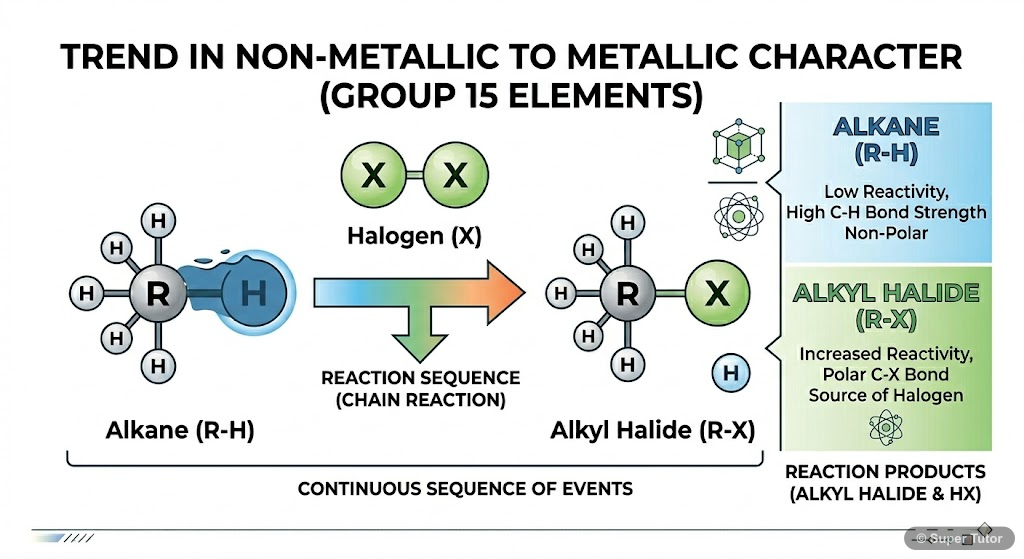
Learn better with visuals Super Tutor pairs illustrations like this with notes and quizzes for Principle of Mathematical Induction.
Key Topics to Revise
1. Understanding Statements and Propositions
- A statement (or proposition) is a sentence that is either definitively true or definitively false, but never both
- Not all sentences are statements - questions, exclamations, and open sentences without fixed domains are NOT statements
- Open sentences like 'x - 5 = 7' become statements only when the variable's domain is specified or when quantified
2. The Principle of Mathematical Induction - Statement and Understanding
- Mathematical induction consists of TWO MUST-SATISFY conditions that work together like climbing a ladder
- BASE CASE: P(1) must be true - this is the first rung of the ladder
- INDUCTION CASE: IF P(k) is true, THEN P(k+1) must be true - this is the mechanism that takes you from one rung to the next
3. Proofs Using Mathematical Induction - Sum Formulas
- SUM FORMULA PROBLEMS: Prove that the sum of certain sequences equals a given formula
- Common patterns: arithmetic sequences (1+2+...+n), odd numbers (1+3+5+...), cubes (1³+2³+3³+...)
- Strategy: Use induction hypothesis to substitute the known formula for sum up to k, then show sum to k+1 follows the pattern
4. Proofs Using Mathematical Induction - Divisibility
- DIVISIBILITY PROBLEMS: Prove that some expression is divisible by a given number for all natural numbers n
- A number is divisible by d if we can write it as d×m for some integer m
- Strategy: Assume P(k) says the expression with k is divisible by d (equals d×m for some integer m), then show P(k+1) is also divisible by d
Get complete notes with diagrams and examples
Full NotesKey Concepts
Frequently Asked Questions
What are the important topics in Principle of Mathematical Induction for NIOS Class 12 Mathematics?
How should I revise Principle of Mathematical Induction for the NIOS Class 12 board exam?
Sources & Official References
Content is aligned to the official syllabus. Refer to the board website for the latest curriculum.
More resources for Principle of Mathematical Induction
For serious students
Get the full Principle of Mathematical Induction chapter — start free.
Quizzes, flashcards, an AI doubt solver and a study plan for NIOS Class 12 Mathematics. Free to start, no card needed.