Chapter 3 of 10
Revision Notes
Trigonometric Functions - I — Revision Notes
NIOS · Class 12 · Mathematics
Trigonometric Functions - I revision notes for NIOS Class 12 Mathematics: 4 topics in quick points. Part of the NIOS Class 12 Mathematics syllabus.
45 questions25 flashcards9 formulas & key relations5 concepts
Interactive on Super Tutor
Studying Trigonometric Functions - I? Get the full interactive chapter.
Quizzes, flashcards, AI doubt-solver and a step-by-step study plan — built for revision notes and more.
Free trial, no card needed.
Super Tutor
One of 8 illustrations for Trigonometric Functions - I in Super Tutor — alongside flashcards, concept maps and practice questions.
Key Topics to Revise
1
Circular Measure of Angles: Degrees and Radians
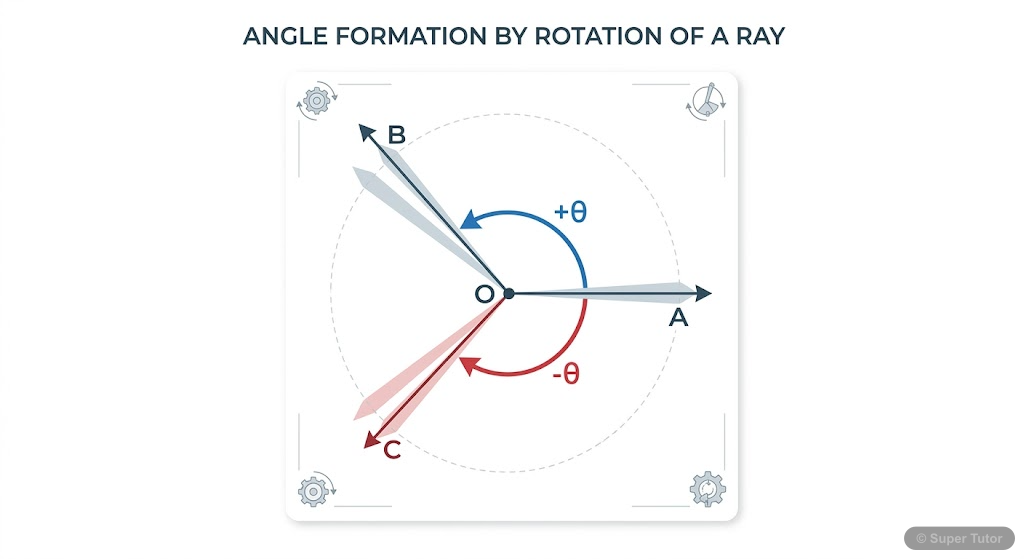
- An angle is formed by the rotation of a ray from its initial position to its final position.
- Anticlockwise rotation gives a positive angle; clockwise rotation gives a negative angle.
- A unit circle is a circle with radius equal to 1 unit.
2
Trigonometric Functions Using the Unit Circle
- For any point P(x, y) on the unit circle corresponding to angle θ, we define: sin θ = y, cos θ = x.
- The coordinates of P can also be written as (cos θ, sin θ).
- tan θ = y/x (defined when x ≠ 0), cot θ = x/y (defined when y ≠ 0).
3
Trigonometric Values of Standard Angles
- The values of sin and cos at 0, π/6, π/4, π/3, π/2 must be memorised perfectly.
- Memory trick for sin values: sin 0 = √(0/4), sin π/6 = √(1/4), sin π/4 = √(2/4), sin π/3 = √(3/4), sin π/2 = √(4/4). Simplify to get 0, 1/2, 1/√2, √3/2, 1.
- Cosine values are the reverse: cos 0 = 1, cos π/6 = √3/2, cos π/4 = 1/√2, cos π/3 = 1/2, cos π/2 = 0.
4
Graphs of Trigonometric Functions
- Graph of y = sin θ: starts at 0, rises to maximum 1 at π/2, returns to 0 at π, falls to minimum -1 at 3π/2, returns to 0 at 2π. It is continuous and wave-shaped.
- Graph of y = cos θ: starts at maximum 1 at θ=0, falls to 0 at π/2, reaches minimum -1 at π, rises to 0 at 3π/2, returns to 1 at 2π. It is also continuous and wave-shaped.
- Graph of y = tan θ: increases from 0 to +∞ in (0, π/2), then from -∞ to 0 in (π/2, π). Has vertical asymptotes at θ = π/2 and 3π/2. Discontinuous.
Get complete notes with diagrams and examples
Full NotesKey Concepts
An angle is formed by rotatingA degree (°) measures an angleWhen an angle θ (in radians)A unit circle (radius = 1)Since (x
Frequently Asked Questions
What are the important topics in Trigonometric Functions - I for NIOS Class 12 Mathematics?
Key topics in Trigonometric Functions - I include Circular Measure of Angles: Degrees and Radians, Trigonometric Functions Using the Unit Circle, Trigonometric Values of Standard Angles, Graphs of Trigonometric Functions. Study these first, then practise questions on each for the NIOS Class 12 board exam.
How should I revise Trigonometric Functions - I for the NIOS Class 12 board exam?
Learn the core ideas first, then work through the 45 practice questions on Trigonometric Functions - I. Revise definitions regularly and use flashcards for quick recall before the exam.
Sources & Official References
Content is aligned to the official syllabus. Refer to the board website for the latest curriculum.
More resources for Trigonometric Functions - I
For serious students
Get the full Trigonometric Functions - I chapter — start free.
Quizzes, flashcards, an AI doubt solver and a study plan for NIOS Class 12 Mathematics. Free to start, no card needed.