Principle of Mathematical Induction — Chapter Summary
NIOS · Class 12 · Mathematics
Summary of Principle of Mathematical Induction for NIOS Class 12 Mathematics. Part of the NIOS Class 12 Mathematics syllabus.
Interactive on Super Tutor
Studying Principle of Mathematical Induction? Get the full interactive chapter.
Quizzes, flashcards, AI doubt-solver and a step-by-step study plan — built for chapter summary and more.
Free trial, no card needed.
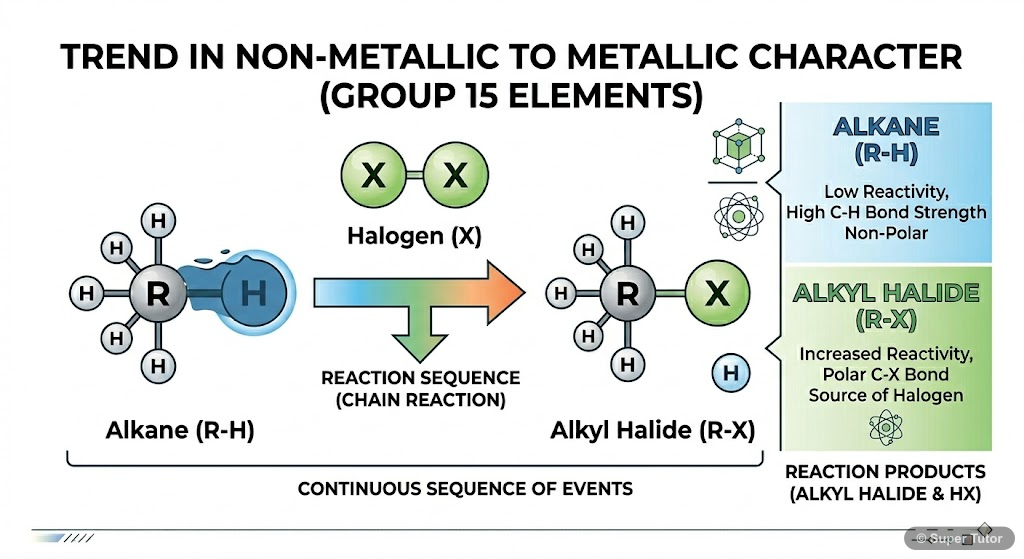
Learn better with visuals Super Tutor pairs illustrations like this with notes and quizzes for Principle of Mathematical Induction.
Overview
Mathematical induction is a powerful proof technique used in mathematics to establish the truth of statements that apply to all natural numbers or a sequence of natural numbers. Unlike deductive reasoning, which applies general rules to specific cases, induction builds general truths from specific o
Key Concepts
A mathematical statement (or proposition)
A mathematical statement (or proposition) is a sentence that is either definitely true or definitely false, but not both. For example, '5 is even' is
The Principle of Mathematical Induction states
The Principle of Mathematical Induction states: Let P(n) be a statement involving a natural number n. If (i) P(1) is true (base case), AND (ii) whenev
The base case is the first
The base case is the first step in a proof by mathematical induction. We verify that the statement P(1) is true by direct substitution or calculation.
The inductive step involves two parts
The inductive step involves two parts: (1) assuming P(k) is true for some arbitrary natural number k (this assumption is called the inductive hypothes
Every proof by mathematical induction follows
Every proof by mathematical induction follows three steps: (1) State the statement clearly as P(n). (2) Verify the base case by showing P(1) is true (
Learning Objectives
- Understand what constitutes a mathematical statement and distinguish statements from non-statements
- Learn and state the Principle of Mathematical Induction in its formal definition
- Verify the base case P(1) for various mathematical statements
- Understand and apply the inductive step to verify P(k+1) assuming P(k) is true
- Apply the principle of mathematical induction to prove summation formulas
Frequently Asked Questions
What are the important topics in Principle of Mathematical Induction for NIOS Class 12 Mathematics?
How should I revise Principle of Mathematical Induction for the NIOS Class 12 board exam?
Sources & Official References
Content is aligned to the official syllabus. Refer to the board website for the latest curriculum.
More resources for Principle of Mathematical Induction
For serious students
Get the full Principle of Mathematical Induction chapter — start free.
Quizzes, flashcards, an AI doubt solver and a study plan for NIOS Class 12 Mathematics. Free to start, no card needed.