Plant Kingdom — Practice Quiz
Punjab Board · Class 11 · Biology
Try a 4-question quiz on Plant Kingdom for Punjab Board Class 11 Biology: tap an answer to check it and see why. 44 questions in the full chapter test.
Interactive on Super Tutor
Studying Plant Kingdom? Get the full interactive chapter.
Quizzes, flashcards, AI doubt-solver and a step-by-step study plan — built for practice quiz and more.
Free trial, no card needed.
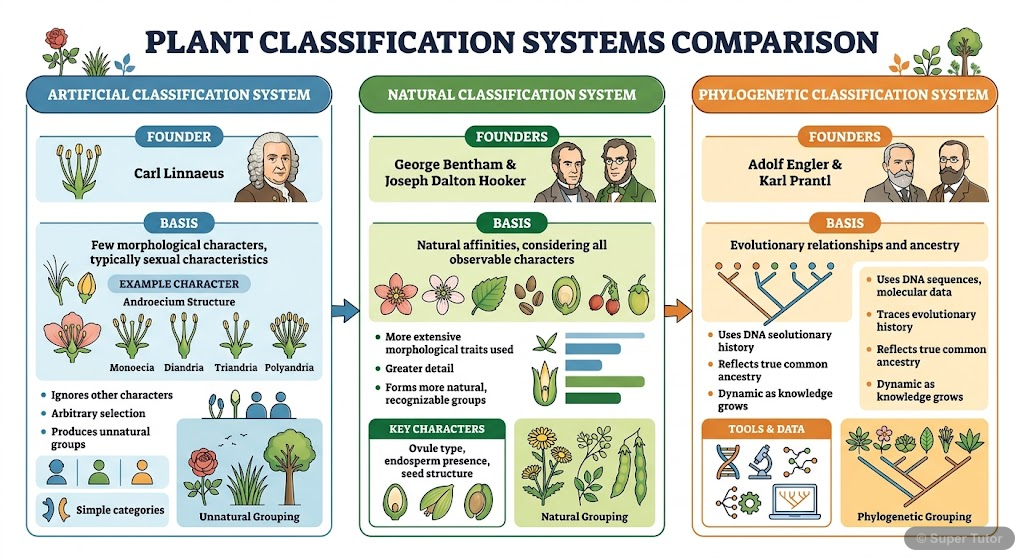
One of 15 illustrations for Plant Kingdom in Super Tutor — alongside flashcards, concept maps and practice questions.
Quick Quiz: Plant Kingdom
0/4Tap an answer to check it instantly. No sign-up needed for these 4.
Which of the following correctly describes the basis of classification of algae into Chlorophyceae, Phaeophyceae, and Rhodophyceae?
The storage product floridean starch, which is similar to amylopectin and glycogen in structure, is found in which class of algae?
In sexual reproduction of algae, when fusion occurs between one large, non-motile female gamete and a smaller, motile male gamete, this type of reproduction is called:
Bryophytes are called the 'amphibians of the plant kingdom' because:
Sample Questions
Which of the following statements correctly describes the sporophyte of bryophytes?
Show answer
It is attached to the gametophyte and derives nourishment from it
Step 1: In bryophytes, the life cycle alternates between gametophyte and sporophyte generations. Step 2: The dominant phase is the gametophyte (haploid), which is photosynthetic and free-living. Step 3: The sporophyte (diploid) develops from the zygote and is NOT free-living — it remains attached to the gametophyte and gets nutrients from it (it is partially or completely dependent). Step 4: Option A is wrong — the dominant free-living phase is the gametophyte, not the sporophyte. Option C is wrong — the sporophyte is diploid and produces spores (not gametes). Option D is incorrect — the sporo
Gemmae are specialised asexual reproductive structures found in liverworts. Which of the following correctly describes gemmae?
Show answer
They are green, multicellular buds found in gemma cups on the thallus
Step 1: Liverworts reproduce asexually in two ways — by fragmentation of thalli and by formation of gemmae. Step 2: Gemmae are green, multicellular, asexual buds. Step 3: They develop in small cup-shaped receptacles called gemma cups, which are located on the thalli of liverworts like Marchantia. Step 4: When gemmae become detached from the parent body, they germinate and form new individual plants. Step 5: Option A describes zoospores (flagellated), Option C is incorrect as gemmae are multicellular and formed on the gametophyte, and Option D describes gametes, not gemmae.
What is a 'prothallus' in the context of pteridophytes?
Show answer
The inconspicuous, free-living, photosynthetic gametophyte
Step 1: In pteridophytes, the dominant phase is the sporophyte (the main fern plant with roots, stem, and leaves). Step 2: When spores are produced and germinate, they give rise to the gametophyte generation called prothallus. Step 3: The prothallus is small (inconspicuous), free-living, mostly photosynthetic, and thalloid in structure. It grows in cool, damp, shady places. Step 4: The prothallus bears sex organs — antheridia (male) and archegonia (female). Step 5: Option A describes the sporophyte. Option C describes spores (macro/microspores). Option D describes a sporophyll. The prothallus
Pteridophytes are considered an important evolutionary milestone among land plants primarily because:
Show answer
They were the first terrestrial plants to possess vascular tissues
Step 1: Vascular tissues (xylem and phloem) are conducting tissues that transport water, minerals, and food throughout the plant body. Step 2: Bryophytes, which came before pteridophytes in evolutionary terms, do not have vascular tissues — they are non-vascular plants. Step 3: Pteridophytes were the FIRST terrestrial plants to evolve vascular tissues (xylem and phloem), which is why they are such an important evolutionary group. Step 4: Option A is wrong — seeds first appeared in gymnosperms. Option C is wrong — sexual reproduction appeared much earlier (even in algae). Option D is wrong — fl
+40 more questions on Plant Kingdom (Punjab Board Class 11 Biology)
Practise AllFrequently Asked Questions
What are the important topics in Plant Kingdom for Punjab Board Class 11 Biology?
How many practice questions are there for Plant Kingdom?
Sources & Official References
Content is aligned to the official syllabus. Refer to the board website for the latest curriculum.
More resources for Plant Kingdom
For serious students
Get the full Plant Kingdom chapter — start free.
Quizzes, flashcards, an AI doubt solver and a study plan for Punjab Board Class 11 Biology. Free to start, no card needed.