Biological Classification — Practice Quiz
Punjab Board · Class 11 · Biology
Try a 4-question quiz on Biological Classification for Punjab Board Class 11 Biology: tap an answer to check it and see why.
Interactive on Super Tutor
Studying Biological Classification? Get the full interactive chapter.
Quizzes, flashcards, AI doubt-solver and a step-by-step study plan — built for practice quiz and more.
Free trial, no card needed.
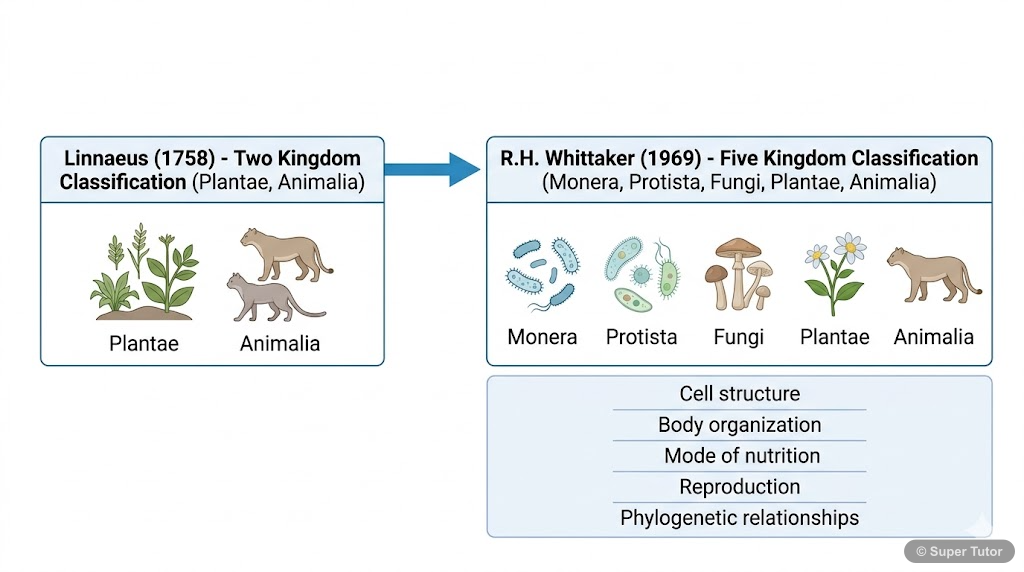
Learn better with visuals Super Tutor pairs illustrations like this with notes and quizzes for Biological Classification.
Quick Quiz: Biological Classification
0/4Tap an answer to check it instantly. No sign-up needed for these 4.
Which of the following correctly distinguishes Archaeabacteria from Eubacteria?
Cyanobacteria are classified under Kingdom Monera and NOT under Kingdom Plantae, even though they are photosynthetic. Which feature BEST justifies this classification?
In Whittaker's five-kingdom classification, which pair of organisms were brought together under Kingdom Protista, even though they were previously placed in completely different kingdoms?
Diatomaceous earth, formed by deposits of diatom cell walls, is used commercially in filtration and polishing. What property of diatom cell walls makes them so durable and useful?
Sample Questions
Euglena is often described as a 'connecting link' between plants and animals. Which combination of features BEST supports this statement?
Show answer
Euglena is photosynthetic in sunlight and becomes heterotrophic in the absence of sunlight, and has plant-like pigments
Step 1: Euglena is a euglenoid under Kingdom Protista that uniquely shows both plant-like and animal-like features. Step 2: Like plants, Euglena has pigments identical to those in higher plants and performs photosynthesis in the presence of sunlight. Step 3: Like animals, when deprived of sunlight, Euglena becomes heterotrophic and feeds on other smaller organisms by predation. Step 4: Option A is wrong – Euglena does NOT have a cell wall; instead it has a protein-rich layer called pellicle that makes its body flexible. It also does not use pseudopodia. Step 5: Option C is wrong – Euglena's re
In fungi, the dikaryotic stage (n+n) is a unique phase found specifically in which two classes?
Show answer
Ascomycetes and Basidiomycetes
Step 1: In fungi, sexual reproduction involves three steps – plasmogamy (cytoplasm fusion), karyogamy (nucleus fusion), and meiosis. Step 2: In some fungi, plasmogamy occurs first but karyogamy is delayed. During this interval, each cell has two haploid nuclei (n+n) – this is called the dikaryotic or dikaryophase. Step 3: This intermediate dikaryotic phase occurs specifically in Ascomycetes and Basidiomycetes. Step 4: In Phycomycetes, the two haploid cells fuse directly to form diploid cells – there is no prolonged dikaryotic stage. Step 5: Deuteromycetes are called 'imperfect fungi' because t
Deuteromycetes are called 'imperfect fungi'. What is the MOST accurate reason for this name?
Show answer
Only their asexual or vegetative phases are known; their sexual stage has not been observed
Step 1: In biology, 'perfect' fungi refers to fungi where the sexual stage (perfect stage) is known, while 'imperfect' refers to those where only the asexual stage is known. Step 2: Deuteromycetes are called imperfect fungi because scientists have only observed their asexual reproduction (by conidia) – the sexual phase is unknown or absent. Step 3: When the sexual stage of some Deuteromycetes was later discovered, those species were reclassified into Ascomycetes or Basidiomycetes. Step 4: Option A is wrong – Deuteromycetes have well-developed, septate, and branched mycelium. Step 5: Option C i
Which of the following statements correctly describes the sexual reproduction process in Basidiomycetes?
Show answer
Sex organs are absent; plasmogamy occurs by fusion of somatic cells, leading to a dikaryotic stage, followed by karyogamy and meiosis in the basidium to produce exogenous basidiospores
Step 1: Basidiomycetes lack sex organs entirely, which sets them apart from many other organisms. Step 2: Instead, plasmogamy (cytoplasm fusion) occurs between two vegetative somatic cells of different strains (genotypes), creating a dikaryotic cell (n+n). Step 3: This dikaryotic structure develops into the basidium, where karyogamy (nuclear fusion) occurs, creating a diploid (2n) cell. Step 4: Meiosis then occurs in the basidium, producing four haploid basidiospores that are borne EXOGENOUSLY (on the outside of the basidium). Step 5: Option A is wrong – sex organs are absent and spores are ex
+41 more questions on Biological Classification (Punjab Board Class 11 Biology)
Practise AllFrequently Asked Questions
What are the important topics in Biological Classification for Punjab Board Class 11 Biology?
How many practice questions are there for Biological Classification?
Sources & Official References
Content is aligned to the official syllabus. Refer to the board website for the latest curriculum.
More resources for Biological Classification
For serious students
Get the full Biological Classification chapter — start free.
Quizzes, flashcards, an AI doubt solver and a study plan for Punjab Board Class 11 Biology. Free to start, no card needed.