Molecular Basis of Inheritance — Important Questions
Punjab Board · Class 12 · Biology
45 important questions from Molecular Basis of Inheritance for Punjab Board Class 12 Biology, with answers. Includes multiple choice questions.
Interactive on Super Tutor
Studying Molecular Basis of Inheritance? Get the full interactive chapter.
Quizzes, flashcards, AI doubt-solver and a step-by-step study plan — built for important questions and more.
Free trial, no card needed.
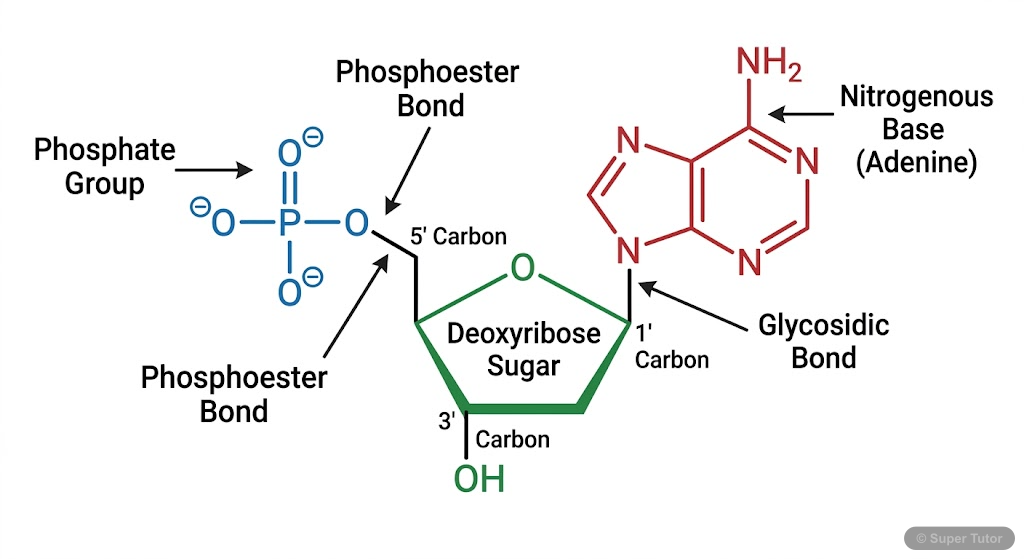
One of 22 illustrations for Molecular Basis of Inheritance in Super Tutor — alongside flashcards, concept maps and practice questions.
Important Questions from Molecular Basis of Inheritance
Chargaff's rule states that in a double-stranded DNA molecule, A=T and G=C. If a DNA molecule has 20% Guanine, what percentage of the total nucleotides is Adenine?
Show answer
30%
Step 1: Chargaff's rule: In dsDNA, %A = %T and %G = %C. Step 2: Given %G = 20%, therefore %C = 20%. Step 3: Total of G + C = 20% + 20% = 40%. Step 4: Remaining percentage for A + T = 100% - 40% = 60%. Step 5: Since %A = %T, each = 60%/2 = 30%. Therefore, %Adenine = 30%. Option A (20%) is wrong — that is the percentage of G or C. Option C (40%) is wrong — that is the combined G+C content. Option D (60%) is wrong — that is the combined A+T content.
The Hershey-Chase experiment conclusively proved that DNA is the genetic material. Which of the following best explains why radioactive sulfur (³⁵S) was used to label the protein component of the bacteriophage?
Show answer
Proteins contain sulfur-containing amino acids (methionine and cysteine), whereas DNA contains no sulfur; so ³⁵S specifically labels protein and not DNA.
Step 1: The Hershey-Chase experiment needed to separately label protein and DNA of the bacteriophage. Step 2: DNA contains phosphorus (in the phosphate groups) but no sulfur. Step 3: Proteins contain amino acids; two amino acids — methionine (Met) and cysteine (Cys) — contain sulfur in their side chains. Step 4: Therefore, growing phages in ³⁵S medium specifically incorporates radioactivity into proteins only, not into DNA. Step 5: Similarly, ³²P was used to label DNA specifically because DNA has phosphate groups and proteins generally lack phosphorus. This differential labelling allowed resea
During DNA replication in E. coli, one strand is synthesised continuously while the other is synthesised discontinuously. What is the molecular reason for discontinuous synthesis on one strand?
Show answer
DNA polymerase can only add nucleotides in the 5'→3' direction, but at the replication fork one template strand runs 5'→3' (same direction as fork movement), forcing discontinuous synthesis in short fragments.
Step 1: DNA polymerase always synthesises the new strand in the 5'→3' direction — it adds nucleotides to the 3'-OH end of the growing chain. Step 2: At the replication fork, the two parental strands run antiparallel. Step 3: One template strand (3'→5') allows continuous synthesis in the 5'→3' direction as the fork opens — this is the leading strand. Step 4: The other template strand runs 5'→3' in the direction of fork movement. Polymerase cannot synthesise in the 3'→5' direction on this strand, so it must repeatedly start new fragments (Okazaki fragments) moving away from the fork — this is th
In eukaryotic transcription, the primary transcript (hnRNA) undergoes processing before becoming functional mRNA. Which of the following correctly describes the process of CAPPING?
Show answer
Addition of an unusual methylated guanosine triphosphate (7-methylguanosine cap) at the 5'-end of hnRNA in a template-independent manner.
Step 1: eukaryotic hnRNA undergoes three major post-transcriptional modifications: capping, tailing, and splicing. Step 2: Capping involves adding an unusual nucleotide — 7-methylguanosine triphosphate (methyl guanosine triphosphate) — to the 5'-end of the hnRNA. Step 3: This addition is template-independent (it is not directed by the DNA template). Step 4: The cap protects mRNA from degradation by exonucleases and helps in ribosome recognition and initiation of translation. Step 5: Option A describes tailing (poly-A tail at 3'-end), not capping. Option C describes splicing. Option D describes
+41 more questions on Molecular Basis of Inheritance (Punjab Board Class 12 Biology)
Practise AllFrequently Asked Questions
What are the important topics in Molecular Basis of Inheritance for Punjab Board Class 12 Biology?
How many important questions are there in Molecular Basis of Inheritance?
Sources & Official References
Content is aligned to the official syllabus. Refer to the board website for the latest curriculum.
More resources for Molecular Basis of Inheritance
For serious students
Get the full Molecular Basis of Inheritance chapter — start free.
Quizzes, flashcards, an AI doubt solver and a study plan for Punjab Board Class 12 Biology. Free to start, no card needed.