Principles of Inheritance and Variation — Important Questions
Punjab Board · Class 12 · Biology
42 important questions from Principles of Inheritance and Variation for Punjab Board Class 12 Biology, with answers. Includes multiple choice questions.
Interactive on Super Tutor
Studying Principles of Inheritance and Variation? Get the full interactive chapter.
Quizzes, flashcards, AI doubt-solver and a step-by-step study plan — built for important questions and more.
Free trial, no card needed.
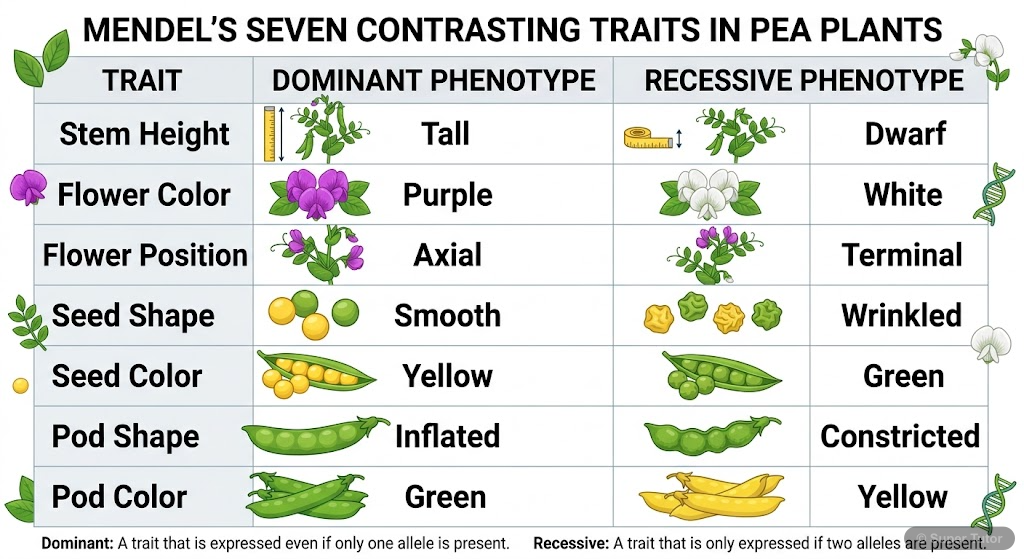
One of 15 illustrations for Principles of Inheritance and Variation in Super Tutor — alongside flashcards, concept maps and practice questions.
Important Questions from Principles of Inheritance and Variation
In a dihybrid cross between RRYY and rryy pea plants, what is the phenotypic ratio expected in the F2 generation?
Show answer
9:3:3:1
Step 1: In a dihybrid cross, two traits are considered simultaneously. Here R = round (dominant), r = wrinkled (recessive), Y = yellow (dominant), y = green (recessive). Step 2: The F1 generation is RrYy (round yellow). Step 3: When F1 (RrYy × RrYy) is self-pollinated, each trait segregates independently as per the Law of Independent Assortment. Step 4: Round : Wrinkled = 3:1 and Yellow : Green = 3:1. Combining: (3 Round : 1 Wrinkled) × (3 Yellow : 1 Green) = 9 Round Yellow : 3 Wrinkled Yellow : 3 Round Green : 1 Wrinkled Green. Step 5: This gives the classic 9:3:3:1 ratio. The 3:1 ratio is fo
The Chromosomal Theory of Inheritance was proposed by:
Show answer
Sutton and Boveri
Step 1: After Mendel's work was rediscovered in 1900, scientists began linking gene behaviour to chromosome behaviour. Step 2: Walter Sutton (a graduate student) and Theodore Boveri (a German biologist) independently noticed that chromosomes behave similarly to Mendel's 'factors' (genes). Step 3: Both chromosomes and genes: occur in pairs, segregate during gamete formation, and assort independently. Step 4: Sutton united this knowledge into what is called the Chromosomal Theory of Inheritance. Step 5: Morgan and Sturtevant worked on linkage maps; de Vries and Correns rediscovered Mendel's work
Morgan used Drosophila melanogaster for his genetics experiments. Which of the following is NOT a reason why Drosophila is suitable for genetic studies?
Show answer
It has a large number of chromosomes (46 pairs) making analysis easier
Step 1: Drosophila melanogaster is ideal for genetics due to several features. Step 2: It has a VERY SHORT life cycle (~2 weeks), allowing multiple generations to be studied quickly — this is a genuine advantage. Step 3: A single mating produces hundreds of offspring, giving large sample sizes for statistical analysis — this is a genuine advantage. Step 4: Males and females are easily distinguished externally — another genuine advantage. Step 5: However, Drosophila actually has ONLY 4 PAIRS (8) of chromosomes, NOT 46 pairs. 46 chromosomes is the number in HUMANS. Fewer chromosomes actually mak
The term 'linkage' in genetics refers to:
Show answer
The physical association of two or more genes on the same chromosome
Step 1: During Morgan's dihybrid crosses in Drosophila, he observed that some gene pairs did NOT segregate independently as Mendel's Law would predict. Step 2: This happened when two genes were located on the SAME chromosome — they tended to be inherited together. Step 3: Morgan coined the term LINKAGE to describe this physical association of genes located on the same chromosome. Step 4: Closely linked genes (physically near each other) show very low recombination, while loosely linked genes show higher recombination. Step 5: Crossing over (recombination) can separate linked genes — this is a
+38 more questions on Principles of Inheritance and Variation (Punjab Board Class 12 Biology)
Practise AllFrequently Asked Questions
What are the important topics in Principles of Inheritance and Variation for Punjab Board Class 12 Biology?
How many important questions are there in Principles of Inheritance and Variation?
Sources & Official References
Content is aligned to the official syllabus. Refer to the board website for the latest curriculum.
More resources for Principles of Inheritance and Variation
For serious students
Get the full Principles of Inheritance and Variation chapter — start free.
Quizzes, flashcards, an AI doubt solver and a study plan for Punjab Board Class 12 Biology. Free to start, no card needed.